

Understanding Cognitive Behavioral Therapy: A Path to Change
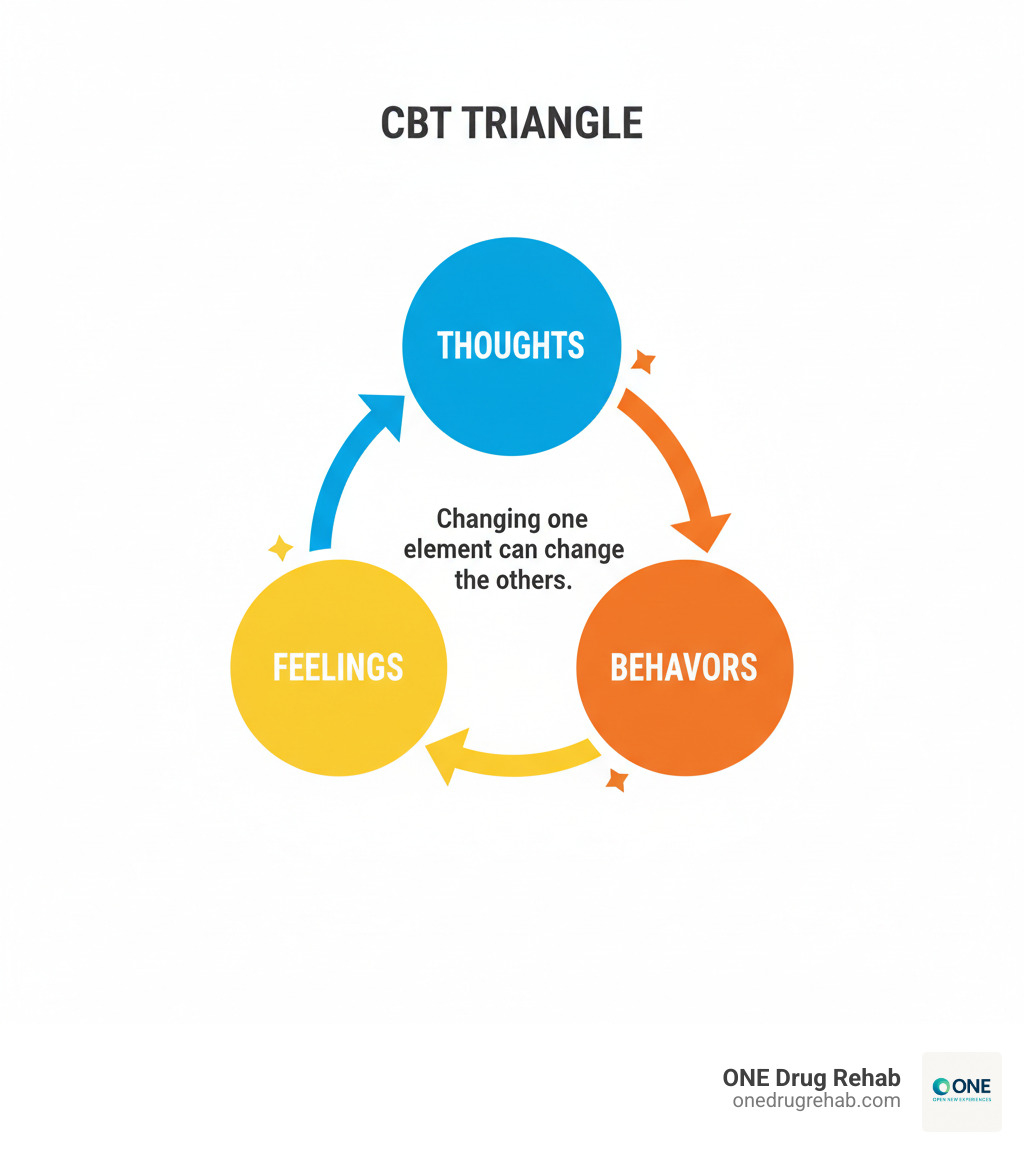
Cognitive behavioral therapy (CBT) is a structured, goal-oriented form of talk therapy that helps you identify and change unhelpful thinking patterns and behaviors. It focuses on the connection between your thoughts, feelings, and actions—and how changing one can positively impact the others.
Key Facts About CBT:
- What it treats: Depression, anxiety, PTSD, substance use disorders, eating disorders, chronic pain, insomnia, and many other conditions
- How long it takes: Typically 5-20 sessions, usually meeting weekly
- How it works: You work with a therapist to recognize distorted thinking, challenge unhelpful beliefs, and develop practical coping skills
- What makes it different: CBT is present-focused, time-limited, and teaches you to become your own therapist
- Evidence base: One of the most researched and proven effective forms of psychotherapy
Unlike therapies that dig into your past, CBT is present-focused and equips you with practical tools. Decades of research confirm its effectiveness, showing it can be as or more effective than other therapies or medication for many conditions.
CBT is built on the idea that since psychological problems often stem from learned patterns, you can learn better ways of coping. Through structured sessions and collaboration with a therapist, you develop skills that last a lifetime. Whether you’re dealing with depression, anxiety, or substance use issues, CBT offers a clear roadmap to building a healthier future, starting today.
The Foundations of CBT: How It Works and Why It’s Effective
Cognitive behavioral therapy works by targeting the learned patterns that keep us stuck. It operates on a simple truth: your thoughts, feelings, and behaviors are interconnected. Change one, and you create a ripple effect, a principle backed by decades of scientific research on the science of cognitive therapy.
Core Principles of CBT
CBT rests on three foundational ideas:
First, your thoughts shape your emotional world more than the events themselves. The same event can lead to vastly different emotional outcomes based on your interpretation.
Second, many psychological problems stem from learned patterns of thinking and acting. These patterns, including cognitive distortions, often become automatic over time.
Third, we can learn better ways of coping. Just as you learned unhelpful patterns, you can learn healthier, more practical skills.
CBT’s effectiveness is improved by its structure. It is present-focused, time-limited (usually 5-20 sessions), and deeply collaborative. Sessions are structured with a clear agenda, review of homework, and planning for the next week.

The CBT Model and Levels of Cognition
CBT identifies three levels of thinking:
- Automatic thoughts are the instant, unfiltered commentary in your head.
- Intermediate beliefs are the ‘if-then’ rules and assumptions guiding your reactions.
- Core beliefs are fundamental convictions about yourself, others, and the world.
When these beliefs are rigid, they can create unhelpful thinking styles or cognitive distortions. These include all-or-nothing thinking, catastrophizing, overgeneralization, mental filtering, jumping to conclusions, emotional reasoning, personalization, and using rigid “should” statements. Recognizing these patterns is the first step toward change.
The Goal: Becoming Your Own Therapist
The ultimate aim of cognitive behavioral therapy is to make you your own therapist. It’s a skills-based approach involving practical homework assignments, like keeping a thought record, to help you practice in real-world situations.
Through self-monitoring, you learn to spot triggers and patterns you may not have noticed before. This awareness is powerful and empowers you with relapse prevention strategies. This approach fosters genuine long-term wellness and confidence in your ability to handle future challenges, long after therapy has ended.
Core Techniques and Strategies in Cognitive Behavioral Therapy
Cognitive behavioral therapy provides a mental toolbox filled with practical cognitive and behavioral strategies. You practice these tools in and out of therapy until they become second nature.
Cognitive Strategies to Reshape Your Thinking
These techniques help you investigate and challenge your own thought patterns.
- Cognitive restructuring is the core technique for identifying and re-evaluating unhelpful thoughts.
- A thought record is a structured worksheet to practice this, where you document a situation, your automatic thoughts, and then challenge them to find a more balanced perspective.
- This process involves identifying cognitive distortions, the mental ‘tricks’ that reinforce negative thinking.
- Therapists use Socratic questioning, a gentle, probing style of inquiry, to help you find insights on your own.
- This encourages you to examine evidence for and against your negative thoughts, treating them as hypotheses to be tested rather than facts.
Behavioral Strategies to Change Your Actions
Changing what you do can be the fastest way to change how you feel.
- Behavioral activation combats depression by scheduling meaningful or pleasurable activities, even without motivation.
- Exposure therapy effectively treats anxiety and phobias by gradually and safely facing feared situations.
- Role-playing allows you to practice new skills, like assertiveness, in a safe setting before using them in real life.
- Relaxation techniques like deep breathing provide immediate tools to calm your mind and body during moments of stress.
- Problem-solving skills offer a structured way to break down and tackle overwhelming challenges.
- Activity scheduling helps you intentionally build accomplishment and joy into your daily routine.
A Versatile Tool for Mental Wellness: Conditions Treated by CBT
One of CBT’s greatest strengths is its versatility. It is a flexible framework for a wide range of challenges, from mental health disorders to physical health issues. Its effectiveness is supported by extensive research, including strong evidence on CBT for anxiety disorders, making it a first-line treatment in many settings.

Mental Health Conditions
Cognitive behavioral therapy is a powerful tool for many mental health conditions.
- Depression: CBT challenges negative thought loops and uses behavioral activation to re-engage with life.
- Anxiety Disorders: It reduces avoidance behaviors and manages physical symptoms, often using exposure therapy.
- PTSD: Trauma-focused CBT helps process traumatic memories and rebuild a sense of safety.
- Phobias and OCD: These are treated with exposure techniques. A specialized form called Exposure and Response Prevention (ERP) is the gold standard for OCD.
- Eating Disorders: CBT addresses distorted body image, unhealthy eating patterns, and underlying emotional triggers.
- Substance Use Disorders: CBT is highly effective in addiction treatment, helping individuals identify triggers, develop coping skills, and prevent relapse. At ONE Drug Rehab, we know that therapies like CBT are central to many addiction treatment programs.
- Bipolar Disorder and Schizophrenia: Used alongside medication, CBT helps manage symptoms, recognize warning signs, and improve overall functioning.
Physical and Other Issues
CBT’s principles also apply to physical health and life challenges.
- Insomnia: A specialized form, CBT-I, is a highly effective, drug-free treatment for sleep problems.
- Chronic Pain: CBT can change one’s relationship with pain, improving quality of life even if the pain remains.
- Irritable Bowel Syndrome (IBS): It can reduce symptom severity by addressing related stress and anxiety.
- Marital Problems: CBT techniques can improve communication and conflict resolution skills.
- Stress Management: CBT offers practical tools to identify stressors and develop effective coping strategies.
It is often used as an adjunctive treatment, meaning it works alongside other therapies, especially for co-occurring disorders.
Your CBT Journey: What to Expect and How to Succeed
Starting cognitive behavioral therapy is a practical, structured process. It’s a collaborative partnership with your therapist that requires your active participation and honesty. Think of your therapist as a coach who teaches you skills to manage life’s challenges.

What to Expect in Your First Session
Your first session is an intake and assessment where you’ll discuss your current problems and begin setting specific, achievable goals. Your therapist will explain the CBT model—the connection between thoughts, feelings, and behaviors—and you’ll both determine if it’s a good therapeutic fit. This is your chance to ask questions and build rapport.
How Long Does CBT Last?
Cognitive behavioral therapy is a short-term therapy, typically lasting 5 to 20 weekly sessions. The exact duration depends on the severity of your issues, your commitment to homework, and whether you have co-occurring disorders. The skills you learn are designed to last a lifetime.
Benefits, Risks, and Limitations of Cognitive Behavioral Therapy
CBT has many benefits, but it’s important to understand its limitations.
Benefits:
- Proven Effectiveness: It is backed by decades of research, making it a “gold standard” therapy.
- Long-Lasting Skills: It empowers you to become your own therapist.
- Structured and Goal-Oriented: Its clear roadmap provides tangible progress.
Risks and Limitations:
- Emotional Discomfort: Confronting difficult thoughts and fears can be temporarily distressing.
- Not a Quick Fix: It requires consistent effort and homework between sessions.
- Focus on the Present: Some find this limiting if they wish to explore past events in depth.
Despite some criticisms, the benefits of CBT for most people far outweigh the risks, offering practical tools for lasting change.
CBT in Context: Comparisons and History
To understand cognitive behavioral therapy, it helps to know its history and how it compares to other therapies. It evolved from decades of research and clinical practice, standing out for its present-focused, action-oriented approach.
How does cognitive behavioral therapy compare to other therapies?
Unlike psychoanalysis, which digs into the unconscious and past, CBT is structured, short-term, and collaborative. The table below highlights the key differences.
| Feature | Cognitive Behavioral Therapy (CBT) | Psychoanalysis |
|---|---|---|
| Focus | Current thoughts, feelings, and behaviors; identifying and changing unhelpful patterns. | Unconscious conflicts, repressed memories, and early childhood experiences. |
| Duration | Generally short-term (5-20 sessions), time-limited. | Long-term (months to years), often open-ended. |
| Techniques | Cognitive restructuring, behavioral activation, exposure, thought records, Socratic questioning. | Free association, dream analysis, interpretation of transference. |
| Therapist Role | Collaborative guide, teacher, coach; actively directs the process. | Neutral, interpretive; helps uncover unconscious material. |
| Goal | Symptom reduction, skill development, practical problem-solving, behavioral change. | Insight into unconscious motivations, personality restructuring. |
| Evidence Base | Highly researched and empirically supported for a wide range of disorders. | Less empirical support for specific symptom reduction, more on overall insight. |
Psychodynamic therapy, a modern form of psychoanalysis, also focuses more on insight than action. Humanistic therapies are less directive, focusing on personal growth. CBT’s strength lies in its vast evidence base, which is why CBT is considered a gold standard for targeted symptom relief.
Compared to medication, CBT can be equally effective for moderate depression and anxiety, and it works well as an adjunctive treatment for more severe illnesses like bipolar disorder or schizophrenia.
The History and Evolution of CBT
CBT’s history merges two major psychological movements. It began with behaviorism in the early 20th century, which focused on changing actions through conditioning. The cognitive revolution in the 1950s and 60s added the missing piece: our thoughts. Pioneers Albert Ellis (Rational Emotive Behavior Therapy) and Aaron T. Beck (Cognitive Therapy) showed that our beliefs and thought patterns are central to our emotional distress.
The fusion of these two approaches created what we now call cognitive behavioral therapy. The evolution continues with “third wave” therapies that incorporate mindfulness and acceptance, such as Acceptance and Commitment Therapy (ACT), Mindfulness-Based Cognitive Therapy (MBCT), and Dialectical Behavior Therapy (DBT). This ongoing evolution shows that CBT is a living approach that adapts to better serve those seeking healing.
Frequently Asked Questions about Cognitive Behavioral Therapy
Let’s tackle some common questions about cognitive behavioral therapy.
Is CBT effective for everyone?
While highly effective, CBT’s success isn’t guaranteed for everyone. Key factors include your commitment to the process, especially doing homework between sessions, and the therapist-client fit. A strong therapeutic relationship is crucial. CBT may be less suitable if you prefer unstructured talk therapy or want to focus primarily on past experiences. A proper diagnosis from a qualified professional is essential to ensure CBT is the right approach for you.
Can I do CBT on my own?
You can learn CBT principles on your own, but it’s different from working with a therapist. Self-help books, workbooks, and apps can be valuable for learning basic skills, and research shows online CBT can be effective for some conditions. However, self-help resources are often most effective with therapist support. A therapist provides personalized guidance, helps you steer emotional discomfort, and offers motivation.
You should seek professional help if your symptoms are severe, persistent, or significantly impacting your daily life. If you have thoughts of suicide or self-harm, seek emergency help immediately.
How do I find a qualified CBT therapist?
Finding a qualified CBT therapist is a manageable process.
- Look for licensed mental health professionals (e.g., psychologists, LPCs, LCSWs) with specific training in CBT.
- Verify credentials through your state’s licensing board.
- Use directories from professional organizations like the Association for Behavioral and Cognitive Therapies (ABCT).
- Ask for referrals from your doctor or trusted sources.
- Interview potential therapists to ask about their experience, approach, and fees.
- Trust your gut. The therapist-client relationship is key, so don’t hesitate to keep looking until you find a good fit.
If you or a loved one is struggling with substance use, therapies like CBT are often a core part of comprehensive treatment programs. At ONE Drug Rehab, we provide information about treatment facilities that use evidence-based approaches including cognitive behavioral therapy to help people build lasting recovery skills.
Take the Next Step Towards a Clearer Mind
We’ve explored what cognitive behavioral therapy is, how it works, and who it helps. Now, it’s time for action. CBT is empowering because it gives you practical skills for life. It teaches you to challenge unhelpful thoughts and build healthier patterns.
Change is possible. Whether you’re facing depression, anxiety, or substance use issues, CBT offers a structured path forward. You learn that while you can’t control every event, you can control your response.
If you or a loved one is struggling with substance use, effective therapies like cognitive behavioral therapy are a key part of a comprehensive treatment plan. At ONE Drug Rehab, we connect you with information on facilities that use these proven strategies.
Taking the first step is courageous. You deserve a healthier future. Find a treatment facility that uses CBT and start your journey toward long-term wellness today. You don’t have to do this alone, and with the right support, meaningful change is within reach.