

Court ordered inpatient rehab: 2025 Ultimate Guide
Understanding Court-Ordered Inpatient Rehab: A Second Chance at Recovery
Court ordered inpatient rehab is a treatment program where a judge requires someone to stay at a residential addiction treatment facility instead of going to jail. This happens when addiction is the root cause of criminal behavior, and the court believes treatment will be more effective than punishment.
Here’s what you need to know:
- Who gets it: People with non-violent, drug-related crimes or those deemed a danger to themselves/others
- How long: Typically 30-90 days, but can extend to 180+ days based on individual needs
- Who pays: Usually the individual, but insurance, Medicaid, and sliding scale fees often help
- What happens if you don’t complete it: You’ll face the original criminal charges and likely jail time
- Success rate: 56% of people successfully complete court-ordered treatment programs
The numbers tell a compelling story. 80% of all offenses that lead to jail stem from drug or alcohol abuse, yet only 20% of inmates receive substance abuse treatment. Court-ordered rehab addresses this gap by treating addiction as a public health issue rather than just a criminal matter.
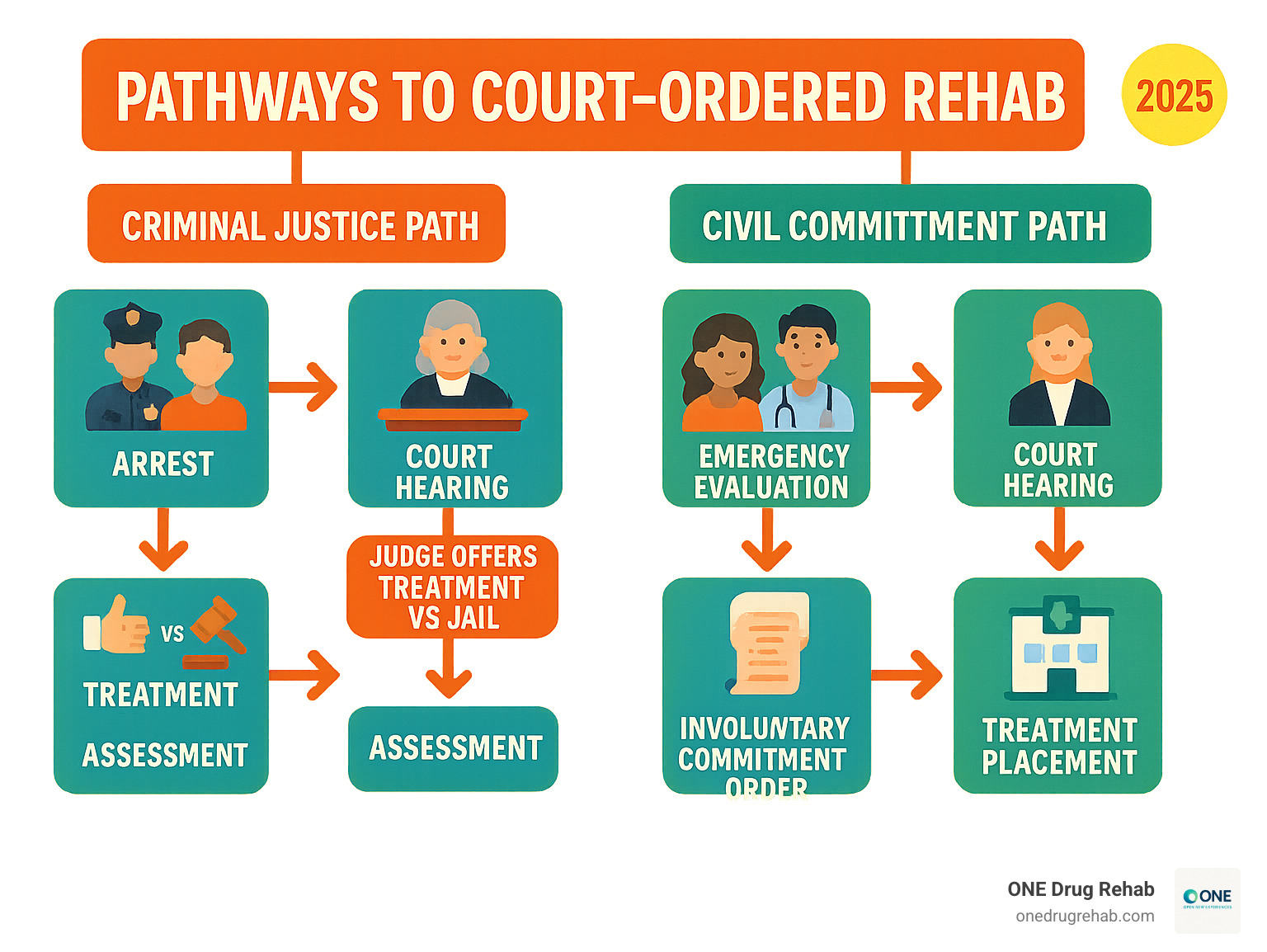
There are two main paths to court-ordered treatment:
- Criminal justice system – offered as an alternative to jail time
- Civil commitment – family or professionals petition the court for emergency intervention
This approach saves taxpayers money too. Drug courts result in savings of up to $6,208 per person because of reduced repeat offenses. More importantly, it gives people struggling with addiction a real chance at recovery instead of cycling through the prison system.
Why Courts Choose Rehab and Who is Eligible

Jail alone rarely fixes addiction-driven crime. Up to 80 % of offenses involve drugs or alcohol, yet only a fraction of inmates ever receive treatment. Drug courts flip that script by offering clinical care instead of a cell, cutting repeat offenses and saving taxpayers as much as $6,208 per participant.
Put simply, courts choose rehab because:
- It tackles the root cause (substance use) rather than the symptom (crime).
- Treatment costs less than incarceration and boosts community safety.
- Graduates are far less likely to re-offend, keeping dockets—and jails—lighter.
Eligibility Through the Criminal Justice System
Judges still protect public safety, so not everyone qualifies. Typical requirements include:
- Non-violent, drug-related or DUI charges
- First-time or low-level offenders
- A guilty plea or admission of substance use
- Evidence that treatment will benefit the individual and the community
Violent offenses, trafficking, or an extensive criminal history usually disqualify a defendant, though each judge has discretion.
Eligibility Through Civil Commitment
When no crime has occurred—but addiction has become life-threatening—families can request help through involuntary commitment. Many states allow this option if a person:
- Poses a danger to self or others or cannot meet basic needs
- Has a diagnosed substance use disorder
- Refuses or is unable to seek voluntary care
A brief court hearing reviews medical records and testimony before ordering placement in an appropriate facility. The goal is emergency stabilization, not punishment.
The Process: From a Judge’s Order to Rehab Admission

Getting from a judge’s order to actually walking through the doors of a treatment center can feel overwhelming. But understanding each step makes the process much less scary and helps you prepare for what’s ahead.
The path to court ordered inpatient rehab isn’t the same for everyone. It depends on whether you’re coming through the criminal justice system or civil commitment, but both routes share similar stages once the court makes its decision.
The Initial Court Proceedings
If you’re facing criminal charges, your journey likely started with an arrest for a drug-related offense. After booking and possibly spending time in jail, you’ll appear before a judge for arraignment. This is your first real opportunity to discuss treatment instead of jail time.
Your lawyer becomes your biggest advocate here. Whether you hired a private attorney or were assigned a public defender, they can argue that treatment would benefit you more than incarceration. They’ll emphasize factors like this being your first offense or how addiction clearly played a role in your crime.
The judge will look at several things during this screening investigation. They want to know about the nature of your offense, your criminal history, and whether there’s clear evidence of substance abuse problems. Your willingness to participate in treatment matters a lot too. Some judges require you to admit you have a problem before they’ll consider alternatives to jail.
Plea agreements often come into play here. You might need to plead guilty to your charges with the understanding that successful completion of treatment could lead to reduced charges or even dismissal. This is where having good legal representation really pays off.
For civil commitment cases, the process starts when family members file a petition with the court. They need to show evidence that you meet the criteria for involuntary commitment – things like medical records, police reports, or testimony from people who’ve witnessed dangerous behavior.
Assessment and Placement
Once the court orders treatment, you’ll go through a thorough clinical evaluation to figure out what kind of care you need. This isn’t just a quick interview – it’s a comprehensive look at your medical, psychological, and social situation.
The assessment team will examine the type and severity of your addiction, your physical health, and whether you need medical detox. They’ll also look for co-occurring disorders like depression or anxiety that might complicate your treatment. Your living situation, job status, and previous treatment attempts all factor into the decision too.
Determining the right level of care is crucial. Some people need intensive medical supervision during detox, while others can start with counseling and therapy. The assessment helps match you with a program that fits your specific needs and meets the court’s requirements.
Finding an approved facility can be tricky. Some courts maintain lists of providers they work with regularly, while others let you choose any licensed facility that can provide proper care and reporting. The key is finding a place that can handle both your clinical needs and the court’s expectations for progress updates.
When you’re looking at potential treatment centers, make sure to ask about their experience with court-ordered patients, their licensing and accreditation, what insurance they accept, and how they coordinate with the court system. You’ll also want to know about their aftercare planning and what happens if you need to extend your stay.
The court liaison at your chosen facility will handle most of the coordination with the judge and probation officers. They’ll set up the reporting schedule and make sure everyone stays informed about your progress. This takes a lot of pressure off you so you can focus on getting better.
The whole process from court order to admission usually takes a few days to a couple of weeks, depending on bed availability and how quickly you can complete the assessment. Don’t worry if it feels rushed – the treatment team is used to working with court timelines and will help you through every step.
Navigating the Logistics of Court Ordered Inpatient Rehab

Daily life in treatment is highly structured—exactly what many people need after months or years of chaos. Expect early wake-ups, therapy blocks, education sessions, peer meetings, and evening activities aimed at sober fun. Progress reports go straight to the court so the judge can see you’re engaged.
Who Pays for Court-Ordered Treatment?
The court mandates care; it doesn’t fund it. Fortunately, most people piece together payment from one or more of these sources:
- Private insurance (substance-use services are an essential health benefit)
- Medicaid, if income-eligible
- Sliding-scale fees or payment plans offered by many centers
- State or federal grants and community charities
Need help finding low-cost options? See our guide on Find Rehab Without Insurance.
How Long Does Court Ordered Inpatient Rehab Last?
Length depends on addiction severity, co-occurring disorders, and your progress, but common milestones are:
- 30 days – detox and basic coping tools
- 60 days – deeper therapy and skill-building
- 90+ days – comprehensive treatment and solid relapse prevention
Research shows three months of continuous care offers the best shot at long-term recovery. If your team recommends a longer stay, most judges will approve it when progress reports back them up. Check out our overview of Types of Addiction Treatment for more detail.
Life During and After Mandated Treatment

Rehab may feel like punishment at first, but many people quickly find it’s a reset button. You’ll gain
- Accountability through counselor check-ins and court updates
- Skills for stress management, trigger avoidance, and sober relationships
- Peer support—living proof that recovery is possible
- Family healing via education and joint therapy sessions
What Happens if You Don’t Complete Court Ordered Inpatient Rehab?
Leaving early usually equals a violation of court order. The judge can reinstate the original charges, issue a warrant, or impose jail time. If treatment feels impossible, talk to staff—often they can adjust your plan or advocate for a transfer rather than a discharge.
Is Mandated Treatment Actually Effective?
Yes. Studies show outcomes for court-ordered patients are comparable to—or better than—voluntary clients, largely thanks to tight structure and legal accountability. About 56 % of adults graduate successfully, and graduates report markedly lower drug use and arrest rates.
Benefits and Next Steps After Successful Completion
- Possible dismissal or reduction of charges
- Better physical and mental health
- Restored relationships and improved job prospects
- Structured aftercare—outpatient therapy, support groups, or sober living—to sustain momentum
Supporting a loved one? See our guide on Rehab for Families for practical tips.
Frequently Asked Questions about Court-Ordered Rehab
Can my family force me into rehab?
Yes, in many states, your family can petition a court for involuntary commitment if you’re a danger to yourself or others due to substance use. This process is completely separate from criminal charges and is designed for emergency situations when someone’s life is at risk.
A majority of states have involuntary commitment laws that allow this type of intervention. The specific process varies by state, but generally requires your family to present evidence that you meet criteria for involuntary commitment, attend a court hearing where this evidence is presented, and have a judge determine that treatment is necessary before placement in an appropriate treatment facility.
This isn’t something families do lightly. It’s typically a last resort when someone’s addiction has become life-threatening and they refuse voluntary treatment. Your family would need to prove that you’re unable to care for yourself or that you pose a serious danger to yourself or others because of your substance use.
The process can be emotionally difficult for everyone involved, but it’s sometimes the only way to save someone’s life when addiction has completely taken over their ability to make rational decisions.
Do I get to choose my own rehab facility?
This depends on the court and your specific situation. Some judges provide a list of approved facilities they work with regularly, while others may allow you to choose any licensed program that meets the court’s requirements and can provide the necessary progress reports.
Several factors influence your facility choice. Your court requirements matter most – some judges have specific facilities they trust and work with regularly. Your insurance coverage may limit which facilities you can use, as not all treatment centers accept all insurance plans. The level of care you need is also important, since not all facilities provide the same services – some specialize in detox, others in long-term residential care.
Geographic restrictions might keep you within a certain area so you can attend court hearings, and availability can be an issue since some quality facilities have waiting lists.
Here’s what you can do to have more say in your placement: Ask your attorney about facility options early in the process. Research facilities that accept court ordered inpatient rehab patients in your area. Check with your insurance about coverage before making preferences known. Consider factors like location, treatment approach, and amenities that matter to you. Most importantly, discuss your preferences with the court – judges often appreciate when someone shows genuine interest in their recovery.
What happens to my criminal record after I complete the program?
Upon successful completion, the court may dismiss the original charges, reduce them to a lesser offense, or seal the record, especially for first-time offenders in diversion programs. This is one of the major benefits and incentives of court ordered inpatient rehab – it’s not just about avoiding jail, it’s about protecting your future.
The possible outcomes depend on your specific plea agreement and state laws. Your charges might be completely dismissed, meaning your record shows the charges were dropped entirely. Sometimes charges get reduced – for example, a felony might become a misdemeanor. Your record might be sealed, which means the charges don’t appear on most background checks. You might simply complete probation and fulfill all court requirements. In some states, you can even get expungement, where the record is completely erased.
The outcome depends heavily on your specific plea agreement, which is why having good legal representation is so important. Some states have different rules for different types of charges, and you may need to petition the court separately for record sealing or expungement after completing treatment.
The process can take time after you complete treatment, but it’s worth it. This is why completing your program is so crucial – you’re not just avoiding jail time, you’re protecting your future employment opportunities, housing applications, and overall quality of life. Many people find that successfully completing court-ordered treatment actually improves their life prospects significantly compared to where they were before their arrest.
Your Path to Recovery Starts Here
Court-ordered rehab isn’t the path anyone dreams of taking, but it might just be the detour that saves your life. While the idea of being “forced” into treatment can feel overwhelming or even unfair, thousands of people find that this legal nudge becomes the turning point they never knew they needed.
Think of it this way: addiction is powerful, and sometimes it takes something equally powerful – like a court order – to break through the cycle of denial and failed attempts at quitting. The shame of being arrested, the fear of jail time, the disappointment of family members – these painful moments can become the foundation for genuine change.
This is your chance to heal. Instead of spending months or years in jail, you get the opportunity to address the root cause of your legal troubles. You’ll learn coping skills, rebuild relationships, and find that life without substances isn’t just possible – it can be fulfilling.
You’re building a life free from addiction and crime. The structure of court ordered inpatient rehab provides a safe space to work through the issues that led to your arrest. Many people find that the accountability and support they receive during treatment becomes a model for how they want to live going forward.
The numbers speak for themselves. People who complete court-ordered treatment are significantly less likely to be arrested again. They report better relationships, improved health, and a sense of hope they hadn’t felt in years. What starts as a legal requirement often becomes a personal mission.
ONE Drug Rehab provides the resources you need to make informed decisions about your treatment. Our directory isn’t affiliated with any particular facility, so you can trust that the information we provide is unbiased and designed to help you find the right fit for your situation.
Whether you’re just starting to explore your options or you’re ready to begin treatment tomorrow, recovery is a journey, not a destination. Every person who has successfully completed court ordered inpatient rehab started exactly where you are now – uncertain, maybe scared, but willing to take that first step.
Ready to explore what’s possible? Find the right treatment facility for your needs and begin writing the next chapter of your story – one where addiction doesn’t call the shots anymore.