
Why Understanding Your Insurance Coverage Matters More Than Ever
Does insurance cover the treatments and services you need? The short answer is: it depends on your specific policy. Most plans cover essential health services, including mental health and addiction treatment, when deemed medically necessary.
Insurance policies can feel like they’re written in a foreign language, with terms like “deductibles,” “endorsements,” and “medical necessity.” The reality is that most people don’t fully understand their coverage until they need it. For example, water damage accounts for about half of all home insurance claims, yet many homeowners don’t know their policy likely excludes flood damage without a special add-on.
The stakes are especially high for health insurance. Therapy can cost $100-$200 per session without coverage, and addiction treatment can exceed $30,000. However, the Mental Health Parity and Addiction Equity Act requires most insurance plans to cover mental health and substance use treatment at the same level as medical care.
The problem isn’t a lack of coverage, but a system designed to be confusing. Insurance companies use complex language and bury details in the fine print, relying on the fact that most people won’t dig deep enough to understand their benefits.
This guide will change that. We’ll walk you through how to decode your policy, find out what’s covered, and get the answers you need without getting lost in insurance jargon.
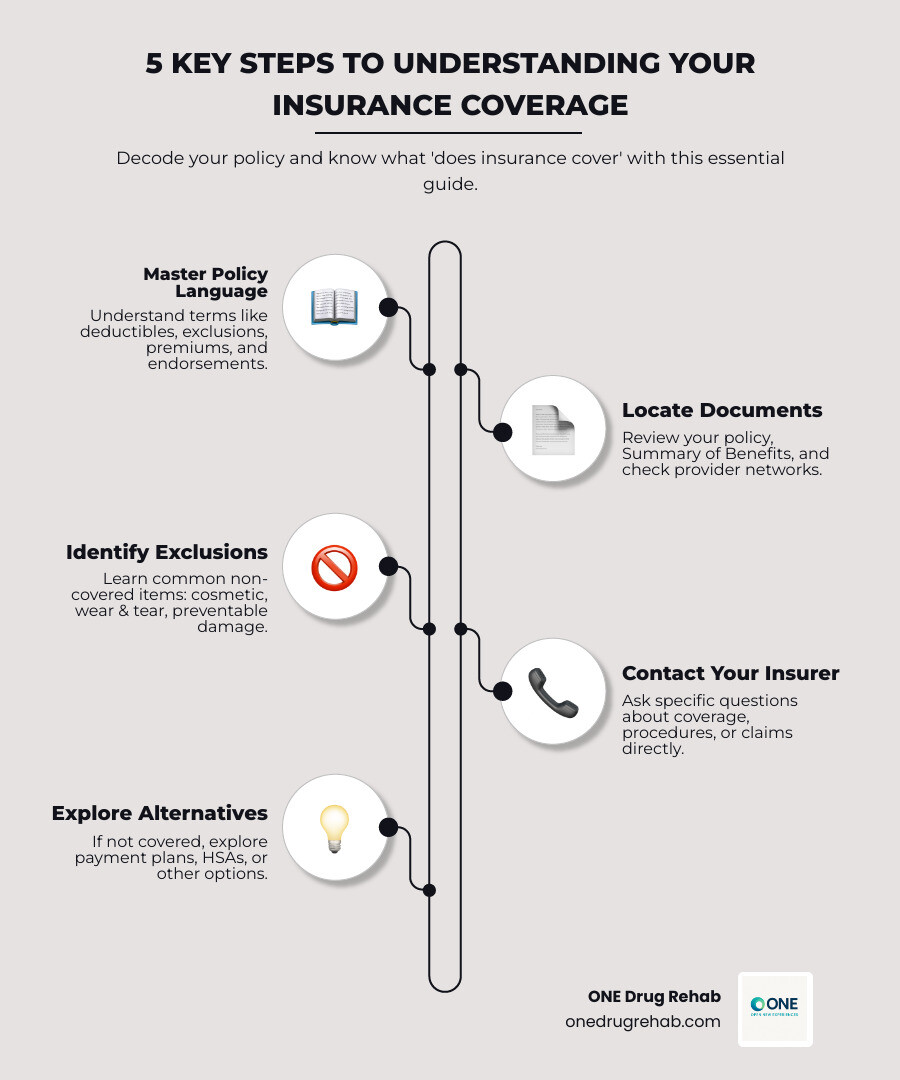
Step 1: Master the Language of Your Insurance Policy
Your insurance policy is a contract between you and your insurer that outlines what risks are covered. Understanding this contract is the first step to knowing what does insurance cover. Mastering a few key terms makes the process much clearer.
Understanding Key Financial Terms
Here are the most common financial terms you’ll find in any policy:

-
Premiums: The fee you pay (usually monthly or yearly) for insurance coverage. It’s based on factors like your age, history, and the value of what’s being insured.
-
Deductibles: The amount you pay out-of-pocket before your insurance covers the rest of a claim. For a $1,000 car repair with a $500 deductible, you pay the first $500, and your insurer covers the remaining $500. A higher deductible generally means a lower premium.
-
Policy Limits: The maximum amount your insurer will pay for a covered loss. For example, your home insurance might have a $500,000 limit for dwelling damage. Costs beyond this limit are your responsibility.
-
Actual Cash Value (ACV) vs. Replacement Cost (RCV): This is crucial for home insurance.
- Actual Cash Value (ACV) pays the cost to replace property minus depreciation. You’d get the value of an 8-year-old fridge, not a new one.
- Replacement Cost (RCV) pays the cost to replace property with a new item, without deducting for depreciation. It offers better protection but usually has higher premiums.
To learn more about how these terms work, you can explore resources like Understanding your insurance policy.
What are Exclusions and Endorsements?
Knowing what your policy doesn’t cover is as important as knowing what it does.
-
Exclusions: These are specific circumstances your policy does not cover. For example, standard auto insurance excludes mechanical failure and wear and tear. Home insurance often excludes damage from landslides or earthquakes. This is the fine print that often catches people by surprise. For a list of typical auto insurance exclusions, see What is not covered.
-
Endorsements (or Riders): These are add-ons that provide extra coverage for excluded risks. For example, you can add an endorsement for earthquake damage or overland flood damage, which are typically excluded from standard home policies. Riders let you tailor coverage to your specific needs.
Step 2: Locate and Review Your Coverage Documents
Now that you understand the language, it’s time to review your policy documents to see what does insurance cover for you. Spending 30 minutes with these documents now can save you thousands of dollars later.
For Home and Auto Insurance

For home and auto policies, start with the declarations page, which is your coverage summary. Home insurance typically protects your dwelling, personal belongings, liability, and additional living expenses. It’s important to know if you have comprehensive coverage (protects against all risks except those excluded) or named perils coverage (only covers disasters listed in the policy).
Water damage is the leading cause of home insurance claims, but standard policies often exclude damage from flooding or sewer backups. You may need an extended water damage endorsement for full protection.
For auto insurance, look beyond mandatory liability for optional coverages. Collision coverage pays to fix your car after an accident, while comprehensive coverage protects against theft, vandalism, and hail. Most insurance companies offer online portals like a Client Centre where you can access your documents 24/7. For more details on auto coverage, check this Comprehensive Car Insurance guide.
For Health Insurance
Health insurance documents follow a standard format. Start with your Summary of Benefits and Coverage (SBC), which breaks down your plan in plain language.
The most important concept is the difference between in-network and out-of-network providers. Your insurer negotiates lower rates with in-network providers, so using them saves you significant money. Always check if your doctor is in-network.
HMO plans are usually cheaper but require referrals from a primary care doctor. PPO plans offer more flexibility to see specialists directly but have higher premiums.
Key terms to know are medical necessity (treatment must be appropriate for your condition) and prior authorization (your insurer must approve certain treatments beforehand). Your plan also has a covered drug list (formulary) that shows which prescriptions are covered and at what cost.
If you need to find a plan, you can use the Healthcare Marketplace or look into government programs like Medicare if you are eligible.
What Does Insurance Cover for Health and Wellness?
Beyond routine check-ups, many people wonder about coverage for mental health, addiction, and other specific treatments. The good news is that does insurance cover these vital services more often than people realize.
Does insurance cover therapy and mental health services?
Yes, most health insurance plans cover therapy and mental health services. The Mental Health Parity and Addiction Equity Act of 2008 and the Affordable Care Act mandate that insurers treat mental health care like physical health care.
This means a therapy session that costs $100-$200 without insurance may only be a co-pay of $15-$45 with coverage. Your plan can cover a wide range of services, including in-person and online counseling, inpatient mental health treatment, outpatient therapy, and psychiatry visits for medication management. Some plans even cover psychological evaluations if deemed medically necessary.
Does insurance cover addiction and substance use treatment?
Yes, most health insurance plans are legally required to cover treatment for substance use disorders. This is critical, as professional addiction treatment can cost upwards of $30,000 without insurance.
Covered services typically include:
- Detoxification: Medically supervised detox to safely manage withdrawal.
- Inpatient addiction treatment: Residential rehab programs for intensive, structured therapy.
- Outpatient programs: Including Partial Hospitalization (PHPs) and Intensive Outpatient Programs (IOPs) for those who need treatment while living at home.
Major insurers like Aetna, Blue Cross Blue Shield, Cigna, Humana, Medicaid, and Medicare provide this coverage. Sober living homes are not usually covered by insurance because they aren’t considered treatment facilities, but outpatient therapy received while living there may be. To learn more about your options, you can explore Types of Addiction Treatment or use our Compare Rehab Centers tool.
What About Other Medical Treatments?
For other treatments, coverage often depends on whether it’s “medically necessary” versus “cosmetic.”
-
Hormone and Testosterone Replacement Therapy (HRT/TRT) are often covered for diagnosed medical conditions like menopause or hypogonadism, as supported by research like this study on Hormone therapy for first-line management of menopausal symptoms: Practical recommendations – PMC.
-
Laser hair removal is usually cosmetic, but may be covered if caused by a medical condition like PCOS.
-
Varicose vein treatment for spider veins is cosmetic, but it may be covered if the veins cause pain, swelling, or ulcers, and after conservative treatments have been tried.
Step 3: Identify Common Exclusions Across All Policies
Now that we’ve covered what does insurance cover, let’s look at what’s commonly excluded. Knowing these limitations can prevent frustrating surprises.
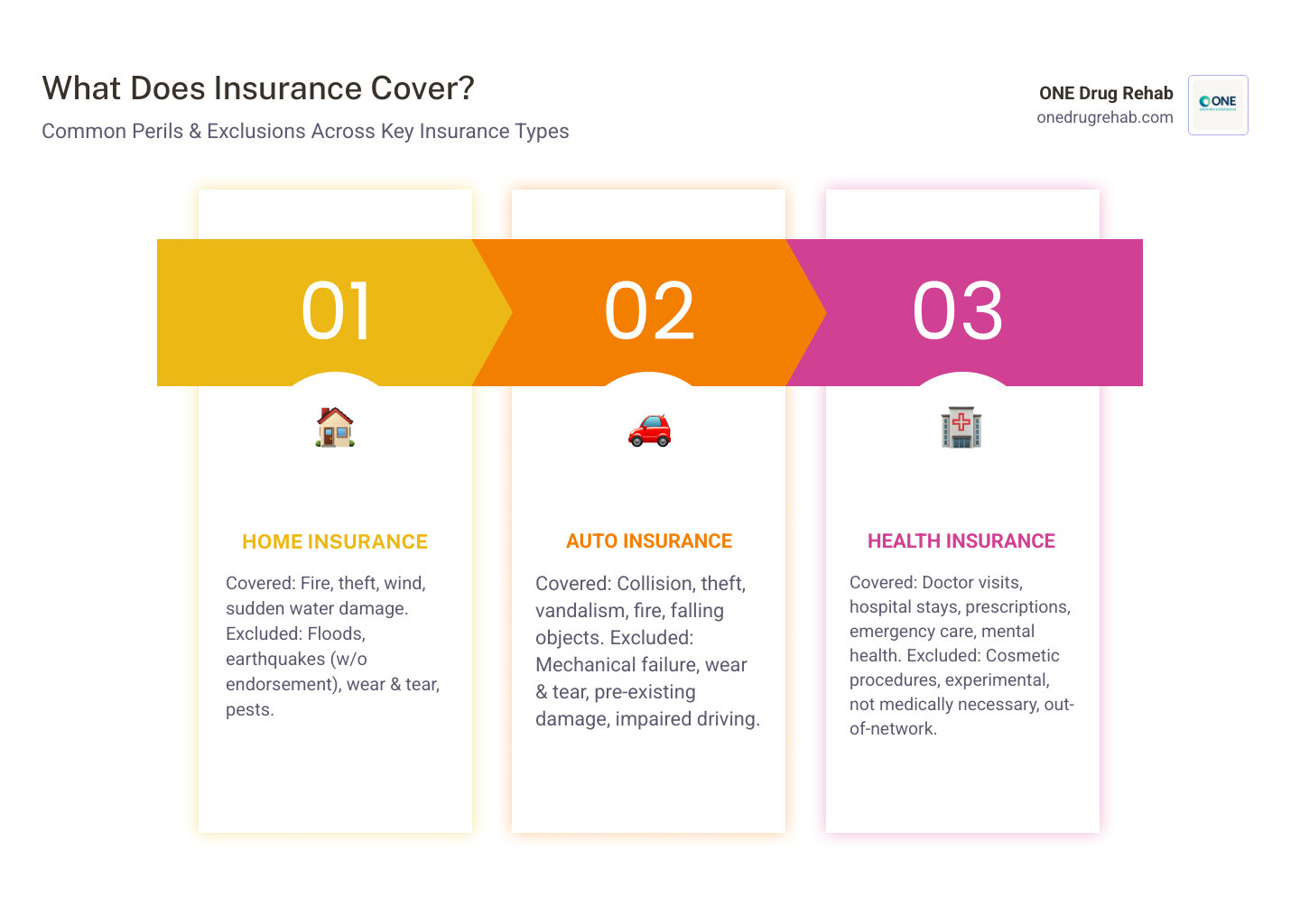
Insurance is designed to protect against sudden, unexpected events—not predictable maintenance or intentional choices. The table below summarizes common covered perils and exclusions.
| Category | Common Covered Perils (Examples) | Common Exclusions (Examples) |
|---|---|---|
| Home Insurance | Fire, theft, wind, hail, lightning, vandalism, sudden water damage (e.g., burst pipe) | Floods (overland water), earthquakes (without endorsement), landslides, wear and tear, neglect, pests (insects/rodents), intentional damage, war/terrorism |
| Auto Insurance | Collision with another vehicle/object, theft, vandalism, fire, hail, falling objects, collision with wildlife | Mechanical failure, wear and tear, routine maintenance, pre-existing damages, impaired driving, racing, using vehicle for illegal activities, personal belongings stolen from vehicle (unless commercial policy) |
| Health Insurance | Doctor visits, hospital stays, prescription drugs, emergency care, mental health services, addiction treatment (if medically necessary) | Cosmetic procedures, experimental treatments, services not medically necessary, services outside network (without specific plan), services without prior authorization, off-label drug use, some alternative therapies |
Common Auto Insurance Exclusions
Your auto policy is not a maintenance plan or warranty. It excludes mechanical failure and wear and tear. For tire protection, you’d need a separate plan like Tire maintenance or protection plans. Personal belongings stolen from your car are usually covered by your home insurance, not your auto policy. Using your vehicle for ridesharing or commercial use requires a special endorsement. Impaired driving will void your coverage, and insurers won’t pay for pre-existing damages that existed before the policy started, as explained here: Pre-existing damages.
Common Home Insurance Exclusions
The biggest misconception involves flood damage. Standard policies do not cover floods from rising overland water; this requires a separate endorsement. Earthquakes and landslides are also standard exclusions that require add-on coverage.
Home insurance is for sudden accidents, not upkeep, so wear and tear, neglect, and pest damage are excluded. Freezing pipes may also be excluded if you fail to take reasonable precautions to prevent damage, such as maintaining heat in your home. Landlords have additional considerations, which can be explored in resources like Are you a Residential Landlord? (PDF).
Step 4: How to Get Answers and What to Do Next
You’ve learned the language and reviewed your documents. Now it’s time to get specific answers about what does insurance cover for your unique situation. Knowing how to get clear, definitive answers is crucial.
Contacting Your Insurance Provider

Your insurance agent or customer service representative is your best resource. Before calling, have your policy number ready and write down your questions. Here are the most important things to ask about a specific procedure or treatment:
- Is this specific service covered under my policy? (Be as detailed as possible.)
- Do I need to use in-network providers?
- Is prior authorization required, and what is the process?
- What will my out-of-pocket cost be? (Ask about your deductible, co-pay, and co-insurance.)
- Are there any limitations I should know about? (e.g., session limits per year.)
- What is the appeals process if my claim is denied?
Don’t hesitate to ask for clarification or call back to speak with someone else if you don’t get a clear answer.
What If You’re Not Covered?
Sometimes, insurance won’t cover what you need, or the out-of-pocket costs are too high. This can be discouraging, but it doesn’t mean you’re out of options.
- Ask about payment plans or sliding-scale fees. Many healthcare providers, especially in mental health and addiction treatment, offer these.
- Use a Health Savings Account (HSA) or Flexible Spending Account (FSA). These let you use pre-tax dollars for healthcare expenses, reducing your effective cost.
- Look for scholarships or grants. Many addiction treatment facilities offer financial assistance programs.
- Consider alternative treatment options. If inpatient rehab isn’t covered, an intensive outpatient program might be a viable, covered alternative.
At ONEDrugRehab.com, we understand these barriers. That’s why we’ve created resources to help you Find Rehab Without Insurance. There is almost always a path forward.
Frequently Asked Questions about Insurance Coverage
Let’s tackle some of the most common questions people ask about what does insurance cover in real-world scenarios.
Does insurance cover natural disasters?
It depends on the disaster and your policy. For your home, standard policies typically cover damage from wind, hail, and fire. However, floods and earthquakes are usually excluded and require a separate policy or endorsement. For your car, comprehensive coverage generally protects against most natural disasters, including hail, wind, fire, and floods.
Is therapy covered by insurance?
Yes, most insurance plans cover therapy. The Mental Health Parity and Addiction Equity Act ensures mental health benefits are comparable to physical health benefits. Your therapy must be deemed “medically necessary” for a diagnosed condition. To keep costs down, use an in-network therapist. Your deductible will still apply, but once it’s met, your insurance should cover a significant portion of the cost.
What’s the difference between “medically necessary” and “cosmetic” procedures?
This distinction is crucial for coverage. A procedure is medically necessary if it treats a health condition, restores function, or prevents a condition from worsening (e.g., treating painful varicose veins). A procedure is cosmetic if its primary purpose is to improve appearance (e.g., removing spider veins for aesthetic reasons).
Insurance covers medically necessary procedures but not cosmetic ones. The gray area is when the same procedure can be either, depending on the reason. For example, laser hair removal is cosmetic, but it might be covered if it treats a medical condition like PCOS. You may need documentation from your doctor to prove medical necessity.
Conclusion
You’ve made it through the maze of insurance. Understanding what does insurance cover is your superpower for navigating your policy with confidence. It’s about getting the most value from your premiums and ensuring your financial security when you need it most.
By being proactive, you’re already ahead of the game. You know how to contact your provider with the right questions and understand your options even when something isn’t covered.
For anyone dealing with addiction, the Mental Health Parity Act has made treatment more accessible, but insurance barriers can remain. At ONEDrugRehab.com, we’re here as your third-party, non-affiliated resource to help you research treatment options without pressure or bias. We understand that navigating insurance and treatment can be overwhelming, and we exist to make the process clearer.
If you find that insurance coverage isn’t enough, don’t give up. We can help you explore alternatives and Find Rehab Without Insurance. Recovery shouldn’t depend on having perfect coverage.
Your journey to understanding your insurance starts with a call to your provider. Armed with the knowledge from this guide, you’re ready to ask the right questions and get the answers you need. Take that step—your future self will thank you.