

Rehab Accreditation Standards: The Gold Standard 2025
Why Rehab Accreditation Standards Are Your Safety Net
Rehab accreditation standards are quality benchmarks that independent organizations use to evaluate addiction treatment facilities. These standards ensure that rehab centers meet strict requirements for patient safety, staff qualifications, treatment effectiveness, and ethical practices.
Quick Reference: What You Need to Know
- CARF International: Accredits 30% of surveyed rehab facilities with person-centered care standards
- The Joint Commission: Accredits 23% of surveyed facilities with focus on patient safety
- Key Benefits: Higher quality care, qualified staff, insurance coverage, and accountability
- Verification: Check facility websites, accrediting body databases, or ask admissions directly
- Important Note: 5.5% of treatment facilities operate without any licensing or accreditation
When you or someone you care about needs addiction treatment, the choice can feel overwhelming. As one industry expert noted, “With so many rehab program options in the growing industry of addiction treatment, how can you identify a rehabilitation program that will provide the quality care you or your loved one need?”
Accreditation vs. Licensing: The Key Difference
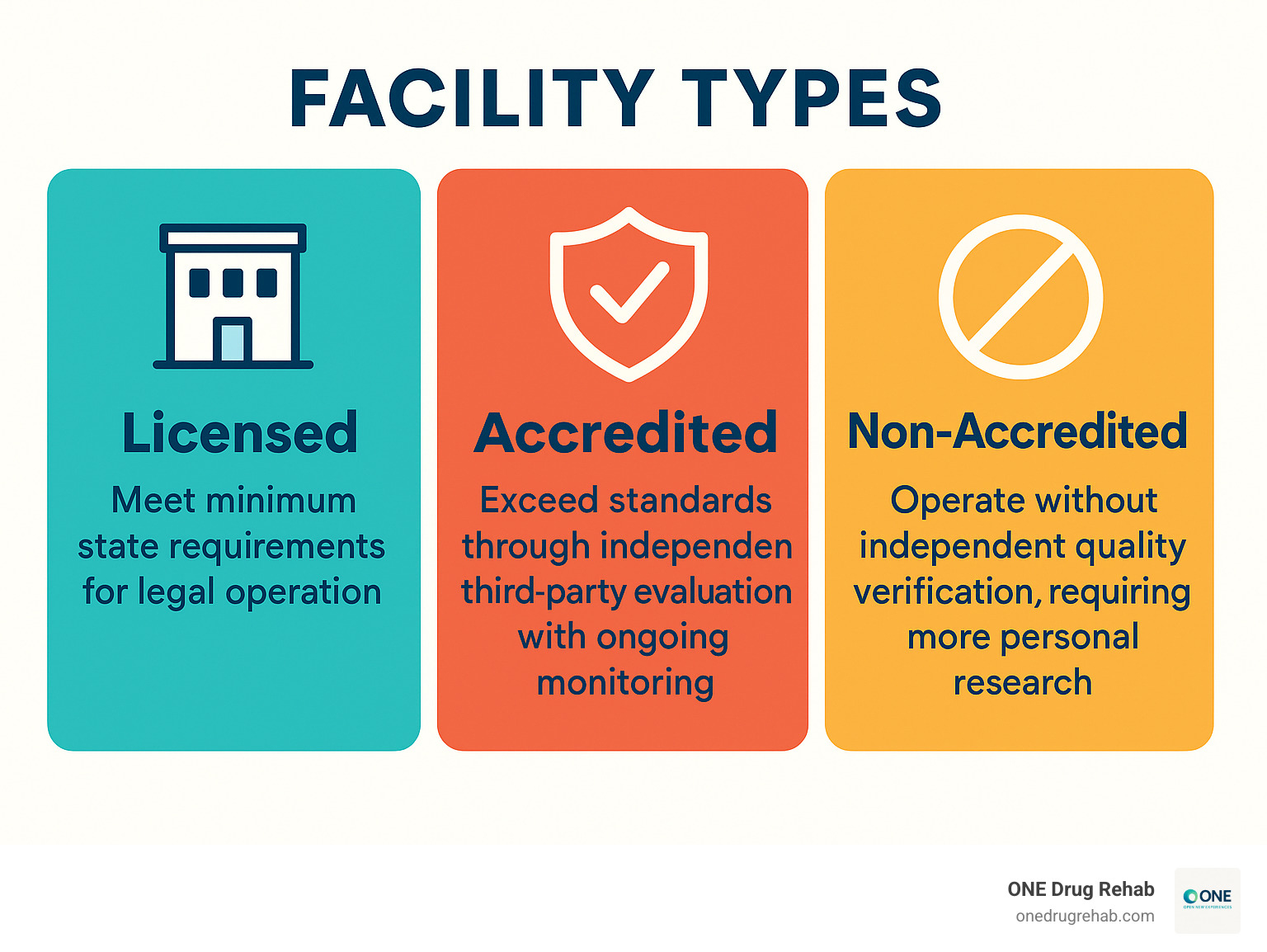
Licensing is mandatory – it’s the basic legal requirement for a facility to operate. Think of it as getting a driver’s license.
Accreditation is voluntary – it’s like earning a safety award from AAA. It shows the facility went above and beyond minimum requirements.
Out of 16,066 addiction treatment programs surveyed in 2020, over 13 million people are served annually by accredited organizations. This isn’t just about paperwork – it’s about your safety and recovery success.
The stakes are real. Choosing an accredited facility means you’re getting care from programs that have been independently verified to meet rigorous standards for everything from staff training to emergency procedures to treatment effectiveness.
The Gatekeepers of Quality: Major Rehab Accrediting Bodies
Think of rehab accreditation standards as having trusted watchdogs in your corner. These aren’t government agencies or profit-driven companies – they’re independent, non-profit organizations that have made it their mission to separate the good from the great in addiction treatment.
These third-party evaluators work like quality control inspectors, but for something far more important than manufactured goods – they’re evaluating the places where people rebuild their lives. They set the industry benchmarks that push facilities to excel, and they provide the accountability that keeps everyone honest.
The Joint Commission (TJC)
If you’ve ever been to a hospital, you’ve likely encountered The Joint Commission’s work without even knowing it. This organization has been around since 1951 – you might remember them by their old name, JCAHO. They’re the folks behind that familiar Gold Seal of Approval® you see displayed in healthcare facilities.
Patient safety is their obsession, and rightfully so. TJC doesn’t just hand out certificates – they conduct thorough on-site surveys where trained evaluators spend days examining every aspect of a facility’s operations. These aren’t friendly visits; they’re comprehensive examinations that happen every few years.
The numbers speak for themselves: TJC accredits more than 22,000 organizations across the country. In the addiction treatment world specifically, they’ve earned the trust of 23% of surveyed rehab facilities. When you see that Gold Seal, you know the facility has passed some seriously rigorous testing.
CARF International
While TJC focuses broadly on healthcare, CARF International (Commission on Accreditation of Rehabilitation Facilities) has laser-focused on rehabilitation since 1966. Their approach feels different – it’s deeply rooted in person-centered care, meaning they design their standards around what actually helps people recover.
CARF’s ASPIRE to Excellence® framework isn’t just a catchy name. It’s a systematic approach that helps facilities continuously improve by assessing their environment, setting strategy, getting input from the people they serve, implementing plans, reviewing results, and making changes. It’s like having a GPS for quality improvement.
The scope of CARF’s work is impressive: they accredit over 66,000 programs worldwide, serving more than 13 million people annually. In addiction treatment specifically, 30% of surveyed rehab facilities have earned CARF accreditation. That’s a significant vote of confidence from the industry. More information on CARF’s standards is available directly from their organization.
Other Notable Certifying Organizations
Beyond the two major players, several other organizations contribute to maintaining high rehab accreditation standards:
The Council on Accreditation (COA) has been working with human service organizations since 1977, including behavioral health programs. They’re particularly important because they’re an approved accreditor for opioid treatment centers, as mandated by SAMHSA.
The National Association of Addiction Treatment Providers (NAATP) brings together industry leaders who prioritize staying current with trends and advocating for patient care. While they’re primarily an association rather than an accrediting body, their influence on best practices and ethical standards is significant. Learn about NAATP’s mission to understand their role in advancing the field.
These organizations work together to create a safety net of oversight that goes far beyond basic licensing requirements. They’re the reason families can have confidence when choosing treatment, knowing that independent experts have thoroughly evaluated the facility’s commitment to quality care.
A Closer Look at Rehab Accreditation Standards
What happens when a rehab facility decides to pursue accreditation? It’s like signing up for the most thorough inspection of your life – except it’s actually a good thing. The process goes far beyond a simple checklist. Think of it as a comprehensive health exam for the entire facility, where experienced professionals examine every aspect of how care is delivered.

The beauty of rehab accreditation standards lies in their focus on continuous improvement. This isn’t about catching facilities doing something wrong – it’s about helping them do everything right. Surveyors, often peers from the field with clipboards in hand, evaluate every corner of operations to ensure patients receive the best possible care.
Core Principles of Rehab Accreditation Standards
Every accredited facility operates on fundamental principles that put patients first. Patient-centered care means your treatment plan is built around your unique needs, goals, and preferences – not a one-size-fits-all approach. You’re actively involved in your recovery journey, with your voice heard every step of the way.
Individualized treatment plans are crafted after thorough assessments, recognizing that no two recovery stories are identical. Your plan adapts as you progress, ensuring the treatment remains relevant and effective for your specific situation.
Patient rights protection is non-negotiable. This covers everything from maintaining your dignity and privacy to ensuring you understand your treatment options. You have the right to voice concerns, ask questions, and participate in decisions about your care.
Ethical practices and HIPAA compliance work together to create a trustworthy environment. Your personal health information stays confidential, and staff follow strict professional standards that always prioritize your wellbeing over profits.
Perhaps most importantly, accredited facilities use evidence-based treatment approaches. This means the therapies you receive have been scientifically proven to work. No experimental treatments without solid research backing them up. Different facilities may offer various approaches, and you can learn more about Types of Addiction Treatment to understand your options.
Continuous quality improvement and outcome measurement ensure facilities don’t rest on their laurels. They’re constantly tracking what works, what doesn’t, and how to get better. Your progress becomes part of valuable data that helps improve care for future patients.
Key Areas of Evaluation
When surveyors arrive at a facility, they examine everything with a fine-tooth comb. Leadership and governance gets scrutinized first – do the people running the place have a clear vision and effective management? Are they genuinely committed to helping people recover?
Staff competency and credentials receive intense attention. Every therapist, counselor, and support staff member must be properly licensed and continuously trained. There’s no room for unqualified people providing care when someone’s life and recovery are on the line.
The environment of care and facility safety go hand in hand. Is the space clean, comfortable, and conducive to healing? Are there proper safety protocols, emergency exits, and security measures? A chaotic or unsafe environment can derail recovery efforts.
Emergency preparedness might seem like a small detail, but it’s crucial. Facilities must demonstrate they can handle medical emergencies, natural disasters, or other crises. Staff training and regular drills ensure everyone knows what to do when seconds count.
The clinical program structure and assessment process determine whether patients receive appropriate care levels. From detox through outpatient services, programs must be well-organized and comprehensive. Initial assessments need to uncover not just addiction issues but any co-occurring mental health conditions.
Medication management becomes critical for facilities offering medication-assisted treatment. Pills, dosages, and administration must be handled with pharmaceutical precision. One mistake could be dangerous or even fatal.
Finally, information management and secure patient records ensure your sensitive information stays protected while being used effectively to improve your care. It’s a delicate balance between accessibility for treatment purposes and ironclad security.
The Accreditation Process for Facilities
The journey to accreditation starts with a brutally honest self-assessment. Facilities compare their current operations against the accrediting body’s standards, often finding gaps they didn’t know existed. This stage involves developing action plans to address shortcomings before moving forward.
Application submission comes next, requiring detailed documentation about programs, policies, and procedures. It’s like preparing a comprehensive resume for the entire facility – every claim must be backed up with evidence.
The on-site survey is where the rubber meets the road. Surveyors spend days at the facility, interviewing staff and patients, reviewing records, observing treatment sessions, and inspecting every corner of the building. They’re looking for proof that policies aren’t just written down but actually followed in daily practice.
A peer-review process follows, where experts from the rehabilitation field evaluate the survey findings. This ensures fair, knowledgeable assessment from people who understand the challenges of running quality treatment programs.
The accreditation decision can result in full accreditation, accreditation with improvement recommendations, or in rare cases, denial. But earning accreditation is just the beginning.
Ongoing compliance requires facilities to demonstrate continued adherence to standards through regular reports and updates. The re-accreditation cycle typically occurs every one to three years, ensuring sustained quality and adaptation to evolving best practices.
This rigorous process explains why accreditation serves as such a reliable indicator of a facility’s commitment to excellence. It’s not easy to achieve, and it’s even harder to maintain – which is exactly why it matters so much for your recovery journey.
Benefits for Patients and How to Verify a Facility’s Status
When you’re searching for addiction treatment, you’re already dealing with so much. The last thing you need is uncertainty about whether you’re choosing the right place. That’s where rehab accreditation standards become your best friend – they’re like having a trusted advisor who’s already done the hard work of vetting facilities for you.

Think of accreditation as your safety net. It gives you the confidence to focus on what really matters – healing and recovery – instead of worrying about whether the facility can actually deliver on its promises.
The Tangible Benefits of Choosing an Accredited Rehab
When you walk into an accredited rehab facility, you’re not just entering a building. You’re stepping into a place that has proven itself worthy of your trust. Here’s what that really means for you and your recovery journey.
Quality you can count on is the biggest advantage. An accredited facility has undergone rigorous independent review by experts who know what good treatment looks like. They’ve checked everything from treatment methods to staff qualifications to safety procedures. It’s like having a quality guarantee on the most important purchase you’ll ever make.
Better care across the board happens because accredited facilities don’t just meet minimum requirements – they exceed them. They stay current with the latest research, use proven treatment methods, and continuously improve their programs. Your treatment team isn’t just winging it; they’re following best practices that actually work.
Staff who really know their stuff is another huge benefit. Accrediting bodies carefully review staff credentials, training, and ongoing education. The counselor helping you through your darkest moments? They’ve been verified as qualified and competent. The medical staff managing your detox? They have the right training and experience to keep you safe.
A safe place to heal isn’t just about physical safety (though that’s important too). Accredited facilities create environments where you can be vulnerable, work through difficult emotions, and rebuild your life without fear. They have clear policies for everything from emergency situations to protecting your privacy.
Insurance coverage often depends on accreditation. Many insurance companies will only cover treatment at accredited facilities, which can save you thousands of dollars. Even if your insurance doesn’t require it, accredited facilities are more likely to be in-network providers.
Someone watching out for you is what accountability really means. Accredited facilities can’t just coast along – they’re regularly monitored and must continuously demonstrate they’re meeting high standards. If something goes wrong, there are systems in place to address it.
How to Check a Rehab Center’s Accreditation
Verifying a facility’s accreditation is easier than you might think, and it’s one of the most important steps you can take. Here’s how to become a detective for your own recovery.
Start with their website because reputable facilities are proud of their accreditations. Look for official seals from organizations like CARF, The Joint Commission, or COA. These are usually displayed prominently on the homepage or in an “About Us” section. If you can’t find any mention of accreditation, that’s a red flag worth investigating.
Go straight to the source by checking the accrediting body’s website directly. For CARF, visit carf.org and use their “Search for Providers” tool. For The Joint Commission, go to jointcommission.org and use “Quality Check.” Simply type in the facility’s name to see their current status. This takes about two minutes and gives you definitive answers.
Ask the admissions team directly about their accreditations. A good facility will be happy to discuss their credentials and explain what they mean. They should be able to tell you which organizations accredit them, when they were last surveyed, and how long they’ve maintained their accreditation. If they seem evasive or can’t provide clear answers, keep looking.
Read what others are saying through independent reviews and testimonials. While this doesn’t replace checking accreditation directly, it can give you insights into how well a facility lives up to its standards. You can read independent Rehab Facility Reviews to get a fuller picture of what to expect.
Don’t skip the verification step even if everything looks good on the surface. It only takes a few minutes to confirm accreditation status online, and it’s worth the peace of mind. Your recovery is too important to leave to chance.
The bottom line? Accreditation isn’t just a nice-to-have – it’s your assurance that a facility has been independently verified to provide quality, safe, and effective care. In a field where the stakes are literally life and death, that verification matters more than you might realize.
Frequently Asked Questions about Rehab Accreditation
When you’re researching treatment options, rehab accreditation standards can feel overwhelming. We get it – there are lots of acronyms, different organizations, and technical terms. Let’s break down the most common questions families ask us.
Is accreditation the same as being licensed?
This is probably the most important distinction to understand, and the answer is no – they’re completely different things.
Licensing is mandatory. Every rehab facility must be licensed by their state to legally operate. Think of it like getting a driver’s license – you can’t drive without it, but having one doesn’t make you a great driver. Licensing sets the bare minimum standards that facilities must meet to keep their doors open.
Accreditation is voluntary. It’s what happens when a facility decides to go above and beyond those minimum requirements. An independent organization comes in and says, “We’re going to hold you to much higher standards than the state requires.” It’s like earning a safety award from AAA – you don’t need it to drive, but it shows you’re committed to excellence.
When a facility pursues accreditation, they’re making a statement about their commitment to quality care. They’re willing to invest time, money, and effort to prove they meet rigorous rehab accreditation standards set by respected organizations.
Does accreditation guarantee a successful recovery?
We wish we could give you a simple yes, but recovery is more complex than that. No single factor – not accreditation, not the fanciest facility, not even the best staff – can guarantee successful recovery. Recovery is deeply personal, and your commitment and engagement play the biggest role.
However, choosing an accredited facility absolutely improves your chances of success. Here’s why: accredited facilities use evidence-based treatment methods. This means their therapies and approaches are backed by scientific research showing they actually work.
Accredited facilities also have qualified staff who understand addiction’s complexity. They maintain safe environments, follow ethical practices, and continuously work to improve their programs. They’re required to track patient outcomes and adjust their methods based on what’s working.
Think of it this way – accreditation doesn’t guarantee success, but it gives you the best possible foundation for your recovery journey. It’s like having a skilled guide when you’re climbing a mountain. The guide can’t climb it for you, but they significantly improve your chances of reaching the summit safely.
Are non-accredited rehabs bad?
This question deserves a nuanced answer because the situation isn’t black and white.
Non-accredited facilities aren’t automatically bad. A brand-new facility might be excellent but simply hasn’t had time to complete the accreditation process yet. Accreditation can take months or even years to achieve, and some newer facilities are still working toward it.
However, the absence of accreditation does mean something important: there’s no independent, third-party validation of their quality or safety. When you choose a non-accredited facility, you’re taking on more responsibility to research and verify their practices yourself.
You’ll need to dig deeper into questions like: Are their staff properly credentialed? Do they follow evidence-based practices? What are their safety protocols? How do they handle emergencies? What are their success rates?
The numbers tell an interesting story. In 2020, about 5.5% of addiction treatment facilities operated without any licensing or accreditation. While some of these might provide good care, it’s harder to know for sure without that external oversight.
The bottom line: if you’re considering a non-accredited facility, just do your homework more thoroughly. Ask more questions, request references, and verify their staff credentials independently. Your safety and recovery are worth the extra effort.
Conclusion: Making an Informed Choice for Your Recovery Journey
When you’re facing addiction treatment decisions, the path forward can feel overwhelming. But here’s the thing – understanding rehab accreditation standards gives you a reliable roadmap through all the options out there. Think of accreditation as your quality assurance badge, showing that a facility has been thoroughly evaluated by independent experts who know what real recovery looks like.
This isn’t just about checking boxes or meeting requirements. Accreditation serves as a crucial benchmark that tells you a facility is genuinely committed to your safety, your healing, and your success. It means they’ve gone beyond the bare minimum and invested in creating an environment where recovery can truly flourish.
Empowering patients and families is what this is all about. When you understand what those accreditation seals mean and how to verify them, you’re no longer guessing about quality. You have a concrete tool for navigating treatment options with confidence. It’s like having a trusted friend who’s already done the research for you.
The beauty of accreditation is that it represents a commitment to excellence that goes far beyond words on a website. These facilities have opened their doors to rigorous scrutiny, welcomed independent evaluators, and demonstrated that they can consistently deliver the kind of care that changes lives.
At ONEDrugRehab.com, we believe in giving you the information you need to make decisions that feel right for your unique situation. We’re here as your third-party, non-affiliated resource – not to push you toward any particular facility, but to help you understand what quality looks like in addiction treatment.
As you take this important step in your recovery journey, choosing an accredited facility is choosing peace of mind. It’s choosing a place where evidence-based practices aren’t just buzzwords, where staff qualifications matter, and where your safety and success are the top priorities.
Ready to explore your options? We’re here to help you find rehab centers that meet your needs and match your specific situation. Find Rehab Centers that meet your needs.