

Why Spiritual Recovery Matters for Lasting Sobriety
Spiritual recovery programs are treatment approaches that integrate faith, mindfulness, or a connection to something greater than yourself into addiction recovery. These programs address not just the physical and mental aspects of addiction, but also the spiritual void that often drives substance use.
Quick Overview of Spiritual Recovery Programs:
- 12-Step Programs (AA/NA): Use spiritual principles and connection to a “Higher Power” – 73% of US treatment centers include these
- Faith-Based Rehabs: Christian, Catholic, Buddhist, Jewish, or Islamic programs that integrate religious teachings with evidence-based therapy
- Holistic/Non-Denominational: Yoga, meditation, mindfulness, and nature-based approaches without specific religious affiliation
- Secular Spiritual Options: Focus on purpose, gratitude, and connection without religious elements
Key Benefits: Research shows 84% of studies find faith is a positive factor in recovery, with participants experiencing better emotional well-being, stronger coping skills, and reduced relapse rates.
Addiction is often described as a spiritual malady—a deep disconnection from yourself, others, and your sense of purpose. When substances become your refuge, they can leave you feeling empty and searching for more.
The good news is that you don’t have to be religious to benefit. Whether you find connection through prayer, meditation, nature, or the fellowship of others, spirituality offers healing tools that go beyond traditional therapy. This guide will help you understand what spiritual recovery means, explore the different programs available, and find the right fit for your beliefs.
Understanding Spirituality in Recovery: More Than Just Religion
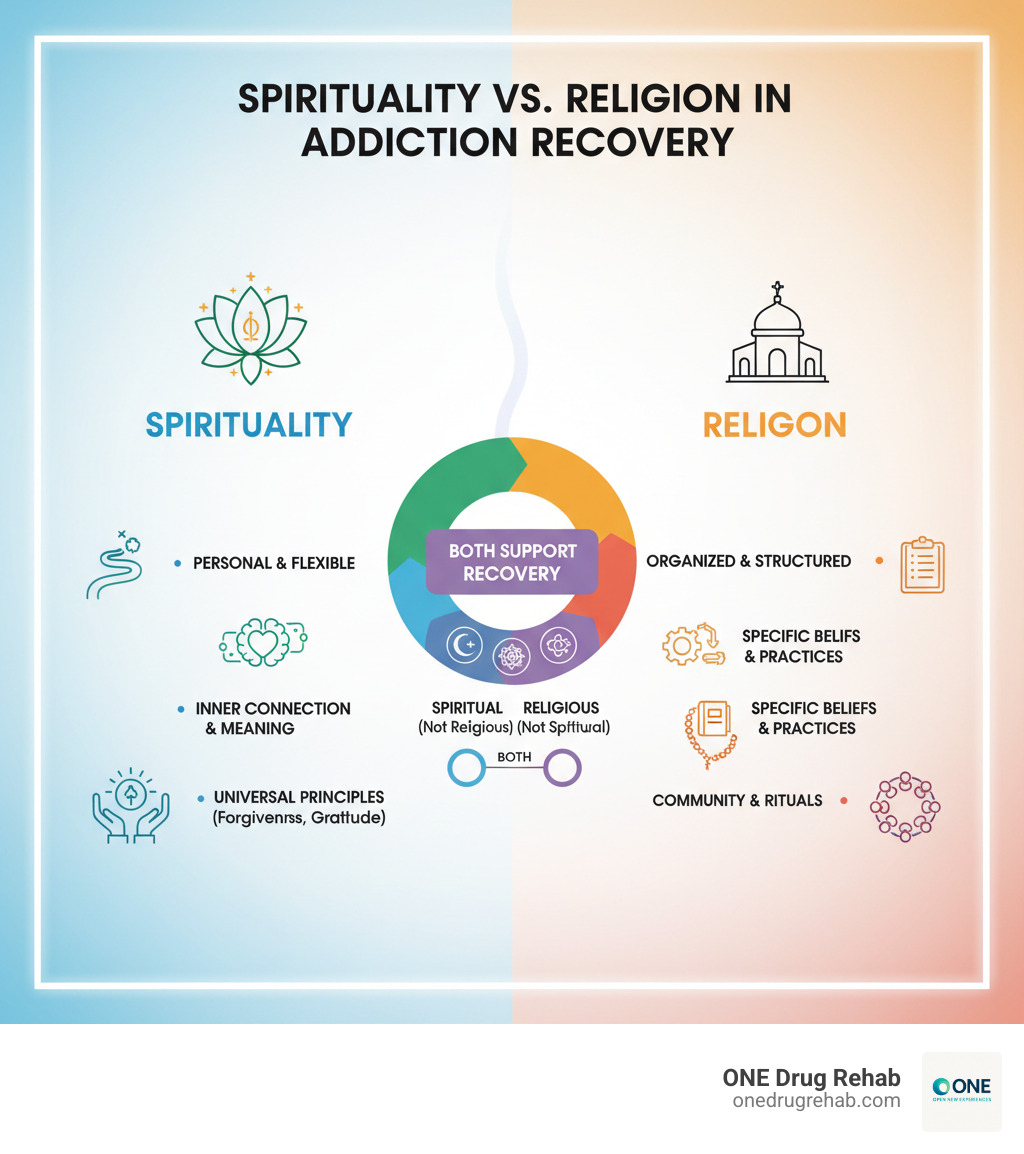
Many people are surprised to learn that spirituality and religion are not the same. Understanding this difference is key to finding a path that works for you.
Spirituality is a personal search for meaning, purpose, and inner peace. It’s about connecting to something greater than yourself, whether that’s a divine presence, nature, humanity, or universal principles like love and compassion. It’s about finding hope and connection.
Religion, in contrast, is typically an organized system of beliefs and practices shared by a community. While many find spirituality within religion, it’s not a requirement.
In spiritual recovery programs, the emphasis is on developing a personal spiritual path that resonates with you. They often refer to a “Higher Power,” but this is intentionally flexible. It can be God, your recovery group, nature, or any force for good you choose. This inclusive approach welcomes everyone, regardless of their religious background—or lack thereof—to find support for lasting sobriety.

Key Spiritual Principles for Lasting Sobriety
Spiritual principles are practical tools that can transform how you live in recovery. Let’s look at the core principles that help build a strong foundation for lasting sobriety.
Forgiveness is a challenging but liberating principle. Addiction often leaves behind guilt, shame, and resentment. Forgiving yourself isn’t about excusing past actions but releasing the emotional weight that holds you back. Forgiving others frees up energy consumed by negativity, redirecting it toward healing.
Practicing gratitude shifts your focus from what you lack to what you have. It’s about acknowledging and appreciating even small things, which reframes your outlook, fosters contentment, and reduces the urge to use substances. Daily gratitude practices can cultivate a more positive mindset.
Accepting grace means recognizing you’re worthy of love and support, even when you feel undeserving. It’s a path to self-compassion, allowing you to move past harsh self-judgment. Grace reminds you that recovery involves receiving help and kindness from others, your community, and perhaps a Higher Power.
Personal accountability is about taking responsibility for your actions and recovery journey, not about blame. It’s empowering because it acknowledges you have the power to make different choices. It often involves making amends and living with integrity.
Finding a life purpose fills the void that addiction once occupied. A purpose—whether through helping others, pursuing a passion, or being present for family—gives you a reason to stay sober. It transforms recovery from simply “not using” into building a life worth living.
These principles work together to heal not just addiction, but also the mental health issues that often accompany substance use.
The Science Behind Spirituality and Sobriety
You might wonder if there’s science backing up spirituality in recovery. The answer is clear: research consistently shows that spiritual practices have real, measurable impacts on sobriety.
Improved emotional well-being is a significant benefit. Spiritual practices foster peace, hope, and resilience, which are critical in early recovery. This can lead to reduced anxiety and depression. Studies link higher levels of spirituality with longer periods of sobriety.
Spirituality also contributes to increased life satisfaction. By helping you connect with meaning and purpose, it can transform your outlook from despair to hope. This newfound satisfaction acts as a buffer against stress, a primary relapse trigger.
Better coping skills develop through spiritual practices like mindfulness, meditation, and prayer. These are proven techniques for managing stress and cravings. They help you respond to challenges constructively rather than reactively.
Research also shows that spirituality leads to a greater sense of optimism, which is vital for long-term recovery. This optimism fuels perseverance and helps you believe that change is possible.
The scientific community has taken notice. Over 84% of studies show that faith is a positive factor in addiction prevention or recovery. This overwhelming evidence has led organizations like The Association for Addiction Professionals to train counselors in incorporating spirituality into their practices, recognizing its profound impact on treatment outcomes.
For a deeper dive into the research, you can explore scientific studies on spirituality and hardship that document these benefits in detail.
Exploring Different Types of Spiritual Recovery Programs
Finding the right recovery path can feel overwhelming, as there’s no single “correct” way to incorporate spirituality. What works for one person may not for another.

Most spiritual recovery programs share a common goal: to help you reconnect with yourself, others, and something meaningful. They address the spiritual emptiness that addiction often leaves behind, whether through a connection to God, nature, or the collective strength of a support group.
The landscape of spiritual recovery is diverse. 12-Step programs like Alcoholics Anonymous (AA) and Narcotics Anonymous (NA) are the most widely recognized, influencing about 73% of US treatment centers. They encourage members to connect with a “Higher Power” as they personally understand it, which could be God, the universe, or the group itself.
Faith-based programs integrate specific religious teachings into recovery. Christian programs like Celebrate Recovery blend biblical principles with 12-step frameworks, and there are also programs for Catholic, Jewish, Islamic, and Buddhist communities. These work well for people who want to lean on an existing faith tradition.
Holistic and non-denominational approaches don’t require any religious affiliation. They focus on universal spiritual principles like inner peace and self-awareness, using practices like mindfulness meditation, yoga, art therapy, or time in nature.
The key is finding something that feels genuine and empowering. Exploring the options in a treatment directory can help you find a program with spiritual elements that’s right for you. The right fit can make all the difference in building a recovery that lasts.
Spiritual Recovery Programs at ONE Drug Rehab
Here at ONE Drug Rehab, we’re not a treatment facility ourselves—we’re an online directory that helps you find the right treatment center for your unique needs. We know how important spirituality can be, which is why we make it easy to search for programs that integrate it.
Through our directory, you’ll find facilities that accept 12-step principles as a core part of their philosophy. These programs provide a structured path that has helped millions by working through the steps and practicing principles like honesty and humility.
Our listings include centers offering mindfulness and meditation practices. These accessible techniques help you stay present, manage stress, and regulate emotions. Learning to observe your thoughts without judgment is a powerful tool for rebuilding your life.
You’ll also find programs that emphasize holistic therapies—approaches that treat the whole person. These might include nutritional counseling, physical fitness, creative arts, and spiritual counseling to restore balance to your physical, mental, emotional, and spiritual life.
Personalized spiritual counseling is another service you’ll find at many facilities. This one-on-one guidance allows you to explore your own spiritual beliefs with a trained professional and integrate them into your recovery plan.
For those seeking something more immersive, some programs in our directory offer specialized spiritual rehabilitation retreats. These retreats provide dedicated time and space away from everyday distractions for deep introspection and focused healing.
By exploring the options available through ONE Drug Rehab, you can connect with facilities that understand and prioritize the spiritual dimension of recovery.
Holistic and Non-Denominational Spiritual Recovery Approaches
Not everyone finds their spiritual path through organized religion. Holistic and non-denominational spiritual recovery programs focus on nurturing your whole self—mind, body, and spirit—without requiring you to subscribe to any particular religious doctrine.
Yoga is popular in recovery for good reason. It combines physical movement, breathing, and meditation to help you reconnect with your body. After substance use, many feel disconnected from their physical selves; yoga helps release tension and find calm. It’s a practice accessible to all levels.
Nature-based therapy, or ecotherapy, taps into our need to connect with the natural world. Spending time outdoors—hiking, gardening, or sitting by water—can be inherently healing. Research shows that time in nature reduces anxiety, lifts mood, and fosters a sense of connection to something larger than ourselves.
Art and music therapy offer creative pathways to spiritual exploration. When words are difficult, expressing yourself through painting, sculpting, or music can be a powerful way to process trauma and find hidden strengths. The act of creating can be profoundly spiritual.
What ties these approaches together is their emphasis on personal growth and self-findy. They provide tools and experiences that help you figure out what spirituality means to you, rather than telling you what to believe. The goal is to help you build your own spiritual foundation that supports lasting sobriety.
Finding Your Path: Integrating Spirituality and Seeking Help
The recovery journey is deeply personal, and cultivating an inner life that supports sobriety is an empowering step. This often begins with taking personal inventory—an honest assessment of your strengths, weaknesses, and past behaviors. This judgment-free appraisal is a cornerstone of many spiritual recovery models, helping you understand where you’ve been and where you want to go.
How to Incorporate Spirituality into Your Daily Life
Integrating spirituality into daily life can be done through simple, powerful practices:
- Journaling for self-reflection: Regularly writing down your thoughts and feelings helps you process emotions, identify patterns, and gain insight into your inner world.
- Meditation or prayer: Dedicating time to connect with your inner self or a Higher Power can bring peace and clarity. Even a few minutes each day can help manage stress.
- Connecting with nature: Spending time outdoors can evoke a sense of awe and interconnectedness, reminding us of our place in the larger universe.
- Acts of service: Selflessly helping others shifts focus from personal problems to the needs of others. This fosters gratitude, humility, and a sense of purpose, which aids in healing.
- Building a supportive community: Spirituality often flourishes in a community. Connecting with others on a similar path provides encouragement, accountability, and a sense of belonging.
These practices, when applied consistently, help cultivate a resilient spirit and a stable foundation for sobriety.
Supportive Alternatives within ONE Drug Rehab
We recognize that a spiritual path isn’t for everyone. Our directory at ONE Drug Rehab also features a wealth of secular alternatives, because effective treatment should be customized to your beliefs and values.
You’ll find listings for programs emphasizing evidence-based therapies like Cognitive Behavioral Therapy (CBT) and Dialectical Behavior Therapy (DBT). These methods focus on changing thought patterns and developing coping skills without a spiritual framework. Many secular programs also offer strong peer support networks, recognizing the power of shared experience.
Personalized treatment plans are a cornerstone of the facilities in our directory. Whether you seek a spiritual, secular, or blended approach, you can find a program to fit your needs, potentially including physical health, mental wellness, and family therapy. Our goal is to connect you with the right resources for your unique journey, on your terms.
Frequently Asked Questions about Spiritual Recovery
We know that exploring spiritual recovery programs can bring up questions. We want to address them honestly and directly.
Do I have to be religious to join a spiritual recovery program?
No, you don’t. This is a common myth about spiritual recovery programs.
While some programs are faith-based, spirituality is much broader than religion. It’s about finding personal meaning, connection, and hope. For example, 12-Step programs like AA and NA, used in 73% of US treatment centers, refer to a “Higher Power,” but this is intentionally flexible. It can be God, nature, the universe, or the recovery group itself. The goal is not to adopt specific beliefs but to be open to support. Many non-religious people find their own sense of spirituality through this process.
What if I don’t believe in God?
Then you’re in good company. You can still find tremendous value in spiritual recovery, as many programs are agnostic and atheist-friendly.
For many, the recovery group itself becomes their “Higher Power”—a collective strength greater than their own. The focus is on universal principles like honesty, humility, and service, not theology. There are also non-theistic approaches, like Buddhist-inspired programs that use mindfulness and meditation. You can explore these principles through resources like Buddhist teachings. The only requirement is an openness to the process of change and connection.
Are spiritual programs more effective than secular ones?
The honest answer is that it depends on the person.
Recovery isn’t one-size-fits-all, and your personal commitment is the most important factor. However, research is compelling. Studies show that combining professional treatment with spiritual support like AA or NA can significantly increase the likelihood of maintaining sobriety, with 84% of studies finding spirituality to be a positive factor.
This is because spiritual components can provide a sense of purpose, community, and coping skills that clinical treatment may not focus on. At the same time, secular programs using evidence-based therapies like CBT are also highly effective for many people.
The key is to find what resonates with you. The best program is one that aligns with your beliefs and that you are willing to engage with fully. Success comes from that engagement, not from the category of program you choose.
Conclusion
Recovery from addiction is about rebuilding your life from the inside out. Spiritual recovery programs offer a powerful way to heal the emptiness and disconnection that often fuel substance use.
As we’ve explored, spirituality in recovery is flexible. It’s about finding a personal connection to something meaningful, whether that’s a Higher Power, nature, community, or a new set of values. These programs meet you where you are, adapting to your beliefs.
The evidence shows that engaging with spiritual principles like forgiveness, gratitude, and service leads to better emotional health, stronger coping skills, and higher rates of lasting sobriety. These are practical tools that help you build a life worth staying sober for.
Whether you’re drawn to 12-Step programs, faith-based approaches, or holistic therapies, there is a path for you. If spirituality isn’t your focus, that’s okay too; what matters is finding an approach that resonates with you and helps you heal mind, body, and spirit.
At ONE Drug Rehab, we know choosing a program is a big decision. Our directory provides information on a wide range of treatment options, from spiritual to secular, to help you make an informed choice. We’re not here to push one approach over another; we’re here to help you find what works.
Your recovery journey is unique. Taking the step to explore your options takes courage. If you’re ready to learn more, we’re here to help. Find help and start your journey today.