

Understanding the Journey Ahead: Your Outpatient Recovery Roadmap
The different phases of outpatient rehab program follow a structured progression to support your recovery while you maintain daily responsibilities. Here’s a brief overview:
Phase 1: Assessment & Planning – Initial evaluation and personalized treatment plan creation
Phase 2: Intensive Treatment – High-frequency therapy (9-20+ hours/week) through PHP or IOP
Phase 3: Step-Down Care – Reduced intensity while building independent coping skills
Phase 4: Maintenance & Aftercare – Long-term support with 1-2 sessions per week and community resources
Recovery is a journey with distinct stages, each building the skills for lasting sobriety. Outpatient rehab offers a flexible approach, letting you receive professional treatment while living at home. Unlike residential programs, you can continue working, caring for family, or attending school.
The core of outpatient treatment is its step-down approach. You begin with intensive support and gradually transition to less frequent sessions as your coping skills and confidence grow.
This article will guide you through each phase of the outpatient journey, helping you understand what to expect. Knowing the roadmap ahead can reduce anxiety and set realistic expectations for your recovery.
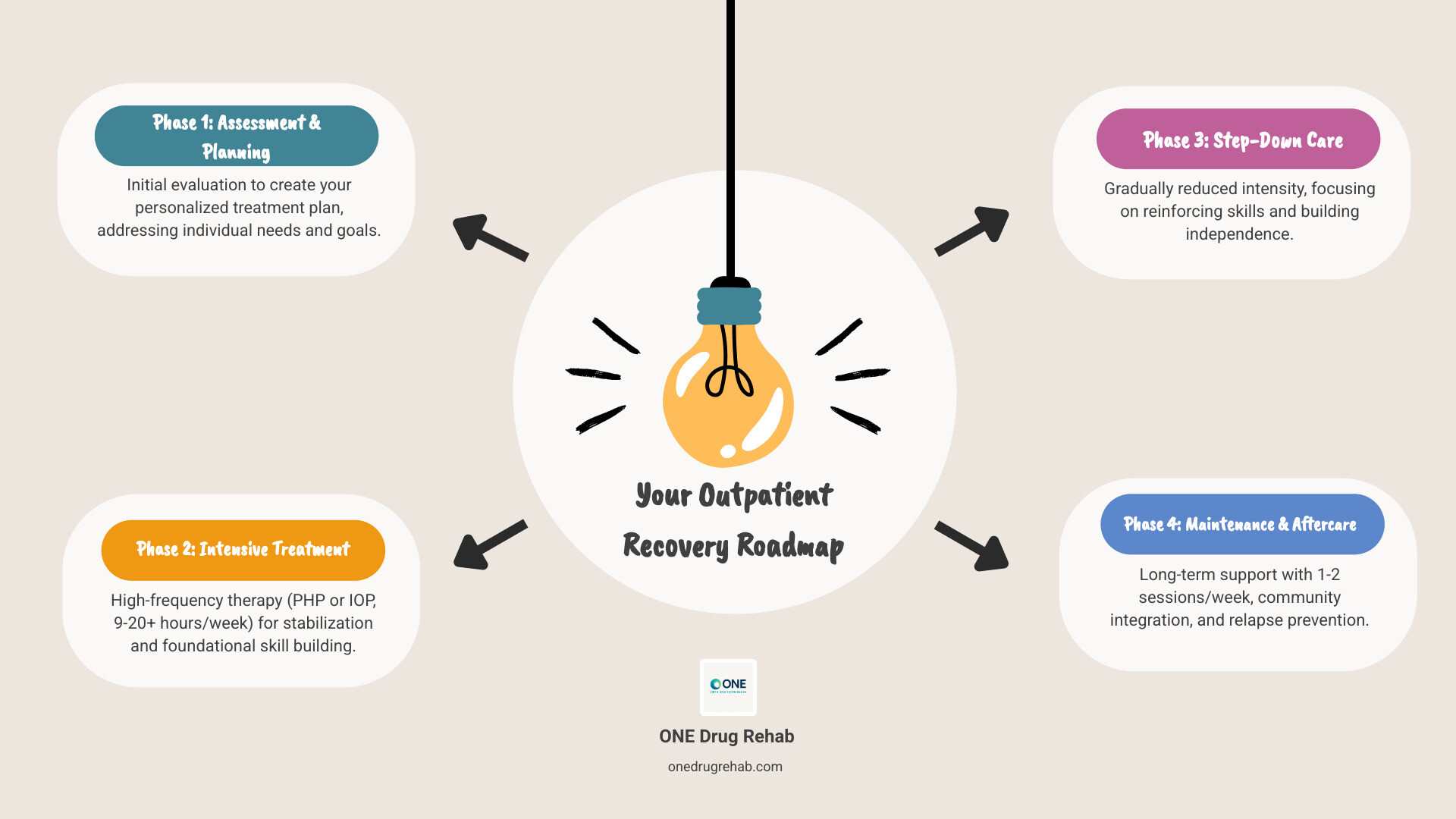
Different phases of outpatient rehab program definitions:
Stage 1: Comprehensive Assessment and Treatment Planning

The first stage in the different phases of outpatient rehab program is a comprehensive assessment. This is a collaborative process where your treatment team works to understand your unique situation, challenges, and strengths. Because every person’s story is different, this personalized approach is essential for effective treatment.
The Goals of Your Initial Assessment
Your initial assessment has several key goals:
- Determining the right level of care: An honest evaluation determines if outpatient treatment is the best fit or if a more intensive level of care is needed initially.
- Identifying co-occurring disorders: Many people with addiction also have depression, anxiety, or trauma. Addressing these simultaneously is crucial for success.
- Creating a baseline for measuring progress: This initial snapshot helps track and celebrate your progress throughout treatment.
The assessment covers your medical evaluation, psychiatric assessment, substance use history, and social circumstances (living situation, support system, work). Many facilities use The ASAM Criteria for addiction treatment to match people to the most appropriate level of care based on six key dimensions.
Creating Your Personalized Treatment Plan
After the assessment, you’ll collaborate with your treatment team (doctors, therapists, counselors) to create a personalized treatment plan. This plan is a dynamic roadmap for your recovery, designed to adapt as you grow and change.
Your plan will include short-term and long-term goals, ranging from completing your first week of treatment to rebuilding relationships and returning to work. It also involves matching therapies to your specific needs, incorporating group or individual therapy, family counseling, or trauma-informed care.
If you’re dealing with both addiction and mental health conditions, your plan integrates treatment for both. You can find More info about Co-occurring Disorder Treatment to better understand this comprehensive approach.
Your input is essential. The more open you are during this process, the better your treatment team can support you.
The Core Phases of an Outpatient Rehab Program

Once your treatment plan is in place, you’ll begin the heart of your recovery journey through the different phases of outpatient rehab program. This continuum of care is designed to help you develop the tools for lasting recovery while maintaining your daily responsibilities. You’ll start with intensive support and gradually step down as you build confidence and skills.
Phase 1: Intensive Treatment & Stabilization (Early Stage)
In this early phase, your primary focus is achieving and maintaining abstinence while building foundational skills. You’ll learn to manage cravings, identify personal triggers, and develop healthier coping strategies. Treatment commitment is high, typically 9-20+ hours per week, to help create new, healthy habits.
Two main options for this level of care are:
- Partial Hospitalization Programs (PHP): The highest level of outpatient care, also called “day treatment.” You attend programming for 5-6 hours a day, 5 days a week, and return home in the evenings.
- Intensive Outpatient Programs (IOP): Offering more flexibility, IOPs typically involve 3-4 hours of treatment, 3-5 days per week. This allows you to balance support with work, school, or family commitments.
Treatment includes individual counseling, group therapy, and psychoeducation about the disease of addiction. Skills training is also central, where you’ll learn to manage triggers for substance use and practice stress management. Therapies like Cognitive Behavioral Therapy (CBT) and Dialectical Behavior Therapy (DBT) help change thought patterns and regulate emotions. This phase can be challenging due to withdrawal and ambivalence, but your team will provide support. For additional stability, IOP Sober Living can be a helpful option.
Phase 2: Step-Down Care & Relapse Prevention (Middle Stage)
As you stabilize, you’ll transition to this middle phase, where the intensity decreases but the work continues. The focus shifts to reinforcing skills, addressing underlying issues, and relapse prevention. You’ll apply what you’ve learned in real-world situations while building long-term resilience.
Family therapy becomes important, helping to heal relationships and improve communication. For more information, see Rehab for Families. Vocational counseling can help you develop job skills and plan a return to work or school. If trauma is an underlying factor, trauma-informed care may be introduced to help you process past experiences.
Common challenges in this phase include complacency (letting your guard down) and Post-Acute Withdrawal Syndrome (PAWS), which can cause mood swings and sleep issues. Your treatment team will help you develop strategies to overcome them.
Phase 3: Maintenance & Aftercare (Late Stage)
This long-term recovery phase focuses on sustaining your progress and integrating into a healthy, sober lifestyle. Formal treatment is minimal (perhaps 1-2 sessions per week), and the focus shifts to your personal aftercare plan.
Recovery is a lifelong journey. The goal is to build a life so rich in purpose and connection that substances lose their appeal. Before completing your program, you’ll work on developing your aftercare plan, a blueprint for ongoing sobriety.
Key components of this phase include:
- Alumni programs: These provide a built-in community for graduates to share experiences and support each other.
- Support groups: Connecting with groups like Narcotics Anonymous (NA) offers structure, accountability, and peer support.
- Non-12-step alternatives: Programs like SMART Recovery offer different approaches focused on individual empowerment.
Challenges include managing long-term stress and avoiding complacency. Recovery is a chronic condition requiring lifestyle changes. This is also a time for continued personal growth, addressing deeper issues that could endanger your recovery. Holistic Education Programs can provide valuable opportunities for further development. Reaching this phase is a major achievement, and you are now equipped with the skills for continued success.
How Progress is Measured and Plans are Adapted

Recovery is not a straight line; it’s a dynamic process with ups and downs. The different phases of outpatient rehab program are designed with this flexibility in mind. Your treatment plan is an adaptable guide that changes with your evolving needs, ensuring you always have the right level of support.
Here’s how the intensity typically changes as you progress:
| Phase/Program Type | Hours/Week (Approx.) | Focus | Typical Duration (Approx.) |
|---|---|---|---|
| Partial Hospitalization (PHP) | 20+ | Intensive stabilization, skill-building, daily structure | 2-3 weeks to 30-90 days |
| Intensive Outpatient (IOP) | 9-15 | Skill reinforcement, addressing underlying issues, transition | 4-12 weeks |
| Standard Outpatient | 1-8 | Relapse prevention, community integration, ongoing support | Several months to years |
Tracking Your Success in Recovery
Success in recovery is more than just abstinence. Your treatment team looks at the whole picture of your well-being. Progress is measured by:
- Sustained abstinence and reduced cravings.
- Meeting therapy goals outlined in your treatment plan.
- Improved well-being, including better mental health and emotional regulation.
- Functional improvement in work, school, and relationships.
- Professional insights from therapists and your own sense of satisfaction with your progress.
Adjusting Your Treatment as You Grow
The phased approach is highly flexible. Your treatment plan is a living document that changes with you.
- Moving between phases: You can move from PHP to IOP to standard care as you gain stability. If you face challenges, the intensity can be temporarily increased to provide more support. This is responsive treatment, not a failure.
- Varying treatment duration: The length of treatment is custom to you. The frequency and duration of sessions can be adjusted to match your current needs.
- Adding specialized therapies: As you progress, you may be ready to address deeper issues like trauma or other mental health conditions, and specialized therapies can be integrated into your plan.
Research from NIDA shows that longer treatment is often linked to better outcomes and lower relapse rates. Continued engagement is crucial for long-term success. Understanding the More info about different Types of Addiction Treatment helps in making informed decisions about your ongoing care.
Frequently Asked Questions about the Different Phases of Outpatient Rehab Program
Navigating the different phases of outpatient rehab program can bring up questions. Here are answers to some common concerns.
How long does each phase of outpatient rehab last?
The duration of each phase is highly individual and depends on your specific needs, the severity of the addiction, and your progress. However, here are some general timelines:
- Assessment: Typically 1-2 sessions.
- Intensive Treatment (PHP/IOP): Can range from a few weeks to several months. A common duration for IOP is 4-12 weeks.
- Step-Down Care: Usually lasts several months as you transition to greater independence.
- Maintenance & Aftercare: This is an ongoing, lifelong phase. You might attend support groups or therapy sessions for years.
Your recovery happens on your timeline. Research shows that longer treatment often leads to better outcomes, so the process is never rushed.
What happens if I relapse during one of the phases?
Relapse is not a failure; it is a common part of the recovery process for many. Addiction is a chronic condition, and setbacks can happen.
If a relapse occurs, your treatment team will work with you to understand what happened and re-evaluate your treatment plan. This isn’t about starting over, but about learning and strengthening your recovery. It may involve:
- Temporarily increasing the intensity of care (e.g., stepping back up to IOP from standard outpatient).
- Identifying new triggers and developing stronger coping strategies.
- Recommitting to recovery with new insights and tools.
Working through a relapse can often make your long-term recovery even more resilient.
Can I start with a less intensive phase of outpatient rehab?
Yes, if it’s appropriate for your situation. Your initial assessment will determine the right starting level of care. A less intensive program, like standard outpatient care, may be suitable if you have a milder substance use disorder, a strong support system at home, and high motivation.
However, if your assessment indicates a need for more structure due to severe symptoms, co-occurring mental health issues, or an unsupportive environment, a more intensive program like PHP will be recommended. The flexibility of outpatient care means your level of support can always be adjusted to fit your needs.
Conclusion: Your Next Step on the Path to Recovery
Understanding the different phases of outpatient rehab program provides a clear roadmap for your journey. From assessment to aftercare, each stage is designed to build a foundation for lasting recovery, moving you from intensive support to independent sobriety.
Knowing what to expect sets realistic expectations and reduces uncertainty. This structured approach empowers you to be an active participant in your healing. Your recovery journey is unique, and taking the time you need is crucial, as longer engagement in treatment often leads to better outcomes.
At ONEDrugRehab.com, our goal is to provide clear, unbiased information to help you make the best decisions. As a third-party resource, we don’t endorse specific facilities but aim to arm you with the knowledge to find the right fit for your needs.
Taking the first step takes courage. Seeking help for yourself or a loved one is a sign of strength. Recovery is possible, and thousands of people successfully steer these phases every year to build fulfilling, sober lives.
Ready to explore your options? Explore your treatment options and begin your recovery journey today. Your future self will thank you for it.