

Rehab Cost Comparison: 5 Easy Steps
Why Understanding Rehab Costs Can Save Your Life and Money
A rehab cost comparison is essential for anyone seeking addiction treatment. Costs can range from under $1,000 for some outpatient programs to over $100,000 for luxury residential facilities.
Quick Cost Comparison:
- Outpatient Programs: $1,000 – $10,000 for 3 months
- Standard Inpatient: $5,000 – $20,000 for 30 days
- Luxury Residential: $30,000 – $100,000+ for 30 days
- Detox Only: $250 – $800 per day
According to the National Survey on Drug Use and Health, the inability to afford rehab is a primary reason why people who need help don’t receive it. This is tragic, as research shows that affordable outpatient programs are often the most cost-effective treatment modality.
In 2021, 46.3 million Americans had a substance use disorder, but only 4.1 million received treatment. Cost is a major barrier, even though the long-term financial and personal costs of addiction far outweigh treatment expenses.
The good news is that you don’t have to choose between financial stability and recovery. By comparing costs, understanding your options, and finding financial aid, quality treatment is more accessible than you think.
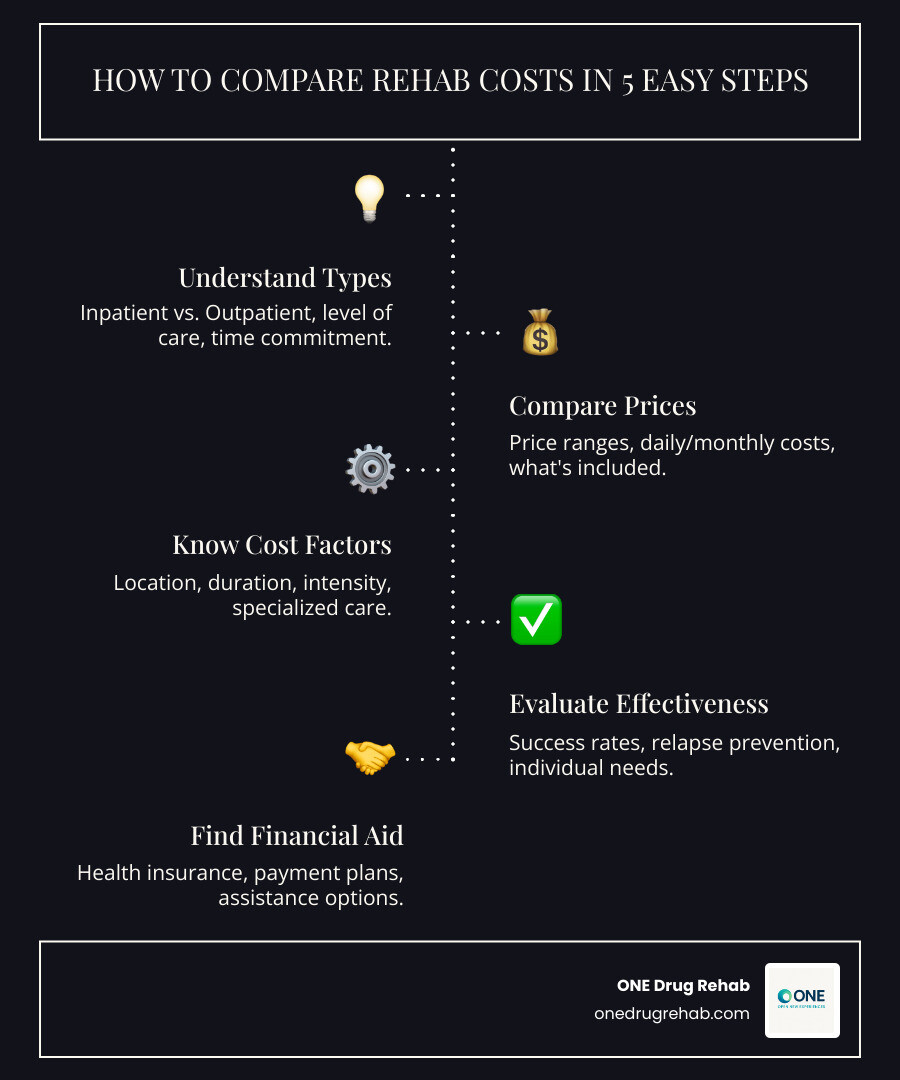
Step 1: Understand the Core Types of Rehab
Addiction treatment primarily falls into two categories: inpatient and outpatient rehab. They differ in their level of care, time commitment, living arrangements, and environment. Understanding these differences is the first step in a meaningful rehab cost comparison.

Inpatient (Residential) Rehab: The Immersive Approach
Inpatient, or residential, rehab offers an around-the-clock program where you stay in a facility overnight, allowing for a complete focus on recovery with 24/7 support. This immersive environment provides a structured routine of therapy, educational sessions, and recreational activities. For those needing medical supervision during detoxification, inpatient programs offer 24/7 medical and mental health support, which is crucial for safe withdrawal from substances like alcohol or opioids.
Pros of Inpatient Rehab:
- Fewer distractions: Away from temptations and negative influences.
- Intensive therapy: Consistent, high-level therapeutic interventions.
- 24/7 support: Medical and mental health professionals are always available.
- Dual diagnosis treatment: Equipped to treat co-occurring mental health conditions.
- High accountability: A structured framework for early recovery.
Cons of Inpatient Rehab:
- Higher cost: Comprehensive care comes at a higher price.
- Time commitment: Requires time off from work, school, or other duties.
- Less freedom: Daily life is highly regulated.
- Insurance limitations: Not all costs may be fully covered.
Inpatient programs typically last 30, 60, or 90 days, and are often recommended for those with severe addictions or unstable home environments.
Outpatient Rehab: Flexibility for Daily Life
Outpatient rehab integrates recovery into your daily schedule. You live at home and attend scheduled sessions at a facility, allowing you to maintain work, school, and family responsibilities. Sessions include individual and group therapy, counseling, and educational components with less intensity than inpatient programs.
Pros of Outpatient Rehab:
- Affordability: Significantly less expensive than inpatient care.
- Flexibility: Maintain work, school, and family life.
- Accessibility: Many communities offer local and online programs.
- Real-world practice: Apply coping skills in your daily environment.
Cons of Outpatient Rehab:
- Less support: No 24/7 medical or emotional support.
- Exposure to triggers: Daily stressors can pose a risk of relapse.
- Requires high motivation: Success depends on self-commitment.
- Limited detox support: Not suitable for withdrawals requiring 24-hour medical care.
Outpatient programs can last from a few months to over a year. They are generally suitable for individuals with mild to moderate addictions, a supportive home environment, or as a step-down from inpatient care.
Step 2: A Detailed Rehab Cost Comparison
Now that we’ve covered the types of rehab, let’s discuss the costs. Understanding these numbers is a key part of making a smart rehab cost comparison and planning for your recovery.

How Much Does Inpatient Rehab Typically Cost?
The immersive, 24/7 care of inpatient rehab includes room and board, meals, continuous medical and clinical care, therapy sessions (individual and group), and access to various amenities. Due to its comprehensive nature, prices vary significantly. A general inpatient program can cost from $2,000 to $40,000. A full residential stay often ranges from $8,000 to $111,000 per month, with many facilities averaging $20,000 to $65,000 monthly.
Luxury rehabs, which offer private rooms, gourmet dining, and spa services, can cost $80,000 or more for a 30-day stay, sometimes exceeding $120,000 per month. This is a significant investment for round-the-clock support in a dedicated healing environment.
How Much Does Outpatient Rehab Typically Cost?
Since you live at home, outpatient programs are generally more budget-friendly. Some basic programs may have a total cost of less than $1,000. However, costs vary by intensity. Standard programs are the most affordable. More structured Intensive Outpatient Programs (IOPs) can cost $500 to $650 a day, while Partial Hospitalization Programs (PHPs), which offer even more support, often cost $350 to $450 a day.
Despite these daily costs for intensive options, studies show outpatient drug-free programs are highly cost-effective. In 1990, the average cost for a client’s treatment was just $700, and about $6,300 for a successfully treated case. This makes outpatient care more cost-effective than inpatient ($15,600) or residential ($14,900) options for achieving sobriety. You can learn more here: The most cost-effective modality for successfully treated cases.
Here’s a quick comparison to make your rehab cost comparison easier:
| Feature | Inpatient (Residential) Rehab | Outpatient Rehab |
|---|---|---|
| Level of Care | 24/7 supervision, highly structured, intensive medical and therapy | Scheduled sessions, flexible, less direct supervision |
| Living | Reside at the facility | Live at home, commute to sessions |
| Typical Duration | 30-90 days (can be up to 6 months) | 2 months to over a year (often longer than inpatient) |
| Average Cost Range | $2,000 – $40,000 (general); $8,000 – $111,000/month (residential) | Less than $1,000 (basic); $1,400 – $10,000 (30-day general program) |
| Best For | Severe addictions, co-occurring disorders, unstable home environments | Mild to moderate addictions, strong home support, need for flexibility |
Step 3: Identify Key Factors That Influence Rehab Prices
When doing a rehab cost comparison, you’ll find that there’s no single price tag. Costs vary dramatically based on what’s included in the treatment package, as every person’s journey is unique and requires a customized plan.

Individual requirements directly impact the final cost. What works for mild alcohol dependency differs from what’s needed for severe opioid addiction with depression.
How Location and Amenities Impact Your Rehab Cost Comparison
Location plays a huge role in rehab pricing. A facility in Malibu will cost more than one in a rural area due to factors like staff salaries and property costs. The biggest price gap, however, is between luxury and standard facilities. Luxury rehabs offer resort-like features such as private rooms, gourmet meals, swimming pools, spas, and equestrian therapy.
Many high-end facilities include holistic therapies (yoga, acupuncture, massage) and extensive recreational facilities as part of their standard package. While these amenities don’t necessarily make treatment more effective, they provide comfort that can help some individuals focus on recovery. These perks significantly increase the price, sometimes to over $100,000 per month.
Program Duration and Intensity
The length of stay is a straightforward cost factor: more time costs more money. However, a longer stay may be more cost-effective long-term. While a 30-day program may seem cheaper, The National Institute on Drug Abuse suggests most individuals need at least 90 days for lasting recovery.
Why? Studies show that longer treatment times are linked to better outcomes. A 90-day program might cost more upfront, but if it prevents relapse, you avoid the cost of repeated treatment.
Medically-assisted detox adds to both duration and cost, typically ranging from $250 to $800 per day. This phase is essential and can be life-saving for withdrawal from substances like alcohol or benzodiazepines. The level of therapy also impacts price, with programs heavy on individual therapy costing more than those focused on group sessions.
Specialized Care and Staff Credentials
Personalized treatment for co-occurring mental health conditions, known as dual-diagnosis treatment, is another key cost factor. This integrated approach treats addiction alongside conditions like depression or PTSD. These programs require specially trained staff and are more expensive but are often essential for lasting recovery.
The staff-to-patient ratio also affects cost. A lower ratio means more individualized attention at a higher price. Similarly, the credentials of therapists and doctors influence pricing, as board-certified specialists command higher salaries. Some facilities offer specialized tracks for groups like veterans or executives, which can be more effective for those populations but also more costly.
Step 4: Evaluate Effectiveness vs. Cost-Effectiveness
For addiction recovery, the goal isn’t finding the cheapest option, but the best value for your recovery—a program that leads to long-term sobriety. This means looking at success rates, relapse prevention, and your individual needs, not just the immediate price tag.
Is Cheaper Always Better? A Look at the Rehab Cost Comparison for Long-Term Success
As mentioned, outpatient drug-free programs are often the most cost-effective modality, offering a great return on investment. However, “cost-effective” doesn’t always mean “best for your situation.” For someone with a severe addiction, an unstable home environment, or significant co-occurring mental health issues, a less intensive program may not provide enough support.
In these cases, inpatient rehab, though pricier upfront, can be more cost-effective long-term by preventing relapse and its associated costs (medical emergencies, legal issues, lost jobs). Investing in the right level of care from the start is crucial. Relapse rates for addiction are 40-60%, similar to other chronic diseases. Relapse isn’t failure; it’s a sign that treatment needs adjustment. Investing in appropriate care and follow-up can reduce the frequency and severity of relapse, as research shows longer treatment times are linked to a more successful recovery.
Furthermore, every dollar invested in treatment yields an estimated $7 reduction in future health and social costs. The cost of untreated addiction in the U.S. is about $600 billion annually, making any rehab program’s price seem small by comparison.
How to Choose the Right Program for Your Needs
Finding the balance between cost and effectiveness starts with understanding your specific needs.
- Get a professional assessment. This is the most crucial step. A doctor or addiction specialist can assess the severity of your addiction and recommend the appropriate level of care, providing an informed basis for your rehab cost comparison.
- Consider severity and co-occurring conditions. If your addiction is severe or you have a dual diagnosis, inpatient treatment may be the most effective choice, leading to better long-term outcomes.
- Evaluate your home support system. A stable, supportive home may be suitable for outpatient care. If your home life is unstable or full of triggers, the protective environment of inpatient rehab might be essential.
- Be realistic about your finances. Once you have a professional recommendation, you can explore how to make that level of care affordable. The goal is to find ways to afford the right type of care, not let cost dictate the type of care.
- Consider a combination approach. Many find success by starting with inpatient treatment for stability and then transitioning to outpatient care for ongoing support. This hybrid model can offer the best of both worlds.
Step 5: Explore Financial Aid and Insurance Options
The cost of rehab can feel overwhelming, but many options exist to make treatment affordable. This final step in our rehab cost comparison focuses on financial aid and insurance to help reduce out-of-pocket expenses.
Using Health Insurance to Cover Costs
Your health insurance is a primary resource for covering rehab costs. Key legislation has made addiction treatment more accessible.
The Affordable Care Act (ACA) designated substance use disorder treatment as an “essential health benefit,” meaning most health plans must cover it. The Mental Health Parity and Addiction Equity Act (MHPAEA) ensures that coverage for addiction is comparable to that for physical health conditions.
Always check if a facility is in-network with your insurance, as this typically means lower costs. Going out-of-network can be significantly more expensive.
Verifying Your Benefits is a critical step. Call your insurer or use their online portal to ask about:
- Your deductible, copayments, and coinsurance.
- Your out-of-pocket maximum.
- Any pre-authorization requirements.
- Coverage for specific services like inpatient, outpatient, detox, and medication-assisted treatment (MAT).
Public insurance like Medicaid and Medicare also covers substance abuse treatment. Medicare covers outpatient care and inpatient stays for up to 90 days per benefit period, and Medicaid coverage has expanded significantly under the ACA.
Finding Financial Assistance and Payment Options
Even with insurance, you may have remaining costs. Don’t let this stop you from seeking help.
Many rehab centers offer flexible payment plans or sliding-scale fees based on your income. Check with your employer about Employer Assistance Programs (EAPs), which may offer confidential referrals and cover some costs.
Look for grants and scholarships from nonprofit groups and some facilities, such as the 10,000 Beds Scholarship Program. Personal savings or loans can be another option, though caution is advised with credit.
Nonprofit and state-funded programs often provide free or low-cost treatment, though they may have waitlists or eligibility requirements. Free community support groups like Alcoholics Anonymous (AA), Narcotics Anonymous (NA), and SMART Recovery offer invaluable ongoing support.
The most important takeaway is not to let perceived cost stop you from seeking help. The long-term costs of addiction far outweigh any treatment expense. At ONEDrugRehab.com, we believe recovery is possible for everyone and can help you explore options to make treatment more affordable.
Frequently Asked Questions about Rehab Costs
Navigating a rehab cost comparison can bring up many questions. Here are answers to some of the most common ones.
How do I choose the right rehab program for my situation?
The most important first step is to get a professional assessment from a doctor or addiction specialist. They can evaluate the severity of your substance use, identify any co-occurring conditions, and assess your home support system. With their expert recommendation, you can use this guide to compare the pros, cons, and costs of different options like inpatient versus outpatient care to find the best fit for your needs.
Does insurance cover the full cost of rehab?
Coverage varies significantly by plan, and it’s rare for insurance to cover the entire cost. You will likely have out-of-pocket expenses like deductibles, copays, or coinsurance. However, thanks to the Affordable Care Act (ACA) and MHPAEA, most plans, including Medicaid and Medicare, are required to cover essential services for substance use disorder. The extent of coverage differs, so it is crucial to verify your specific benefits with your insurance provider before starting treatment to understand your financial responsibilities.
Are there affordable rehab options available?
Yes, many affordable options exist beyond luxury facilities. Many centers offer sliding-scale fees based on income or flexible payment plans. You can also look for scholarships or grants from various organizations. State-funded programs and community health clinics provide low-cost or free treatment, though they may have waitlists. Additionally, free support groups like Alcoholics Anonymous (AA), Narcotics Anonymous (NA), and SMART Recovery offer vital, ongoing community support for recovery.
Conclusion
Starting on addiction recovery is a courageous decision. While a rehab cost comparison is a critical first step, the true cost of untreated addiction—to your health, relationships, and finances—is far greater. Our goal is to empower you to balance quality care with financial feasibility.
Recovery is an investment in your future, and cost should not be a barrier to the life you deserve. You don’t have to take this next step alone.

At ONEDrugRehab.com, we are committed to providing general, non-affiliated information to help you research treatment options. Find the right treatment option for you in our non-affiliated directory.