

The Power of the Group in Healing
Evidence based group therapy is a treatment approach where multiple people meet regularly with trained therapists to work on mental health or substance use issues, using methods that have been scientifically tested and proven effective. This form of therapy combines peer support with structured, research-backed techniques to help people recover.
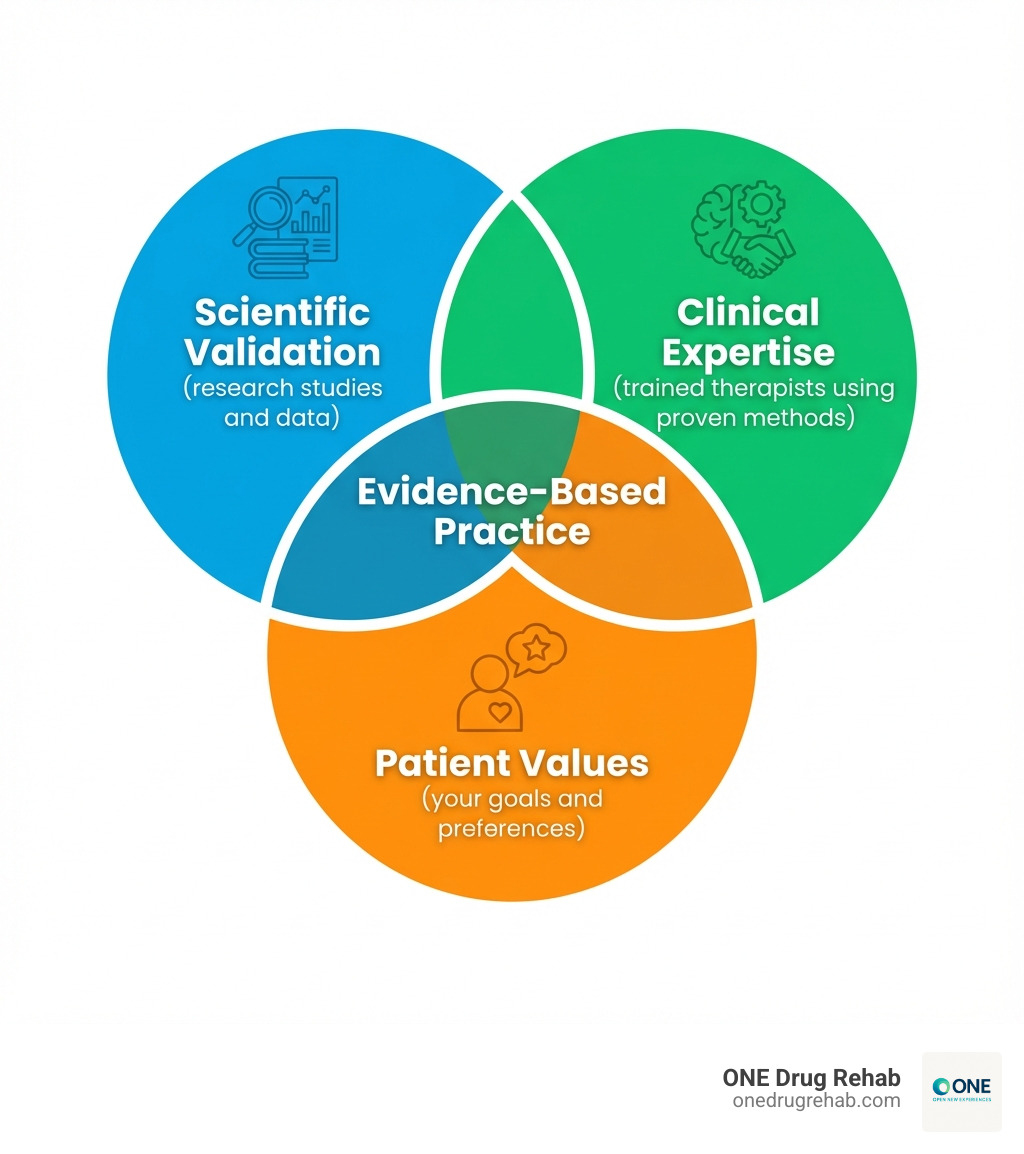
Quick Answer: What Makes Group Therapy Evidence-Based?
- Scientific Validation: Treatment methods tested through rigorous research studies
- Clinical Expertise: Therapists trained in specific, proven techniques
- Patient Preferences: Your values and goals guide treatment choices
- Measurable Outcomes: Progress tracked using standardized tools
- Structured Approach: Clear treatment manuals and protocols
If you’re exploring treatment options for yourself or a loved one, understanding evidence-based group therapy matters because it’s what the Substance Abuse and Mental Health Services Administration (SAMHSA) calls a “Triple-E” treatment: Effective, Equivalent to individual therapy, and Efficient in terms of cost and access.
The numbers tell a compelling story. Research shows that meeting unmet mental health needs with group therapy instead of individual sessions could save over $5.6 billion and require 34,473 fewer therapists. If just 10% of current needs were met through group therapy, 3.5 million more people could receive treatment.
Why Group Therapy Works
Group therapy offers something individual therapy cannot: the power of shared experience. When you sit in a room (or virtual space) with others facing similar struggles, isolation melts away. You realize you’re not alone.
The benefits go beyond just feeling understood:
- Peer Support: Others who truly get what you’re going through
- Reduced Stigma: Normalizing struggles instead of hiding them
- Multiple Perspectives: Learning from others’ successes and setbacks
- Real-Time Practice: Trying new social and coping skills in a safe space
- Hope: Seeing others further along in recovery
Despite being recognized as an effective treatment, group therapy remains underused. It makes up only about 5% of treatment in private practice, with 95% of resources going to individual therapy. Yet for conditions like depression, anxiety, PTSD, substance use disorders, and many others, research consistently shows group therapy works just as well as one-on-one treatment.
The American Psychological Association only recognized group psychology and group psychotherapy as a formal specialty in 2018. This means many mental health professionals received limited training in group methods during their education–but that’s changing as the evidence base continues to grow stronger.
Evidence based group therapy terms to learn:
- group therapy addiction
- how does group therapy help addiction
- what does group therapy in addiction entail
What is Evidence-Based Group Therapy and How Does It Work?
At its heart, evidence based group therapy is about using what science tells us works. It’s not just about getting a bunch of people in a room to talk; it’s about a carefully structured process guided by proven methods. This approach is designed to maximize the therapeutic benefits for every member, helping them achieve lasting change and recovery.
The core principles of evidence based group therapy for substance use and mental health disorders revolve around integrating empirical research with clinical expertise and patient values. This means the therapy models we use have been rigorously tested and shown to be effective.
Our approach also recognizes the crucial role of the therapeutic factors unique to group settings. Irvin Yalom, a pioneer in group psychotherapy, identified several key therapeutic factors that make groups so powerful. These include:
- Universality: Realizing you’re not alone in your struggles, thoughts, or feelings. It’s incredibly validating to hear someone else voice something you thought only you experienced.
- Altruism: Helping others in the group, which can boost your own self-esteem and sense of purpose. It’s often said that in helping others, we help ourselves.
- Instillation of Hope: Witnessing others recover and improve, which gives new members optimism and belief in their own potential for change.
- Imparting Information: Learning about your condition, treatment strategies, and coping mechanisms from both the therapist and peers.
- Corrective Recapitulation of Primary Family Experience: The group can become a “social microcosm” where old family dynamics are re-enacted, allowing members to address and resolve past conflicts in a safer, more supportive environment.
- Development of Socializing Techniques: Practicing new social skills, communication, and conflict resolution in a safe, controlled setting.
- Imitative Behavior: Learning by observing and modeling the healthy behaviors and coping strategies of others in the group.
- Cohesiveness: The sense of belonging, acceptance, and mutual support within the group. This is often considered one of the most important predictors of positive outcomes in group therapy. When a group feels truly cohesive, members feel safe enough to take risks and be vulnerable.
- Existential Factors: Confronting fundamental issues of existence like life, death, freedom, responsibility, and isolation, often leading to a deeper understanding of oneself and purpose.
- Catharsis: The release of strong emotions, often followed by a sense of relief and a clearer perspective.
- Interpersonal Learning (Input and Output): Receiving feedback from others on your behavior (input) and learning to express yourself effectively (output).
- Self-Understanding: Gaining insight into your own patterns of behavior, thoughts, and feelings through interactions with others.
These factors don’t just happen randomly. They are carefully nurtured by a competent therapist who understands group dynamics and guides the group through predictable stages of development:
- Forming/Preaffiliation: The initial stage where members are getting to know each other, establishing trust, and figuring out their place in the group. There’s often some anxiety and dependence on the leader.
- Storming/Power and Control: As comfort grows, members may start challenging the leader or other members, leading to conflicts and struggles over control. This stage, though sometimes uncomfortable, is crucial for growth. Our therapists are skilled at navigating these moments, turning conflict into an opportunity for learning.
- Norming/Intimacy: The group establishes its own norms, roles, and unspoken rules. There’s an increased sense of cohesion, trust, and intimacy, allowing for deeper personal sharing.
- Performing/Differentiation: The group becomes a productive unit where members work through their issues, offer support, and engage in meaningful change. Individual differences are celebrated, and members feel empowered.
- Adjourning/Separation: The final stage, where the group prepares for termination. Members process feelings of loss, review their progress, and plan for maintaining changes outside the group.
For more information on the broader context of mental health support, you might want to explore our More info about behavioral health treatment.
Core Principles of Evidence-Based Group Therapy
The foundation of any effective evidence based group therapy lies in its adherence to specific principles that ensure its efficacy and ethical delivery. These aren’t merely suggestions; they are the bedrock upon which successful treatment is built.
- Scientific Validation: This is paramount. We rely on treatment methods that have been rigorously tested through scientific research, particularly randomized controlled trials (RCTs) and meta-analyses. These studies demonstrate that the interventions we use actually work for the conditions they target. For instance, the EBGT website, developed by the APA’s Society of Group Psychology and Group Psychotherapy, the American Group Psychotherapy Association (AGPA), and the German Health Ministry, is dedicated to summarizing empirically supported group treatments for various disorders.
- Use of Treatment Manuals: Many evidence based group therapy models come with structured treatment manuals. These manuals outline the specific techniques, exercises, and session content, ensuring consistency and fidelity across different therapists and groups. This doesn’t mean therapists are robots; rather, it provides a clear roadmap, allowing for effective delivery while still adapting to individual group needs. For example, the Group Therapy Manual for Cognitive-Behavioral Treatment of Depression evolved from research manuals to provide a structured 12-session format.
- Therapist Training and Fidelity: Even the best manual is only as good as the person delivering it. Our therapists receive specialized training in these evidence-based models, ensuring they can implement them with fidelity. This means they stick to the core components of the treatment while also skillfully adapting to the unique dynamics of each group. The APA’s recognition of group psychology as a specialty in 2018 underscores the importance of this specialized training.
- Routine Outcome Monitoring: We don’t just hope for the best; we track progress. Routine outcome monitoring involves systematically collecting data on how group members are doing throughout their treatment. This feedback helps us identify what’s working, what isn’t, and allows for timely adjustments to the treatment plan. It’s a crucial component of practice-based evidence, ensuring we’re always striving for the best outcomes.
- The Therapeutic Relationship: While structured protocols are important, the human connection is indispensable. The therapeutic relationship–including factors like group cohesion, the alliance between members and with the therapist, and the overall group climate–is a powerful predictor of positive outcomes. In fact, research suggests that the therapeutic relationship can explain as much improvement in group therapy as the treatment protocol itself. Our therapists are skilled at fostering a safe, supportive, and cohesive environment where genuine connection can flourish. You can dig deeper into the importance of this relationship in resources like Recent Developments in Group Psychotherapy Research.
Common Models Used in Evidence-Based Group Settings
Just as there are many roads to recovery, there are many types of evidence based group therapy models, each designed to address specific needs and conditions. Here are some of the most common and effective approaches we use and support:
- Cognitive Behavioral Therapy (CBT) Groups: CBT is a cornerstone of many group therapies. It helps members identify and change unhelpful thinking patterns and behaviors that contribute to their mental health or substance use issues. In a group setting, members can practice new coping skills, challenge distorted thoughts, and receive feedback from peers. CBT is effective for a wide range of conditions, including depression, anxiety, and substance use disorders.
- Motivational Interviewing (MI) Groups: MI is a client-centered approach that helps individuals explore and resolve ambivalence about behavior change. In a group, members can share their motivations for change, discuss barriers, and support each other in setting and achieving recovery goals. It’s particularly useful for those in earlier stages of contemplating change.
- Seeking Safety Groups: This is a present-focused, coping skills group therapy for individuals with a history of trauma and/or substance use disorder. It helps members attain safety from both trauma and substance abuse by focusing on topics like safety, coping skills, self-care, and healthy relationships.
- Trauma-Focused Cognitive Behavioral Therapy (TF-CBT) Groups: Specifically designed for children and adolescents who have experienced trauma, TF-CBT in a group setting helps them process traumatic memories, learn coping skills, and address related emotional and behavioral problems. Group members find solidarity and support from peers who share similar experiences.
- Social Skills Training (SST) Groups: Many mental health conditions and substance use disorders can impair social functioning. SST groups help members learn and practice essential social skills, such as communication, assertiveness, and conflict resolution, in a safe and supportive environment. This is particularly effective for conditions like schizophrenia, depression, and for adolescents struggling with peer interactions.
- Dialectical Behavior Therapy (DBT) Groups: Often used for individuals with borderline personality disorder, chronic suicidality, or severe emotional dysregulation, DBT groups focus on teaching skills in mindfulness, distress tolerance, emotion regulation, and interpersonal effectiveness. It’s a comprehensive approach that can include individual therapy, skills training groups, and phone coaching.
- Matrix Model Groups: This intensive outpatient treatment model is particularly effective for stimulant use disorders. It combines elements of CBT, family education, individual counseling, and group therapy, including social-support groups, to provide a structured path to recovery.
- Psychoeducational Groups: These groups provide members with essential information about their condition, its causes, symptoms, and treatment options. They empower individuals with knowledge, helping them understand their experiences and make informed decisions about their recovery journey.
- Skills Development Groups: Beyond specific therapeutic models, many groups focus on teaching practical life skills necessary for sustained recovery, such as stress management, relapse prevention strategies, financial management, and effective communication.
- Interpersonal Process Groups: These groups focus on the “here and now” interactions between members, helping them understand their relational patterns, address interpersonal difficulties, and develop healthier ways of relating to others.
For a deeper dive into how these and other group therapies are specifically applied in the addiction treatment, check out our guide: More info about group therapy for addiction.
Group vs. Individual Therapy: A Comparative Look
When considering therapy, one of the first questions many people ask is whether to pursue individual or group sessions. Both are incredibly valuable, but they offer distinct experiences and benefits. Let’s compare them to help you understand which might be the best fit for your journey.
| Feature | Group Therapy | Individual Therapy |
|---|---|---|
| Key Benefits | – Community and support: Offers a built-in support system. Hearing from others with similar struggles reduces feelings of isolation and shame. |
- Diverse perspectives: Members can offer different insights and suggestions that you or a single therapist might not have considered.
- Social skills lab: Acts as a safe space to practice social interactions, communication, and conflict resolution skills in real time.
- Cost-effective: Generally more affordable than individual therapy, making long-term treatment more accessible.
- Instills hope: Seeing others progress and overcome their challenges can be motivating and inspiring. | – Personalized focus: The entire session is dedicated to you, your concerns, and your goals.
- Pace control: You and your therapist control the pace of the therapy, spending as much time as needed on specific topics.
- Privacy: Offers a high level of confidentiality and privacy, which can be comforting for those discussing sensitive topics.
- Flexibility: Scheduling is often more flexible, and the therapy can be precisely custom to your individual needs. |
| Potential Drawbacks | – Less individual attention: The therapist’s time is divided among all group members, so you will not receive the same level of one-on-one focus. - Confidentiality concerns: While confidentiality is a strict rule, there is always a risk that other members may not respect it.
- Social anxiety: For those with severe social anxiety, a group setting can initially be intimidating or overwhelming.
- Group pace: The group moves at a collective pace, which might be too fast or too slow for some individuals. | – Higher cost: Typically more expensive per session than group therapy.
- Lack of peer perspective: You miss out on the diverse viewpoints and shared experiences that a group setting provides.
- Possible isolation: Can sometimes reinforce feelings of being alone in your struggles, as you do not have the immediate connection with others facing similar issues.
- Limited social practice: You can discuss social skills, but you cannot practice them in a real-time, multi-person dynamic. |
| Effectiveness and Access | – Research shows group therapy is as effective as individual therapy for many conditions, including depression, anxiety, and substance use disorders. - Often more accessible because it is cost-efficient and allows treatment centers to serve more people.
- Can help reduce stigma by normalizing conversations about mental health and addiction. | – Equally effective for many of the same conditions when evidence-based approaches are used.
- Especially helpful when someone needs intensive, individualized attention (for example, during a crisis or when addressing complex trauma).
- Preferred by some people who value privacy or are not yet ready to share in a group. |
Many people benefit from a combination of both individual and group therapy. Individual sessions can address deeply personal issues, while group sessions provide community and a space to practice new skills. This dual approach is often used in comprehensive treatment programs.
For a deeper dive into how group therapy compares to individual therapy, especially in the context of addiction, see our guide on how group therapy helps addiction.
When to Choose Group Therapy
Group therapy is an excellent choice if you:
- Feel isolated in your struggles and want to connect with others who understand.
- Want to improve your social and interpersonal skills in a safe environment.
- Are looking for a more affordable treatment option.
- Benefit from hearing different perspectives and learning from the experiences of others.
- Are working on relapse prevention or maintaining recovery and want ongoing peer support.
When Individual Therapy Might Be Better
Individual therapy might be a better starting point if you:
- Are dealing with a severe trauma or a crisis that requires one-on-one attention.
- Feel extremely uncomfortable or anxious in social settings.
- Have specific, deeply personal issues you are not ready to share in a group.
- Need a highly flexible schedule or a customized pace of treatment.
- Are experiencing severe symptoms that make participation in a group difficult at first.
The best choice depends on your unique situation. Many people find that a combination of both offers the most comprehensive support. It is always a good idea to discuss your options with a mental health professional to determine the right path for you. For more information on different treatment approaches, explore our resources on behavioral health treatment.
Group vs. Individual Therapy: A Comparative Look
Deciding between individual and group therapy is a common dilemma. Both are incredibly valuable, but they offer distinct experiences and benefits. Let’s compare them to help you understand which might be the best fit for your journey.
| Feature | Group Therapy | Individual Therapy |
|---|---|---|
| Focus of Treatment | Emphasizes peer support, shared experience, and learning in a social context. Members work on issues while interacting with others who have similar challenges. | Emphasizes one-on-one work custom to your specific history, symptoms, and goals, with all time focused on you. |
| Format | Multiple participants meet together with one or more trained therapists on a regular schedule. | You meet individually with a therapist for sessions scheduled around your needs. |
| Best For | People who want connection, feedback from peers, and a space to practice new skills in real time. | People who prefer privacy, need intensive individualized support, or are not yet ready for a group setting. |
In the sections above, you can see more detail on how these options differ in terms of benefits, drawbacks, and when each might be most appropriate. Many treatment plans combine both approaches so you can benefit from the strengths of each.