

Understanding Dual Recovery: When Addiction Meets Mental Illness
Dual recovery support groups provide specialized peer support for individuals facing both substance use disorders and mental health conditions—a situation affecting between 29% and 59% of people with either condition in the United States.
Quick Guide to Finding Dual Recovery Support Groups:
- Contact ONE Drug Rehab directly for integrated treatment programs with built-in group support
- Call SAMHSA’s National Helpline at 1-800-662-HELP (4357) for confidential treatment referrals
- Search online directories like the Dual Recovery Anonymous (DRA) meeting finder at draonline.org
- Ask your current treatment provider for recommendations and referrals
- Explore virtual options if in-person meetings aren’t available in your area
When you’re dealing with both addiction and a mental health condition like depression, anxiety, or PTSD, traditional single-focus support groups often fall short. You might feel judged for taking psychiatric medications at an AA meeting, or uncomfortable discussing substance use in a mental health support group.
This is where dual recovery support groups make a difference. They create a space where both conditions are understood and addressed together—not as separate problems, but as interconnected challenges that require integrated support.
Research shows that participation in specialized dual-recovery mutual aid groups is associated with less substance use, reduced mental health distress, and higher levels of personal well-being. The extent of support you receive—support that actually matches your needs—becomes one of the strongest predictors of successful recovery.
Yet many people struggling with co-occurring disorders feel isolated and overwhelmed. They may not even know that specialized support exists, or where to find it.
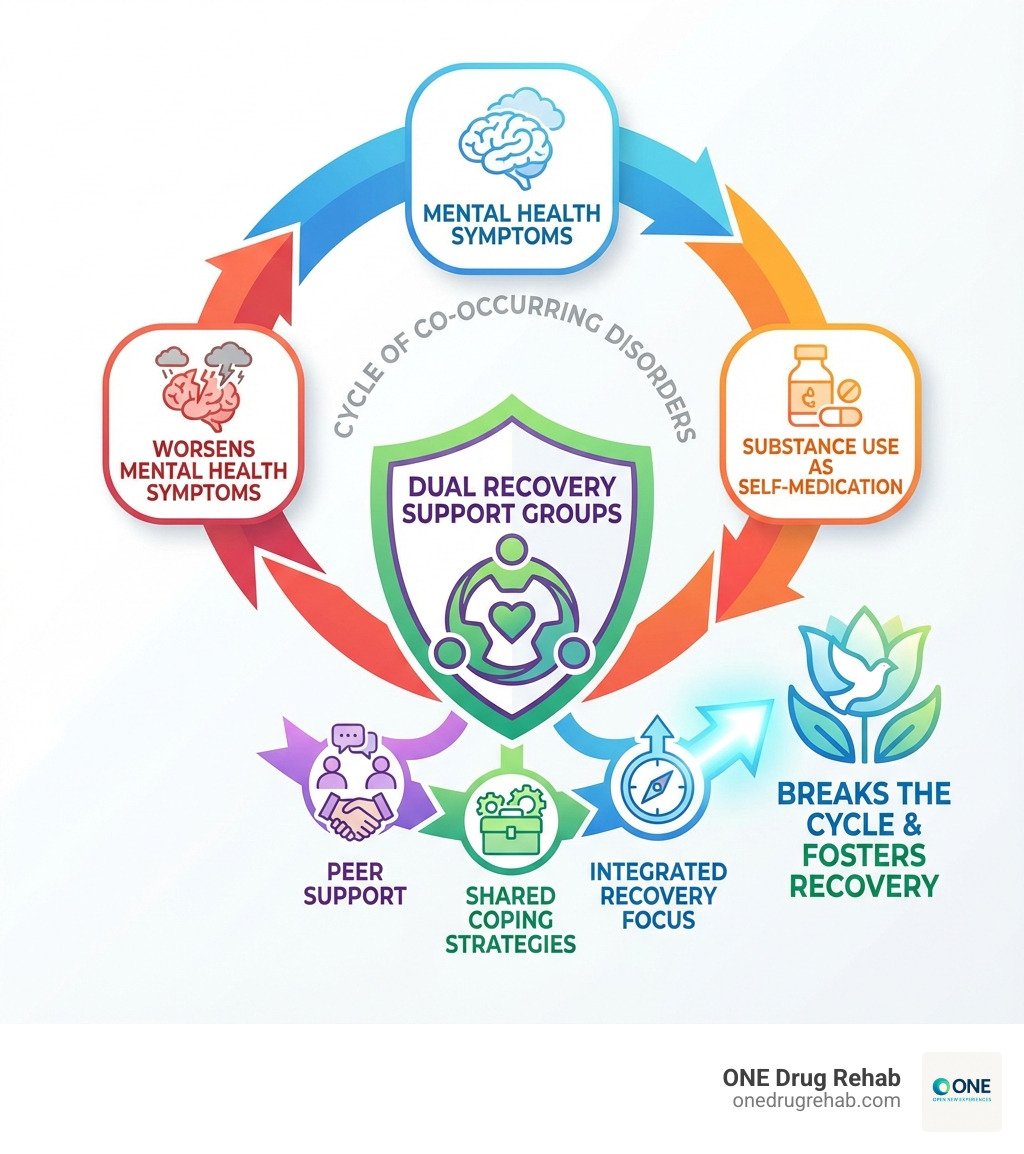
Dual recovery support groups terms simplified:
The Power of Shared Experience: Why Peer Support is Crucial for Recovery

When we face the complex challenges of a dual diagnosis—where a substance use disorder co-occurs with a mental health condition—the journey to recovery can feel particularly daunting. The rate of co-occurring substance abuse and mental health disorders in the United States is significant, ranging between 29% and 59%. This means millions of us are navigating a path where the symptoms of one condition can exacerbate the other, creating a difficult cycle to break. It’s not just about overcoming addiction or managing mental health; it’s about doing both simultaneously, often while struggling with stigma, discrimination, low self-esteem, and practical obstacles like housing or financial insecurity. The stress of change and recovery can be compounded by cognitive impairment, emotional lability, and the side effects of prescribed medications.
This is precisely why peer support becomes not just beneficial, but absolutely crucial. Peer support offers a unique form of understanding and validation that professional treatment, while essential, cannot always provide. It’s the experience of connecting with others who genuinely “get it” because they’ve walked a similar path.
Research consistently highlights the profound impact of this shared experience. Studies have shown that participation in dual recovery support groups is associated with a reduction in both substance use and mental health distress, alongside higher levels of personal well-being. In fact, the extent of support individuals receive from people in their lives emerges as the strongest correlate of personal well-being. This suggests that the more support we perceive, and the more frequently we engage with mutual aid groups, the fewer mental health symptoms and less substance use we experience, leading to a greater sense of overall well-being.
Peer support groups act as a vital buffer, helping us better steer the daily difficulties that arise in recovery. They provide a safe space to share vulnerabilities, celebrate successes, and learn from the collective wisdom of those who truly understand. This environment fosters hope, reminds us that we are not alone, and helps us build a sober social network—a critical component for long-term recovery.
For more scientific insights into the importance of social support, you can explore scientific research on the role of social support in recovery.
How support groups help individuals feel less isolated
One of the most insidious aspects of dual diagnosis is the profound sense of isolation it can create. We might feel misunderstood by friends and family who don’t grasp the intertwining nature of our struggles. We might withdraw due to shame, fear of judgment, or simply the overwhelming nature of our symptoms. Dual recovery support groups directly combat this isolation by offering:
- Shared Understanding: In these groups, we find people who have similar feelings and worries about co-occurring disorders. This immediate common ground creates an atmosphere of understanding, where we don’t have to explain every nuance of our experience.
- Empathy: The empathy we receive in a peer group is powerful. It comes from a place of lived experience, not just theoretical knowledge. This deep empathy helps us feel truly seen and heard.
- Validation of Experiences: Often, we might question our own perceptions or feel like our struggles are unique and therefore impossible. Hearing others articulate similar challenges and coping mechanisms provides immense validation, reinforcing that our experiences are real and shared.
- Sense of Belonging: This shared understanding naturally leads to a sense of belonging. We become part of a community where our dual diagnosis is not a barrier but a bond. This feeling of being part of something bigger than ourselves is incredibly healing.
- Combating Stigma: By openly discussing our mental health and substance use challenges in a supportive environment, we actively work to dismantle internal and external stigma. We learn that these are “no-fault illnesses,” as Dual Recovery Anonymous (DRA) often states, and that recovery is possible.
Strategies learned from dual recovery support groups
Beyond emotional support, dual recovery support groups are practical powerhouses, offering a wealth of strategies and tools for managing co-occurring disorders. Members share what works for them, creating a rich learning environment. We can learn:
- Relapse Prevention Techniques: Peers share personal insights into triggers, early warning signs, and effective strategies to prevent relapse in both substance use and mental health symptoms. This might include identifying stress coping mechanisms that don’t involve substances, or recognizing patterns that precede a mental health downturn.
- Medication Management Tips: For many of us, psychiatric medications are a vital part of managing our mental health. In these groups, we can discuss experiences with different medications, learn strategies for consistent adherence, and understand how to advocate for ourselves with healthcare providers. This is a critical distinction from single-focus groups where medication might be discouraged or misunderstood.
- Healthy Communication Skills: Recovery often involves repairing relationships and establishing new, healthier boundaries. Peer groups provide a safe space to practice communicating our needs and feelings effectively, learning from others’ successes and challenges.
- Stress Reduction Methods: Living with a dual diagnosis can be inherently stressful. Group members often share various stress reduction techniques—from mindfulness and meditation to exercise and creative outlets—that have helped them maintain balance.
- Goal Setting: Seeing others set and achieve recovery goals can be incredibly motivating. We learn to break down our recovery journey into manageable steps, celebrate small victories, and hold each other accountable in a supportive way.
Exploring Dual Recovery Support at ONE Drug Rehab

At ONE Drug Rehab, we understand that recovery from a dual diagnosis requires an integrated and comprehensive approach. It’s not enough to treat the addiction in isolation or to address mental health without considering substance use. Our philosophy centers on the belief that both conditions must be treated simultaneously for lasting healing and well-being. This integrated treatment approach is a cornerstone of our programs, ensuring that we address both substance use and mental health holistically.
We provide a blend of professional and peer support, recognizing the unique strengths of each. Our professional staff offers evidence-based therapies, medication management, and individualized care plans custom to your specific needs. Alongside this, we integrate robust peer support mechanisms, understanding that the power of shared experience is an irreplaceable component of recovery.
Our programs emphasize community and connection, knowing that feeling isolated is a significant barrier to healing. Regular group sessions, often facilitated by trained peer support staff with lived experience, are a core part of our offerings. These sessions provide a safe and empathetic environment where you can connect with others who understand your journey, reducing feelings of anxiety and distress, and fostering a sense of belonging. The benefits of attending dual recovery support groups within a structured treatment program are immense, providing continuous support as you develop coping skills and steer the complexities of daily life in recovery.
Community and Connection at ONE Drug Rehab
We believe that a strong community is foundational to successful dual recovery. At ONE Drug Rehab, we cultivate an environment where every individual feels supported, understood, and empowered.
- Supportive Environment: Our programs are designed to be safe havens where you can openly discuss your challenges without fear of judgment. This supportive atmosphere is crucial for fostering personal growth and healing.
- Focus on Lived Experience: We value the power of lived experience. Many of our peer support providers are individuals who have successfully steerd their own dual recovery journeys. They bring authentic understanding, practical wisdom, and hope to our groups, demonstrating that recovery is not only possible but thriving.
- Family Support Resources: Recovery is a journey that often involves the entire family. We offer resources and support for family members, helping them understand dual diagnosis and learn how to best support their loved ones. This can include family peer support, where family members connect with others who have similar experiences, ensuring that the support network around an individual is strong and informed.
- Options for Both In-Person and Virtual Meetings: Recognizing diverse needs and geographical constraints, we strive to offer flexible meeting options. Whether you prefer the direct connection of in-person meetings or the convenience and accessibility of virtual sessions, we aim to provide avenues for you to engage with our supportive community.
Comparing Support Approaches Within ONE Drug Rehab
Understanding the nuances of different support models can help you choose the best path for your recovery. At ONE Drug Rehab, our approach to dual recovery support groups is designed to be comprehensive and integrated, distinguishing it from traditional single-focus self-help groups.
Here’s a comparison of key features in our integrated dual recovery groups versus other support options:
| Feature | ONE Drug Rehab Integrated Dual Recovery Groups | Traditional Single-Focus Self-Help Groups (e.g., AA/NA) |
|---|---|---|
| Focus | Holistic, simultaneous treatment of both substance use disorder and mental health condition. | Primarily focused on substance abstinence (AA) or a specific addiction (NA) with less emphasis on mental health. |
| Professional Facilitation | Often led or overseen by trained professionals (therapists, counselors) alongside peer support. | Peer-led, non-professional; no clinical oversight. |
| Integrated Clinical Support | Direct integration with individualized treatment plans, medication management, and professional therapies. | Separate from clinical treatment; members often encouraged to seek professional help independently. |
| Discussion of Medications | Openly discussed and supported as a tool for mental health management. | Can sometimes be a sensitive topic; some members may express skepticism or discourage psychiatric medications. |
| Coping Strategies | Focus on strategies for managing both mental health symptoms and cravings/relapse triggers. | Primarily focus on coping with cravings and maintaining substance abstinence. |
| Accessibility & Flexibility | Designed to fit within a broader treatment program; often offers virtual and in-person options. | Meetings vary widely by location and format; may not always be accessible for specific dual diagnosis needs. |
| Peer Support Providers | Often includes peer support providers with formal training and lived experience in both areas. | Peer support comes from members with lived experience primarily in substance use recovery. |
Our integrated approach at ONE Drug Rehab ensures that you receive professional guidance, clinical support, and peer understanding all within one cohesive program. This contrasts with traditional groups like Alcoholics Anonymous (AA) or Narcotics Anonymous (NA), which, while incredibly valuable for many, are primarily single-problem focused. For individuals with a dual diagnosis, this can sometimes lead to feeling misunderstood or that crucial aspects of their recovery journey are not fully addressed. Our goal is to provide a comprehensive and deeply empathetic environment where both sides of your dual diagnosis are acknowledged and supported.
How to Find Dual Diagnosis Support Groups at ONE Drug Rehab
Finding the right support is a crucial step toward integrated healing. We understand that navigating the landscape of treatment and support options can be overwhelming, especially when managing a dual diagnosis. At ONE Drug Rehab, we strive to make this process as clear and straightforward as possible. Our aim is to connect you with the resources and communities that can best support your unique journey.
There are several actionable steps you can take to find dual recovery support groups that align with our integrated approach or to locate other valuable community resources. We believe in empowering you with choices and guiding you toward the most effective paths for your recovery.
Finding dual recovery support groups through ONE Drug Rehab
If you’re interested in our integrated approach to dual recovery, which combines professional treatment with robust peer support, here’s how you can connect with us:
- Contacting ONE Drug Rehab directly: The most direct way to understand our program offerings and how our dual recovery support groups are integrated into treatment is to reach out to us. Our team can provide detailed information about our curriculum, group schedules, and how we tailor support to individual needs. We’re here to answer your questions and guide you through the initial steps.
- Asking addiction treatment professionals: If you are already working with a therapist, counselor, or doctor, they can be an excellent resource. Discuss your interest in dual recovery support groups and ask if they have specific referrals or if they can help you understand how our programs might complement your current care.
- Program offerings: Our various treatment programs—whether inpatient, outpatient, or intensive outpatient—typically include group therapy and peer support as core components. When you inquire about our programs, we’ll explain how these groups function and how they’re designed to address both your mental health and substance use needs.
- Hospital-based programs affiliated with ONE Drug Rehab: In some cases, our integrated care model may extend to affiliations with hospital-based programs. These can offer specialized support, particularly for individuals requiring more intensive medical or psychiatric care, ensuring continuity of integrated dual recovery support.
Using online resources to connect with ONE Drug Rehab dual recovery support groups
Beyond direct contact, a wealth of online resources can help you explore dual recovery options. While these general resources may not specifically list ONE Drug Rehab’s internal groups, they are excellent starting points for understanding the broader landscape of support:
- ONE Drug Rehab website and contact form: Our website is designed to be a comprehensive resource. You can find information about our philosophy, treatment approaches, and how we integrate peer support. Use our contact form to submit specific inquiries or request a call back.
- SAMHSA’s National Helpline and Treatment Locator: The Substance Abuse and Mental Health Services Administration (SAMHSA) offers a confidential National Helpline at 1-800-662-HELP (4357) for treatment referral and information, available 24/7. Their FindTreatment.gov website is an invaluable tool for locating treatment facilities for mental and substance use disorders across the U.S. While it lists professional treatment centers, many of these incorporate peer support.
- NAMI online support groups: The National Alliance on Mental Illness (NAMI) provides essential support for individuals and families affected by mental illness. Their NAMI Connection Recovery Support Group is a peer-led support group for adults living with mental health conditions. While not exclusively dual diagnosis, it offers a strong community and can be a valuable additional support. You can find more information on their website.
- Dual Recovery Anonymous (DRA): As a prominent example of a specialized dual recovery support group, Dual Recovery Anonymous (DRA) offers meetings specifically for individuals with both chemical dependency and emotional/psychiatric illness. You can find their meeting directory and more information at draonline.org.
- Psychology Today therapist/group finder: Psychology Today offers a robust online directory where you can search for therapists, psychiatrists, and treatment centers by specialty, including dual diagnosis. Many listed professionals or centers may offer their own dual recovery support groups or provide referrals.
Finding the right support is a personal journey. We encourage you to explore these options and connect with us to discuss how our integrated programs can best serve your path to dual recovery.
Frequently Asked Questions about Dual Recovery
We often hear similar questions from individuals and families beginning their journey toward dual recovery. Here, we address some of the most common inquiries to help you better understand the landscape of dual recovery support groups and what to expect.
What is the main difference between specialized dual recovery groups and traditional groups like AA?
This is a critical question, and understanding the distinction can significantly impact your recovery experience.
Specialized dual recovery support groups, such as those integrated into ONE Drug Rehab’s programs or independent fellowships like Dual Recovery Anonymous (DRA), are designed to address both substance use and mental health conditions simultaneously. This means:
- Integrated Focus: Discussions in these groups naturally encompass both addiction and mental health symptoms, triggers, and coping strategies. You won’t have to choose which issue to prioritize.
- Acceptance of Medications: There’s a clear understanding and acceptance that psychiatric medications are often a vital tool for managing mental health conditions. Discussion of medication experiences, challenges, and adherence is welcomed and supported.
- Shared Language: The language and principles are adapted to acknowledge and validate the dual nature of the illness, often emphasizing that both are “no-fault illnesses.”
Traditional single-focus self-help groups, like Alcoholics Anonymous (AA) or Narcotics Anonymous (NA), primarily focus on recovery from a single substance or addiction. While incredibly effective for many, they can sometimes present challenges for individuals with a dual diagnosis:
- Single-Problem Focus: The primary goal is often abstinence from alcohol or drugs. While mental health issues may be acknowledged as contributing factors, they are not the central focus of the group’s recovery work.
- Medication Stigma: In some traditional 12-step environments, there can be a misunderstanding or even stigma surrounding psychiatric medications, sometimes viewed as “substituting one drug for another.” This can make it difficult for dually-diagnosed individuals to feel fully accepted or to openly discuss their treatment.
- Feeling Alienated: Individuals trying to manage severe mental health symptoms alongside addiction might feel that their experiences don’t fully fit within the traditional narrative, leading to feelings of isolation or being misunderstood.
The key takeaway is that specialized dual recovery support groups create a space where discussion of psychiatric medications and symptoms is accepted and understood, providing a more comprehensive and validating environment for individuals managing co-occurring disorders.
Are dual recovery support groups free to attend?
The cost of dual recovery support groups can vary depending on the type of group and where it’s offered.
- Peer-led Mutual Aid Groups: Many independent, peer-led mutual aid groups, such as Dual Recovery Anonymous (DRA) or NAMI Connection Recovery Support Groups, are typically free to attend. They operate on a voluntary contribution model, often passing a basket for donations to cover meeting expenses, but attendance is never contingent on payment.
- Integrated into Treatment Programs: When you participate in a comprehensive treatment program at a facility like ONE Drug Rehab, group support is generally included as part of the overall services. The cost of these groups would be covered by your program fees, which may be partially or fully covered by insurance.
- Professionally Facilitated Groups: Some professionally facilitated support groups, especially those run by private practices or clinics outside of a full treatment program, may have an associated fee.
It’s always a good practice to check directly with the provider or group organizer for details regarding costs or fees.
What can I do if there are no in-person groups in my area?
The good news is that geographical limitations are becoming less of a barrier to accessing vital support. If you find that there are no in-person dual recovery support groups conveniently located in your community, you have several excellent options:
- Virtual and Telehealth Group Options: At ONE Drug Rehab, we understand the importance of accessibility. We offer virtual and telehealth group options, providing the same high-quality peer support and connection from the comfort and privacy of your home. These online platforms allow you to participate in structured, facilitated groups regardless of your physical location.
- Online Directories for DRA and NAMI: Many independent organizations have robust online meeting directories. Dual Recovery Anonymous offers a comprehensive list of virtual meetings available globally. Similarly, NAMI provides information on online support groups. These platforms have been instrumental in ensuring continuity of care and expanding access to support, especially since the pandemic.
- Starting Your Own Group: While it requires initiative, some individuals, with the right resources and guidance, choose to start their own local peer-led group. Organizations like DRA often provide resources and guidelines for starting new meetings.
The key is not to let geographical distance deter you from seeking the support you need. Virtual options have proven to be incredibly effective in fostering connection and facilitating recovery, ensuring that you can access valuable peer support wherever you are.
Conclusion: Your Path to Integrated Healing
The journey through dual diagnosis is undoubtedly challenging, marked by unique obstacles and the profound need for understanding. However, as we’ve explored, dual recovery support groups offer a powerful and effective pathway to integrated healing. These groups provide a vital space where shared experiences reduce isolation, alleviate anxiety, and foster a deep sense of belonging. They are forums for learning practical coping strategies, managing medications, and building healthy social networks—all critical components for sustained recovery.
We’ve seen that participation in specialized dual-recovery mutual aid groups is directly linked to less substance use, reduced mental health distress, and an improved sense of well-being. This isn’t just about abstaining from substances; it’s about learning to thrive despite the complexities of co-occurring disorders.
Recovery is, indeed, a journey, not a destination. It’s a continuous process of growth, learning, and self-findy. The power of community, found within dedicated dual recovery support groups, provides the consistent encouragement and understanding needed to steer this path successfully.
Taking the first step, whether it’s reaching out to ONE Drug Rehab for our integrated programs, exploring online directories, or consulting with a professional, is a courageous act of self-care. We are here to help you find the support that resonates with your unique needs and empowers you to build a life of purpose and well-being.
To learn more about various treatment options and how they can support your recovery journey, we invite you to explore different types of addiction treatment programs.