
Understanding 12-Step Meetings: Your Gateway to Recovery Support
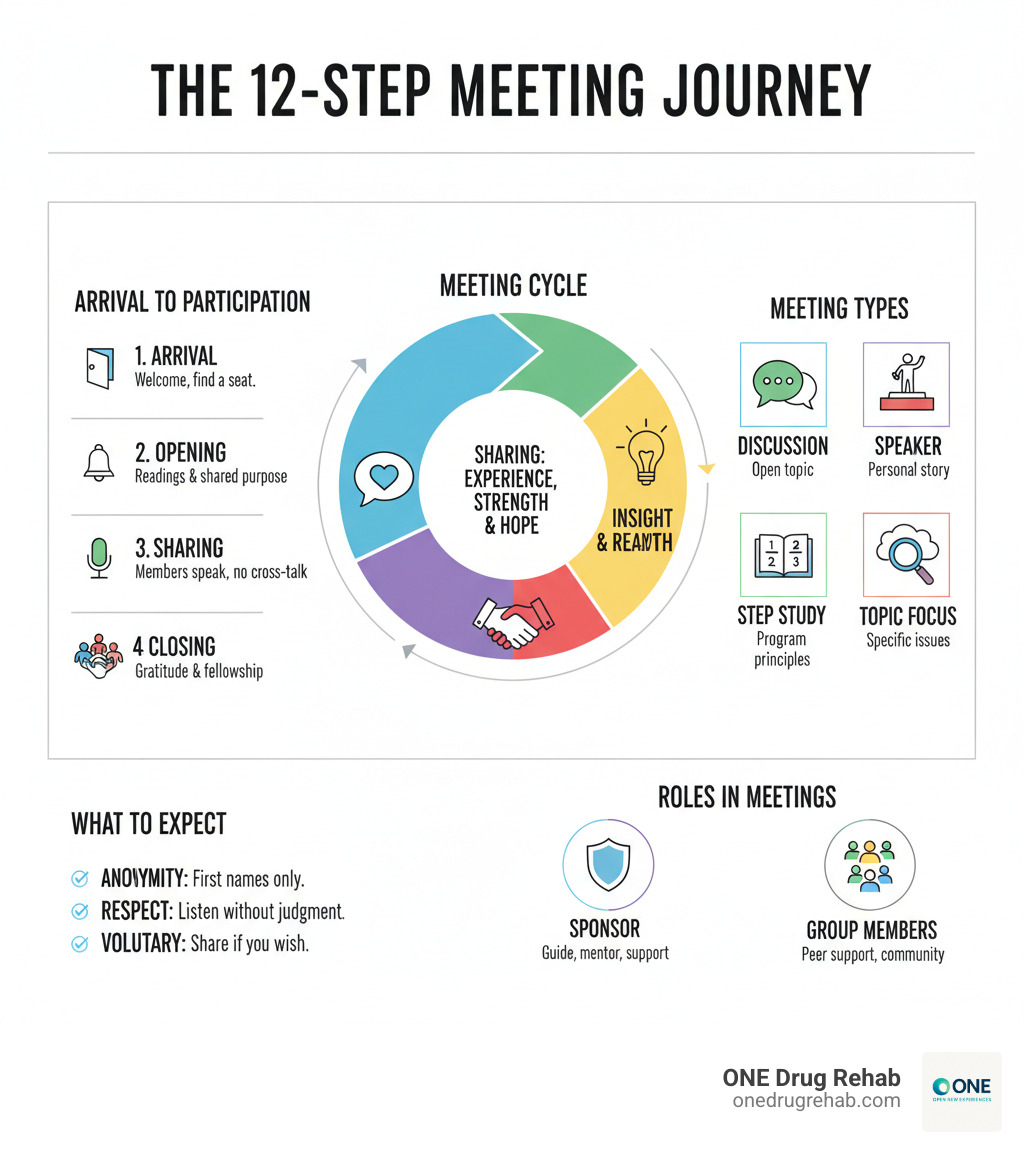
12 step meetings are peer-led support groups for people in recovery. By sharing experiences and following a structured program, members help each other overcome addiction. These meetings are the foundation of programs like Alcoholics Anonymous (AA) and Narcotics Anonymous (NA), which support millions worldwide in achieving and maintaining sobriety.
Key Facts About 12-Step Meetings:
- Free to attend – No dues or fees required
- Available worldwide – Over 65.5% of treatment centers use 12-step models
- Multiple formats – Open meetings (anyone can attend) and closed meetings (members only)
- Various types – Discussion groups, speaker meetings, step studies, and topic-focused sessions
- Anonymous participation – First names only, maintaining privacy and confidentiality
- Flexible attendance – Drop in when you can, no formal commitment required
The model began in 1935 when Bill Wilson and Dr. Bob Smith founded Alcoholics Anonymous. Their simple idea of two people helping each other stay sober has since grown into a global network of programs addressing substance addiction and behavioral compulsions.
Research confirms the effectiveness of these programs. A landmark 2020 Cochrane review found that AA participation led to longer periods of sobriety compared to other treatments like cognitive behavioral therapy, highlighting that active involvement increases the likelihood of abstinence.
Whether you’re seeking help for yourself or a loved one, understanding how 12-step meetings work can be the first step toward finding the right recovery path.
What Are the Core Principles of a 12-Step Program?
Every 12 step meeting is built on practical guidelines that create a roadmap for personal change. The framework consists of two pillars: The 12 Steps, which guide your personal recovery journey, and The 12 Traditions, which keep the groups healthy and focused.
At its core, the 12-step approach asks you to admit you can’t overcome addiction alone. It then walks you through finding strength outside yourself, taking an honest look at your life, making amends where possible, and eventually helping others facing the same challenges. The program’s strength lies in its spiritual principles—not religious doctrine, but universal concepts like honesty, humility, and service that provide a new foundation for living.

The 12 Steps: A Pathway to Recovery
The 12 Steps are a guide to recovery adapted by numerous fellowships. Here’s a summary of the journey through the original Twelve Steps of Alcoholics Anonymous:
-
Steps 1-3 focus on surrender: admitting powerlessness over addiction, coming to believe a Power greater than yourself can help, and making a decision to turn your will over to that Power’s care. This is about accepting that your old way wasn’t working and being open to a new one.
-
Steps 4-9 involve self-examination and action. You take a searching and fearless moral inventory, admit your wrongs, become ready to have character defects removed, and make amends to those you’ve harmed. This is the process of cleaning up the past with courage.
-
Steps 10-12 are about maintenance and service. You continue taking personal inventory, improve your spiritual connection, and, after a spiritual awakening, carry the message to others while practicing these principles in all your affairs.
The steps are a long-term process, typically worked through with a sponsor. You can learn more at The Twelve Steps of AA.
The 12 Traditions: Ensuring Group Unity and Survival
While the Steps guide personal recovery, the 12 Traditions ensure groups remain healthy and unified. Developed in 1946, these traditions prevent internal conflicts that could threaten a group’s existence.
They prioritize group welfare, maintain a singleness of purpose (focusing on a specific addiction), and ensure each group is autonomous and self-supporting. Key traditions protect anonymity, keep the support non-professional, and place principles before personalities, preserving the group’s core mission for the next person who needs help.
The Spiritual Aspect: Understanding a “Higher Power”
The mention of “God” in the steps often causes concern, but 12-step programs are spiritual, not religious. The phrase “God as we understood Him” is intentionally flexible. Your Higher Power can be anything you choose: a traditional deity, the universe, nature, or the collective wisdom of the group itself.
Many atheist and agnostic members use the group as their Higher Power, recognizing it has achieved what they could not alone—sustained sobriety. The goal isn’t religious conversion but finding strength outside of your own willpower. This often leads to what the program calls a spiritual awakening—a fundamental shift in perspective. Secular approaches are common, focusing on principles like service and humility, ensuring there’s a place for everyone, regardless of belief.
The History and Evolution of 12-Step Fellowships
The story of 12 step meetings began in 1935 in Akron, Ohio, when Bill Wilson, a stockbroker, and Dr. Bob Smith, a surgeon, finded they could stay sober by sharing their experiences and holding each other accountable. From the principles of the Oxford Group, a Christian fellowship, they developed a new approach accessible to people of all backgrounds. By 1939, Bill W. had written Alcoholics Anonymous, now called “The Big Book,” which outlined their method and became a vital guide for those seeking recovery.
From Alcoholism to a World of Recovery
As AA grew, it maintained its “singleness of purpose”—focusing only on alcoholism. This led to the creation of new fellowships using the same proven 12-Step model for other addictions. Narcotics Anonymous (NA) was formed in the 1950s, followed by dozens of others. Today, the 12-Step framework addresses everything from gambling and overeating to codependency. Surprisingly, about 80% of all 12-Step programs now focus on issues other than alcohol, proving the universality of the principles.
This growth included programs for behavioral addictions and support programs for family members, such as Al-Anon/Alateen and Co-Dependents Anonymous (CoDA).
A Diverse Network of Support
Today’s 12-Step network offers specific support for nearly any struggle. Substance-focused programs include Narcotics Anonymous (NA), Cocaine Anonymous, and Crystal Meth Anonymous. Behavioral addiction support is available through Gamblers Anonymous (GA), Sex Addicts Anonymous (SAA), Overeaters Anonymous (OA), and Debtors Anonymous (DA).
Family members can find help in groups like Al-Anon for families of alcoholics and Adult Children of Alcoholics (ACA) for those impacted by growing up in an addicted household.
This expansive network means that no matter the issue, people can find others who truly understand their experience. The evolution from two men in Ohio to a global network demonstrates the power of shared experience in fostering recovery.
How to Find and Participate in 12-Step Meetings
Finding 12 step meetings is easier than ever, as they are designed to be welcoming and accessible. Whether you prefer online meetings or face-to-face connection, a community of support is available. These meetings can also work well alongside other treatments, such as the options you can explore by learning more info about outpatient rehab programs.
Finding Local and Online 12-step meetings
Start your search on the official fellowship websites. For Alcoholics Anonymous (AA), visit Find A.A. Near You to connect with local groups that provide schedules. The official Meeting Guide app (iOS/Android) is also excellent for finding meetings on the go.
For online meetings, the Online Intergroup for virtual meetings is a comprehensive resource. This is a great option for those in rural areas, with mobility issues, or who prefer joining from home. Other fellowships like Narcotics Anonymous and Gamblers Anonymous typically have robust meeting finders on their websites, allowing you to filter by time, location, and meeting type.
What to Expect at Your First Meeting
Walking into your first 12 step meeting can be nerve-wracking, but you’ll find a welcoming space. Here’s what to know:
- Cost: Meetings are free. A basket may be passed for voluntary contributions to cover rent and coffee, but there is no obligation to donate.
- Anonymity: Your privacy is protected. Members use first names only, and what’s said in the meeting stays there.
- Meeting Types: You’ll find open meetings (for anyone interested) and closed meetings (for those with the specific addiction). Formats vary, including speaker meetings (one person shares their story), discussion meetings (on a topic or reading), and step study meetings.
- Participation: You are never required to speak. It’s perfectly acceptable to just listen. If you choose to introduce yourself, you can simply say your name and that you’re listening.
The Role of a Sponsor in 12-Step Recovery
A sponsor is a vital part of recovery for many—a mentor who has already worked through the steps and can guide you. Their primary role is to help you steer the Twelve Steps, offering insights from their own journey. This is a peer-to-peer relationship, not professional therapy; it’s built on shared experience.
A sponsor provides gentle accountability and support, often being the first person you call in difficult moments. You can find a sponsor by attending meetings regularly and listening for someone whose story resonates with you. Simply approach them after a meeting and ask if they’d be willing to sponsor you.
Effectiveness, Benefits, and Criticisms of 12-Step Programs
Do 12 step meetings actually work? For nearly 90 years, these programs have helped people recover, and extensive research has studied their effectiveness. While they offer life-changing benefits for many, it’s important to look at the science, alternatives, and potential challenges.

The Science Behind the Steps: Is It Effective?
Research confirms that 12 step meetings are an effective path to recovery. Approximately 65.5% of U.S. treatment centers use 12-Step models, reflecting their evidence-based success. Studies consistently show that active participation in programs like AA and NA leads to higher rates of sobriety and better mental health. A landmark 2020 Cochrane review—the gold standard in medical research—found that AA participants achieved longer periods of continuous abstinence compared to those in other therapies like CBT. You can read the study here: Scientific research on AA effectiveness. For drug addiction, research shows 12-Step programs are as effective as other treatments, making them a solid option. For more on this, see our guide on Drug Rehab Success Rates.
Comparing 12-Step vs. Non-12-Step Approaches
Recovery is not one-size-fits-all, and it’s useful to know the alternatives. 12-Step programs are based on the idea of addiction as a disease requiring surrender to a Higher Power and peer support. Non-12-Step alternatives like SMART Recovery focus on self-empowerment and cognitive-behavioral skills to change learned behaviors, often with trained facilitators. The primary difference is the spiritual component; 12-Step programs are spiritual at their core (though flexible), while alternatives are typically secular. Both paths can lead to recovery; the right choice depends on your personal beliefs and needs. Learn more about Information on Non-12-Step Rehab.
Potential Benefits and Drawbacks
Like any approach, 12 step meetings have distinct benefits and potential drawbacks.
Benefits:
- Free and Accessible: Meetings are available at no cost, nearly everywhere, and at all hours, both in-person and online.
- Strong Community: They provide a powerful peer support network of people who understand the struggle with addiction, reducing shame and isolation.
- Structured Program: The steps offer a clear roadmap for addressing the underlying issues of addiction.
Drawbacks:
- Spiritual Emphasis: The focus on a ‘Higher Power’ can be a barrier for some atheists, agnostics, or those with negative religious experiences.
- Lack of Professional Oversight: As peer-led groups, they are not a substitute for professional therapy, especially for co-occurring mental health conditions.
- Group Dynamics: As with any group, you may encounter personalities or meeting styles that aren’t a good fit, which may require trying different meetings.
For many, the benefits of community and a proven structure far outweigh the drawbacks. They offer an accessible path that has helped millions build sober lives.
Frequently Asked Questions about 12-Step Meetings
Starting your journey with 12 step meetings can bring up many questions. It’s natural to wonder what you’re getting into. Let’s address the most common concerns.
Are 12-step meetings free to attend?
Yes, 12 step meetings are completely free. There are no dues or fees for membership. The groups are self-supporting through voluntary contributions, as outlined in the Seventh Tradition. A basket is often passed during meetings for donations to cover costs like rent and coffee, but there is absolutely no obligation to contribute. You are welcome whether you donate or not, removing any financial barrier to getting help.
Do I have to be religious to join a 12-step program?
No, you do not have to be religious. While the program is spiritual, it is not religious. The phrase “God as we understood Him” is intentionally open to personal interpretation. Your ‘Higher Power’ can be any source of strength you choose—be it a traditional God, the universe, nature, or the collective support of the group itself. Many agnostic and atheist members thrive in these programs by defining their Higher Power in secular terms. The goal is to find strength outside of yourself, not to adopt a specific faith.
Do I have to speak or share at my first meeting?
Absolutely not. You are never required to speak at a 12 step meeting. It is perfectly acceptable to attend and just listen for as long as you like. Many newcomers do this for weeks or months. If the group asks for newcomers to introduce themselves, you can simply state your first name or choose to remain silent. Participation is always voluntary. The focus is on creating a safe, pressure-free environment where you can get comfortable at your own pace.
Conclusion: Finding Your Path in Recovery
Understanding 12 step meetings reveals a core truth: recovery is a personal journey with many paths. What began in 1935 has become a global network of peer support, proving that community and structured principles can lead to lasting change. The accessibility and shared understanding found in these meetings are powerful tools for recovery, backed by research showing they improve sobriety rates.
However, they are not the only option. Whether you connect with the spiritual principles of the Twelve Steps or prefer an alternative like SMART Recovery, what matters most is taking the first step. Recovery is possible, and you don’t have to do it alone.
At ONEDrugRehab.com, our goal is to provide clear, unbiased information so you can choose the best path for your unique situation. We’re here to help you explore all your options, from 12 step meetings to professional treatment, without any agenda.
Your recovery matters. Explore the different approaches and find the support that’s right for you.
Compare different types of addiction treatment