

Non 12 Step Inpatient Rehab 2025: Empowering Hope
What is Non-12-Step Inpatient Rehab?
Finding the right path to addiction recovery is a personal journey. For many, non 12 step inpatient rehab offers an effective alternative to traditional models, built on different ideas about healing.
Here’s what non-12-step inpatient rehab generally focuses on:
- Self-Empowerment: You are given tools and skills to manage your own recovery.
- Evidence-Based Therapies: Treatment uses science-backed methods like Cognitive Behavioral Therapy (CBT) and Motivational Interviewing.
- Secular Approach: There is no requirement for belief in a “Higher Power” or spiritual concepts.
- Personalized Treatment: Your program is custom-built for your unique needs and goals.
- Underlying Issues: The focus is on healing the root causes of addiction, not just the symptoms.
Not everyone connects with the traditional 12-step philosophy. If you prefer a secular approach or want to focus on personal responsibility, this guide will help you understand these programs. We’ll explore their core principles, how they differ, and what results you can expect.
Similar topics to non 12 step inpatient rehab:
Understanding the Non-12-Step Philosophy: A Focus on Empowerment
When you walk into a non 12 step inpatient rehab facility, the atmosphere feels more like empowerment than surrender. These programs are built on a different foundation than traditional approaches.
Instead of starting with the idea that you’re powerless over addiction, non-12-step programs believe in your inner strength. They see you as the hero of your own recovery story, a shift in perspective that can be a breath of fresh air if other approaches didn’t fit.
The core principles revolve around personal responsibility and self-empowerment. You’re not labeled as “diseased”; instead, addiction is viewed as a treatable condition with real causes that can be understood and healed.
This approach is powerful because of its science-based foundation. Every therapy is backed by solid research. The National Institute on Drug Abuse provides excellent insights on these Evidence-Based Approaches to Drug Addiction Treatment, showing how effective these methods can be.
The focus goes deeper than just stopping substance use. These programs address the underlying issues that led to addiction, such as untreated anxiety, trauma, or depression. About two-thirds of people with addiction also struggle with mental health conditions, known as a dual diagnosis or co-occurring disorders.
This means your treatment team helps you understand why you started using substances and gives you better tools to handle life’s challenges.
The Shift from Powerlessness to Personal Agency
Non-12-step programs flip the traditional idea of powerlessness upside down.
They see addiction not as a mysterious disease, but as maladaptive behavior—unhealthy coping strategies that are no longer serving you. This perspective helps you build genuine coping skills for handling stress, managing emotions, and dealing with triggers. The goal is self-reliance, knowing you have what it takes to handle life’s challenges.
One of the biggest differences is that there’s no requirement for a Higher Power. While spirituality can be part of your healing, a secular approach is perfectly valid. Your recovery belongs to you, and you decide what works best.
This philosophy can be especially appealing if you’ve felt uncomfortable with spiritual requirements or prefer a more scientific, psychology-based approach to healing. You’re in the driver’s seat of your own recovery journey.
12-Step vs. Non-12-Step Inpatient Programs: A Head-to-Head Comparison
When you’re looking for addiction treatment, you’ll find two main approaches: traditional 12-step programs and non 12 step inpatient rehab alternatives. Both aim for lasting recovery but take very different paths to get there.

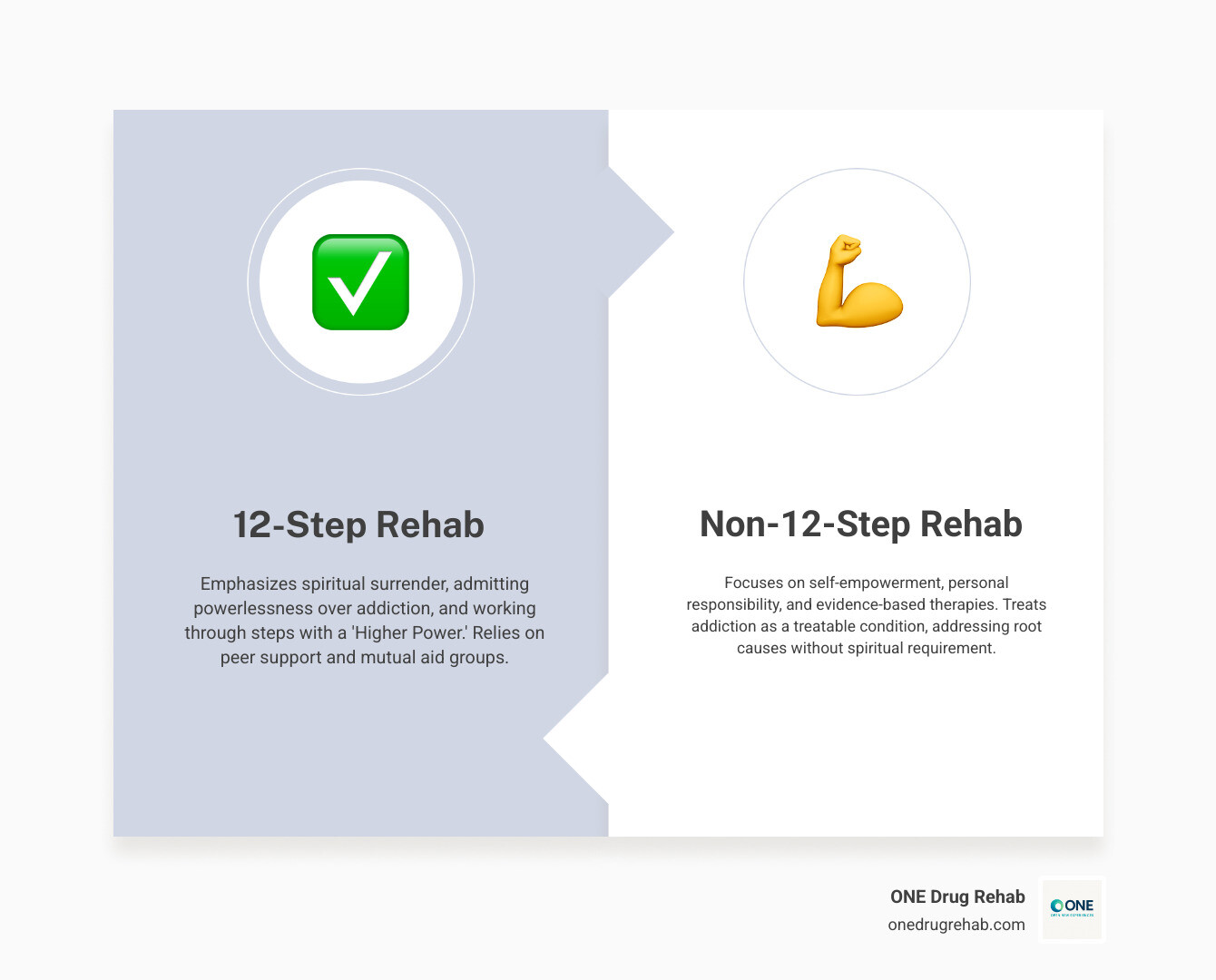
The differences are significant. Traditional 12-step programs like Alcoholics Anonymous and Narcotics Anonymous are built on the idea of powerlessness over addiction. They emphasize surrendering to a Higher Power, with treatment centered on working through the 12 steps and finding community support.
Non-12-step programs believe you have the power to overcome addiction with the right tools. They emphasize personal responsibility and self-empowerment, using evidence-based therapies like Cognitive Behavioral Therapy (CBT), Motivational Interviewing, and Dialectical Behavior Therapy (DBT).
Here’s how they stack up side by side:
| Feature | 12-Step Programs | Non-12-Step Inpatient Rehab |
|---|---|---|
| Core Philosophy | Powerlessness over addiction; surrender to a Higher Power; spiritual awakening | Self-empowerment; personal responsibility; internal locus of control; science-based |
| View of Addiction | A chronic, incurable disease; a spiritual malady | A treatable condition; maladaptive behavior; a symptom of underlying issues |
| Role of Spirituality | Central to recovery; belief in a “Higher Power” is fundamental | Optional; often secular or agnostic; no spiritual requirement |
| Treatment Methods | Peer support groups; working through 12 steps; sponsorship; sharing experiences | Evidence-based therapies (CBT, MI, DBT); individual and group therapy; holistic approaches; customized treatment plans |
| Recovery Goal | Lifelong “recovery” (always in recovery); abstinence through spiritual growth and community support | “Recovered” (achieving self-control and balance); sustained abstinence through personal agency and learned skills |
While 12-step programs have helped millions, they don’t click with everyone. For those uncomfortable with the spiritual aspects or the concept of powerlessness, non-12-step programs offer a different doorway into recovery.
How Peer Support Differs
Both approaches value peer support, but they handle it in distinctly different ways.
In 12-step meetings, group dynamics revolve around working through the steps. People share personal stories in a structured format, building fellowship on shared vulnerability and collective experience.
Non-12-step group therapy is more like a guided learning experience led by trained therapists. Instead of focusing on predetermined steps, the emphasis is on developing practical coping skills and managing thoughts and feelings in the present moment.
The conversations center on applying new tools and strategies to daily life. While confidentiality is sacred in both settings, the goal in non-12-step groups is to build healthy, functional relationships while learning evidence-based techniques for staying sober. It’s less about following a prescribed path and more about each person finding their unique way forward with professional guidance and peer encouragement.
The Science of Healing: Evidence-Based Methods in Non-12-Step Inpatient Rehab
When you choose non 12 step inpatient rehab, you’re choosing a path built on solid scientific ground. These programs use therapies that researchers have tested and proven effective.
The heart of these programs is Cognitive Behavioral Therapy (CBT). This approach helps you identify and change the thoughts and behaviors that fuel addiction, replacing them with healthier ones.
Motivational Interviewing (MI) helps you find your own reasons for change. It recognizes that lasting change comes from within, not from external pressure.
For those dealing with intense emotions, Dialectical Behavior Therapy (DBT) teaches key skills: mindfulness, distress tolerance, emotion regulation, and building better relationships. It’s particularly helpful for those with both addiction and other mental health challenges.
These evidence-based approaches give you real tools to handle cravings, avoid triggers, and build a life that doesn’t revolve around substances. You can explore more about various treatment approaches at Types of Addiction Treatment.
Integrating Holistic and Complementary Therapies
The best non 12 step inpatient rehab programs understand you’re a whole person. That’s why many blend evidence-based therapies with holistic approaches that address your mind, body, and spirit.
Mindfulness and meditation are powerful tools that help you stay grounded and can change your brain’s response to stress and cravings.
Physical wellness also plays a huge role. Yoga and fitness programs release natural mood boosters, while nutritional counseling teaches you how to fuel your body to improve your mood and mental clarity.
Experiential therapies, such as art or equine therapy, help you process emotions and build confidence through doing rather than just talking.
Some programs also offer acupuncture, massage therapy, and other complementary treatments to help with stress relief and overall healing. This integrated approach recognizes that since addiction touches every part of your life, your recovery must as well.
Who Benefits Most and Why? Exploring the Advantages
Non 12 step inpatient rehab is wonderfully flexible and personalized. Since one size doesn’t fit all in recovery, these alternative pathways are designed to meet a wide range of unique needs, offering a fresh approach to healing.
So, who often finds their perfect fit in a non 12 step inpatient rehab program?
It’s often an ideal choice for secular or agnostic individuals. If the idea of a “Higher Power” doesn’t resonate with your beliefs, a secular approach focusing on self-empowerment and science can feel more effective.
This path is also fantastic for those who’ve tried 12-step programs before and found they weren’t the right fit. A non-12-step program offers new tools, a different perspective, and a fresh start.
If you’re someone who thrives with highly personalized care, this approach is key. Programs are built around your unique circumstances, which is crucial for those with complex needs.
For individuals with co-occurring mental health conditions like anxiety or depression, these programs are expertly equipped. The integrated, dual diagnosis approach treats both addiction and mental health needs simultaneously, leading to better outcomes.
Many also benefit if they prefer a “no labels” approach. Framing addiction as a treatable condition, rather than a lifelong identity as “an addict,” can be incredibly empowering.
Finally, if you have a strong internal locus of control—a belief that you’re in charge of your life—this approach aligns with your strengths, fostering personal responsibility to help you heal.
For families seeking to understand treatment options, resources like More info about Rehab for Families can provide additional guidance.
Addictions and Behaviors Treated
The versatility of non 12 step inpatient rehab programs allows them to treat a wide spectrum of challenges, from substance use to behavioral addictions. The core principles are effective across different forms of addiction because the focus is on the underlying causes.
This means we can effectively treat:
- Substance Use Disorder (SUD): Covering addictions to opioids, stimulants, cannabis, and prescription medications.
- Alcohol Use Disorder (AUD): Addressing problematic drinking patterns, from abuse to severe dependence.
- Behavioral Addictions: These programs are well-suited for compulsions like gambling addiction, internet or gaming addiction, eating disorders, sex addiction, and shopping addiction.
Because the focus is on changing the underlying thoughts and behaviors that drive addictive patterns, non 12 step inpatient rehab offers effective treatment for a diverse array of issues.
Finding Your Fit: How to Choose the Right Non-12-Step Inpatient Rehab Program
Choosing the right non 12 step inpatient rehab is a crucial step. It’s about finding a program that fits your personal beliefs, needs, and goals. We encourage you to ask questions and do your research to find the best fit for your recovery.

When you start looking at facilities, explore their core philosophy. Do they champion self-empowerment and a science-based approach? The best option for you will be a residential treatment program custom-built for your unique needs.
Tools like Compare Rehab Centers can help, and if cost is a concern, there are resources to help you Find Rehab Without Insurance.
Key Questions to Ask a Potential Non-12-Step Inpatient Rehab
When you’re ready to chat with potential programs, we recommend asking some important questions.
Always check for accreditation and licensing to ensure the facility meets high professional standards. Inquire about staff qualifications, looking for licensed professionals with expertise in evidence-based therapies like CBT, MI, and DBT. Ask them to detail the therapeutic methods used so you understand what your daily healing will look like.
Ensure they offer truly individualized treatment plans custom to you. Strong aftercare support is crucial for long-term success, so ask if they offer secular options like SMART Recovery meetings. Finally, it’s fair to ask about their success rate data. Be cautious of grand claims; transparency is a good sign.
Common Examples of Non-12-Step Inpatient Rehab Models
Many non 12 step inpatient rehab centers are built around specific recovery models that offer distinct philosophies and tools.
One popular model is SMART Recovery (Self-Management and Recovery Training). This program uses techniques from CBT and motivational therapy. Its 4-Point Program helps participants build motivation, cope with urges, manage thoughts and feelings, and live a balanced life. It considers labels like ‘addict’ unproductive and allows participants to ‘graduate.’ You can explore more about them at SMART Recovery.
LifeRing Secular Recovery emphasizes strengthening your ‘Sober Self’ over the ‘Addict Self’ through shared support, empowering individuals to design their own recovery.
For women, Women for Sobriety (WFS) is designed with women in mind, focusing on positive affirmations, self-responsibility, and emotional growth.
Secular Organizations for Sobriety (SOS) is a network of groups dedicated to sobriety through rational decision-making and ongoing vigilance.
Moderation Management (MM) empowers individuals with early-stage problem drinking to choose moderation or abstinence, offering a nine-step program with self-management strategies.
These models form the philosophical backbone of inpatient programs, guiding therapy and discussions. For instance, a center might use SMART Recovery principles in group therapy while also offering individual CBT. The key is that these approaches inform the entire treatment experience, providing a consistent, empowering framework for recovery.
Frequently Asked Questions about Non-12-Step Recovery
When you’re considering non 12 step inpatient rehab, it’s natural to have questions. Here are some straight answers to help you make the best decision.
What are the success rates of non-12-step programs?
Success in recovery is personal and depends on many factors, including your motivation, program quality, and engagement in aftercare. While it’s tough to give exact numbers, research suggests comparable efficacy to 12-step programs for many individuals. Some studies even find higher satisfaction in non-12-step alternatives.
What really matters is finding a treatment approach that clicks with your personal beliefs and committing to it. Success depends on finding the right personal fit.
Can I combine non-12-step treatment with 12-step meetings?
Absolutely. Recovery is not exclusive, and you can combine approaches. A non 12 step inpatient rehab program won’t require you to attend AA or NA meetings, but you are free to do so if you find them helpful.
In fact, many programs encourage using any helpful resources you can find. This kind of hybrid approach can be incredibly powerful, giving you more tools for your recovery.
Are non-12-step programs suitable for severe addictions?
Yes. Non 12 step inpatient rehab programs are equipped to handle severe addictions. The inpatient setting provides medical detox and 24/7 care, which is crucial for serious substance use disorders.
The evidence-based therapies are effective for all severity levels, and treatment is custom to individual needs. Your care team will design an intensive program with the medical and therapeutic support you need to recover safely. The severity of an addiction simply determines the level of intensive care required.
Conclusion: Taking the First Step on Your Personalized Path to Recovery
Finding your way from addiction to a fulfilling life is a personal journey. For those who find traditional paths aren’t a perfect fit, non 12 step inpatient rehab is a valuable alternative. It’s an approach based on self-belief, science-based healing, and treating you as a whole person.
The core ideas of self-empowerment, personal responsibility, and evidence-based therapies build a strong foundation for lasting recovery. If you prefer a secular, personalized approach, or if 12-step programs haven’t worked for you, these programs offer hope for a fresh start.
Here at ONE Drug Rehab, we believe in empowering you with information to make the best choices for your recovery. As an unbiased, third-party resource, we are dedicated to helping you research your treatment options. Your healing journey is personal, and we’re here to help you steer it. Take that brave first step.
Explore your treatment options today.