

Understanding How Outpatient Rehab Programs Work
How do outpatient rehab programs work? These programs provide professional addiction treatment while you live at home, allowing you to maintain your daily responsibilities. They offer a flexible yet structured path to recovery.
Key Components:
- Live at home: No overnight stays at a facility.
- Scheduled sessions: Attend treatment during specific hours, with evening and weekend options available.
- Flexible intensity: Choose from 9 to 25+ hours of treatment per week based on your needs.
- Comprehensive care: Includes individual therapy, group counseling, family sessions, and medical support.
- Real-world practice: Apply recovery skills in your actual environment.
Unlike residential programs that require you to live at a facility, outpatient rehab integrates treatment into your existing life. This approach is highly effective for individuals with mild to moderate addiction, a strong support system, or those who cannot step away from work and family obligations. Research shows that for many, outpatient programs can be just as effective as inpatient care, offering quality treatment with greater flexibility.
This guide will explain how these programs function, help you decide if outpatient care is right for you, and outline what to expect on your recovery journey.
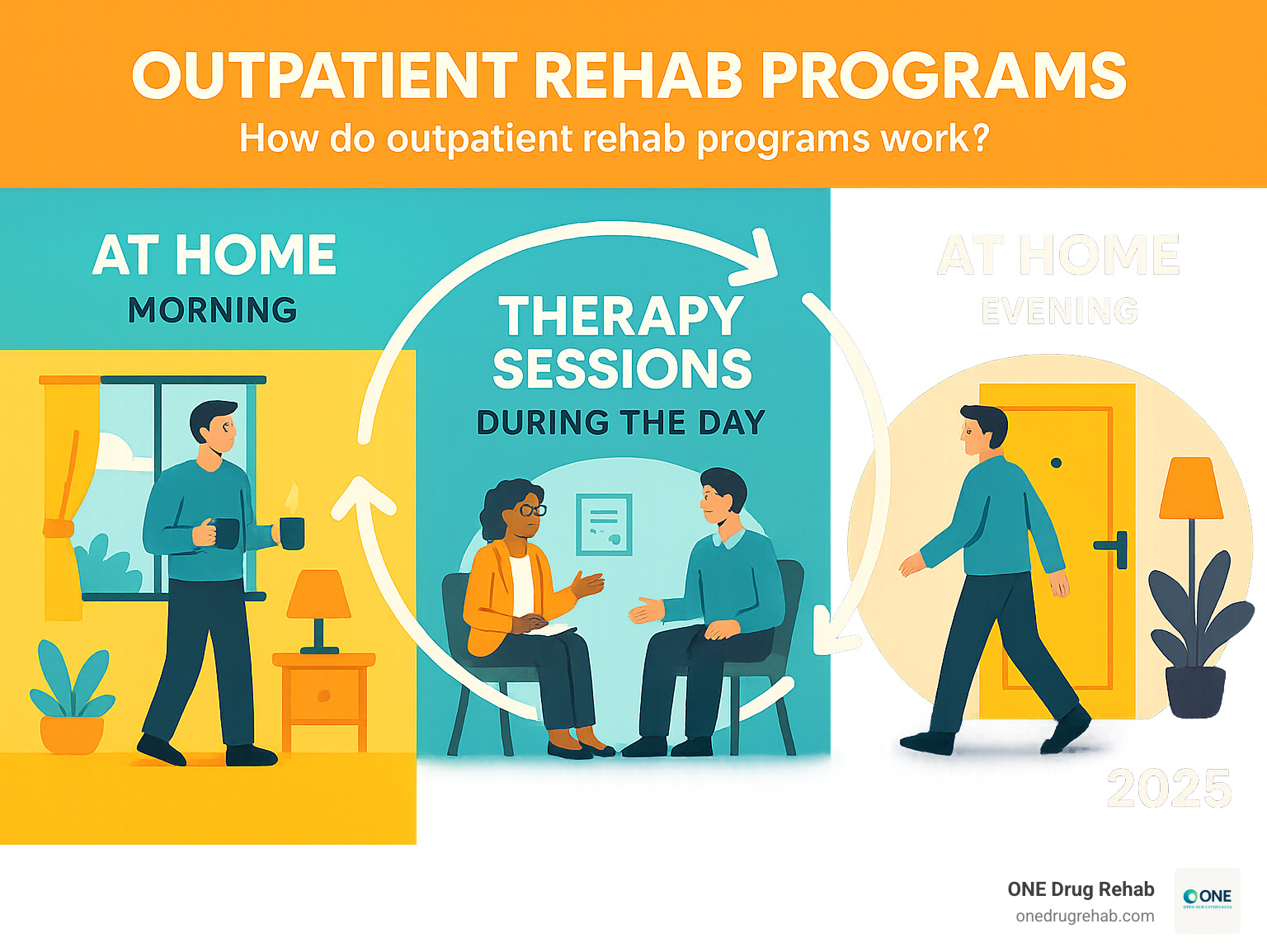
Basic how do outpatient rehab programs work terms:
Understanding Outpatient Rehab and Its Unique Benefits
Addiction treatment generally falls into two categories: inpatient and outpatient rehab. While inpatient rehab requires living at a facility 24/7 for intensive focus on recovery, outpatient rehab allows you to receive treatment while living at home and maintaining your daily life.
The primary benefit of outpatient programs is flexibility. You can schedule therapy around work, school, or family care. This structure is powerful because it allows you to practice recovery skills in real-time, applying coping strategies to daily challenges as they arise. This immediate application helps build stronger, more sustainable recovery habits.
Here’s how outpatient and inpatient programs compare:
| Feature | Outpatient Rehab | Inpatient Rehab |
|---|---|---|
| Living Situation | Live at home or in sober living | Reside at the treatment facility 24/7 |
| Intensity/Hours | Varies (e.g., 9-25+ hours/week); flexible scheduling | Highly intensive (24/7 care); structured daily schedule |
| Cost | Generally less expensive (no room & board) | More expensive (includes room & board, constant supervision) |
| Flexibility | High; allows continuation of work, school, family obligations | Low; requires pause from daily life |
| Support System | Rely on home support system, family, and program peers | Built-in facility support; limited external contact initially |
| Ideal Candidate | Mild-moderate addiction, stable home, strong motivation, transitioning from higher care | Severe addiction, unstable home, medical detox needs, co-occurring mental health issues requiring constant supervision |
Outpatient rehab offers several other key advantages. The cost is significantly lower since you aren’t paying for room and board. It also allows for greater privacy, as you can receive help without disrupting your public life. Perhaps most importantly, outpatient care facilitates stronger family involvement, allowing loved ones to participate in therapy and become part of your support system from the start. While inpatient care is essential for those needing intensive medical support, outpatient treatment provides an effective, practical solution for many.
How Do Outpatient Rehab Programs Work?
So, how do outpatient rehab programs work on a day-to-day basis? They operate on a continuum of care, meaning treatment is adaptable. Some people start with outpatient care, while others transition into it after completing an inpatient program. Your treatment plan is never a one-size-fits-all solution; it’s custom to your unique circumstances, challenges, and goals. This individualized approach provides evidence-based care while accommodating your work, family, or school commitments. You can explore various Types of Addiction Treatment to see how they fit into a comprehensive recovery plan.

The First Step: Intake and Assessment
Your journey begins with a comprehensive evaluation to understand your story. During this intake, a treatment team will review your medical and substance use history, screen for mental health challenges like depression or anxiety, and assess your social environment. Many programs use the ASAM criteria (American Society of Addiction Medicine) to scientifically determine the appropriate level of care. Addressing addiction alongside co-occurring disorders is critical for lasting recovery, a principle central to effective Co-occurring Disorder Treatment. The result is a personalized treatment plan that serves as your roadmap to recovery.
Levels of Care: From Intensive to Standard Support
Outpatient care offers different levels of intensity, allowing you to shift gears as you progress.
- Partial Hospitalization Programs (PHP): The most intensive option, requiring 20-25 hours of treatment per week. PHP is ideal for those needing significant structure but who have a stable home environment, often serving as a step-down from inpatient care.
- Intensive Outpatient Programs (IOP): A common choice offering 9-20 hours of treatment per week. IOP provides substantial support while allowing you to maintain work or school schedules. Combining this with supportive housing can be beneficial, as explained in our IOP Sober Living resources.
- Standard Outpatient Programs: With fewer than 9 hours per week, this level is suited for those with milder issues or as a final step-down to maintain progress.
This stepping down approach allows your care to evolve with your needs, gradually reducing session frequency as you gain confidence.
Core Therapies and Services Offered

The core of outpatient rehab is its therapeutic services:
- Individual Therapy: One-on-one sessions to explore the root causes of addiction and develop coping strategies.
- Group Counseling: A powerful setting to share experiences and learn from peers who understand your struggles.
- Family Therapy: Sessions designed to heal relationships, improve communication, and build a supportive home environment.
- Cognitive-Behavioral Therapy (CBT): A practical approach to identify and change negative thought patterns that fuel addiction.
- Relapse Prevention Skills: Training to manage cravings, handle high-risk situations, and create a plan to prevent relapse.
- Holistic Approaches: Many programs incorporate mindfulness, yoga, or nutritional counseling. Learn more about Holistic Treatment Programs.
- Life Skills Education: Practical training in areas like stress management, financial planning, or healthy communication.
For additional context, you can reference Johns Hopkins Medicine’s overview of Outpatient Rehabilitation.
The Role of Medication-Assisted Treatment (MAT)
For those struggling with opioid or alcohol dependence, Medication-Assisted Treatment (MAT) can be a critical component. MAT combines FDA-approved medications with counseling to address both the physical and psychological aspects of addiction. These medications help reduce cravings and manage withdrawal symptoms, allowing you to focus on the therapeutic work of recovery. For example, medications like buprenorphine or naltrexone are used for opioid dependence, while naltrexone or acamprosate can help with alcohol dependence. When integrated with therapy, MAT significantly improves success rates. Our Outpatient Alcohol Rehab Programs guide provides more detail on this integrated approach.
Is Outpatient Rehab the Right Choice for You?
Choosing the right treatment path requires an honest self-assessment. Consider your motivation level, the stability of your home environment, the strength of your support system, and your work or school obligations. Being realistic about your needs is key to making an informed decision. Understanding Addiction Recovery Success Rates can also provide valuable context for what contributes to long-term sobriety.
Profile of a Good Candidate
Outpatient rehab is often a strong fit if you:
- Have a mild to moderate substance use disorder that doesn’t require 24/7 medical supervision.
- Possess a strong support network of family and friends who encourage your recovery.
- Have a stable, substance-free living situation.
- Are highly motivated and committed to participating fully in your treatment.
- Cannot leave work, school, or family responsibilities.
- Are transitioning from a higher level of care, like inpatient rehab, and need continued support.
Weighing the Benefits and Potential Challenges
Every treatment has pros and cons. It’s important to consider both sides.
Benefits:
- Affordability: Generally less expensive than residential care as it excludes costs for room and board.
- Flexibility: Allows you to maintain your job, school, and family life.
- Real-World Application: Lets you practice recovery skills in your daily environment immediately.
- Privacy: You can receive treatment discreetly while living at home.
- Family Involvement: Makes it easier for loved ones to participate in therapy.
Challenges:
- Less Structure: Requires a high degree of self-discipline and accountability.
- Environmental Triggers: You will return home to face familiar stressors and temptations.
- Not for Severe Cases: Unsuitable for those needing medical detox or a complete break from an unstable environment.
Signs You May Need a Different Level of Care
Outpatient rehab is not for everyone. A higher level of care, such as an inpatient program, might be necessary if you are experiencing:
- Chronic relapse despite previous treatment attempts.
- Severe withdrawal symptoms that require medical supervision.
- An unstable or unsupportive home environment.
- Co-occurring medical or psychiatric issues that need intensive, 24/7 support.
- An inability to stay sober between outpatient sessions.
Professionals use frameworks like The American Society of Addiction Medicine – The ASAM Criteria to determine the most appropriate level of care. Needing more intensive treatment isn’t a failure; it’s a strategic step toward ensuring your safety and success. At ONE Drug Rehab, we can help assess your situation and provide referrals if needed.
Practical Considerations: Duration, Cost, and Insurance
Practical questions about time, cost, and insurance are a normal part of planning for recovery. Understanding these commitments is key to moving forward with confidence.

Our Rehab Cost Comparison guide can help you steer the financial aspects of treatment.
Typical Duration and Cost of Outpatient Rehab
There is no universal timeline for recovery. Program length depends on your individual needs and progress. While some programs, like a 30 Day Outpatient Rehab, offer a structured starting point, research shows that longer treatment durations are linked to better outcomes. Most outpatient programs last 3 to 6 months, with some extending to a year or more for complex cases.
Regarding cost, outpatient rehab is generally more affordable than residential treatment because it doesn’t include room and board. Costs vary by intensity:
- Partial Hospitalization Programs (PHP): Typically $350-$450 per day (private pay).
- Intensive Outpatient Programs (IOP): Usually $250-$350 per day (private pay).
- Standard Outpatient Programs: Cost significantly less due to fewer hours.
These are estimates and can vary by location and provider.
Understanding How Insurance Covers Outpatient Rehab
Thanks to the Mental Health Parity and Addiction Equity Act (MHPAEA), most insurance plans are required to cover addiction treatment similarly to how they cover other medical services. This means your plan likely offers more coverage than you think.
Before starting, verify your specific coverage with your insurance provider. Ask about your deductible, co-pays, and whether a provider is in-network or out-of-network, as this will significantly affect your costs. Medicaid, Medicare, and Affordable Care Act (ACA) plans all include substance use treatment as a covered benefit, though specifics can vary by state and plan.
If you’re uninsured, don’t let cost be a barrier. Many providers offer sliding-scale fees or payment plans. Our guide on how to Find Rehab Without Insurance offers more resources. Treatment is an investment in your future that pays for itself over time.
Beyond the Program: Aftercare and Long-Term Success
Completing an outpatient program is a major achievement, but recovery is a lifelong journey. The focus now shifts to relapse prevention and building a fulfilling, sober life. Ongoing support is critical for long-term success, as studies show that longer treatment times are linked to a more successful addiction recovery process.
The Importance of Aftercare Planning
An aftercare plan is your roadmap for maintaining sobriety. It keeps you connected to the support systems that helped you get well. Key components include:
- Step-down care: Gradually reducing treatment intensity, such as moving from an IOP to a standard outpatient program.
- Sober living homes: Structured, substance-free environments that provide accountability as you transition to independent living.
- Ongoing therapy: Regular check-ins with a therapist to reinforce coping skills and steer new challenges.
- Alumni programs: Events and networking opportunities offered by treatment centers to stay connected with a sober community.
Support Groups and Community
Connecting with peers who understand your experience is one of the most powerful tools in recovery. Support groups offer a judgment-free space to share and learn.
- Alcoholics Anonymous (AA) and Narcotics Anonymous (NA) are 12-step fellowship programs with meetings available worldwide. You can find more information at Alcoholics Anonymous and Narcotics Anonymous.
- SMART Recovery offers a science-based, self-management approach as an alternative to 12-step models.
Building a peer support network is a vital investment in your long-term well-being. This community, whether in formal groups or through sober social activities, becomes a cornerstone of a rich life where substances are no longer needed.
Frequently Asked Questions about Outpatient Rehab Programs
Deciding on treatment brings up many questions. Here are answers to some of the most common ones we hear.
How much freedom do you have in an outpatient program?
Outpatient programs offer significant freedom. You live at home and maintain your daily routine outside of scheduled treatment sessions. This allows you to continue working or attending school and manage family responsibilities. This freedom is balanced with the responsibility to adhere to program rules, such as attending all sessions and remaining sober.
Can my family be involved in my treatment?
Yes, family involvement is highly encouraged. Most outpatient programs offer family therapy sessions to heal relationships, improve communication, and educate loved ones about addiction. The goal is to create a supportive home environment that fosters, rather than hinders, your recovery.
What happens if I relapse during outpatient treatment?
Relapse can be a part of the recovery process; it is not a sign of failure. If a setback occurs, the most important step is to be honest with your therapists. They will provide non-judgmental support and work with you to re-evaluate your treatment plan. This may involve adjusting your level of care, such as increasing session frequency or incorporating medication-assisted treatment, to get you back on track. A relapse is an opportunity to learn and strengthen your recovery plan for the future.
Find the Right Path to Recovery
We hope this guide has clarified how do outpatient rehab programs work and whether this balanced approach is right for you. The power of outpatient rehab lies in its flexibility and effectiveness, offering professional treatment while you maintain your life’s connections and responsibilities.
Understanding the process—from assessment to aftercare—empowers you to make an informed choice. Recovery is possible, and it doesn’t require putting your life on hold. The thousands who have succeeded in outpatient programs are proof that you can rebuild your life one day at a time.
Taking the first step requires courage, but you are not alone. At ONEDrugRehab.com, we serve as your trusted, independent resource. We don’t push specific facilities, because we believe you deserve unbiased information to find the right fit.
Ready to take the next step? Find a program that fits your needs using our directory, or read our Rehab Facility Reviews to learn from others. Your journey to a healthier, substance-free life can begin today.