

Understanding the Relationship Between IOP and 12-Step Programs
When you’re searching for addiction treatment, is intensive outpatient rehab a 12 step program is a common question that deserves a clear answer.
Quick Answer:
- No – Intensive Outpatient Programs (IOPs) are clinical treatment programs, not 12-Step programs.
- However – Many IOPs integrate 12-Step principles through “12-Step Facilitation Therapy.”
- Key Difference – IOPs are professional treatment; 12-Step programs are peer support groups.
- Integration – About 65.5% of treatment centers nationwide use 12-Step models (SAMHSA).
The confusion is understandable, as both help with addiction recovery but operate very differently. An IOP is a structured clinical program where you attend therapy with licensed professionals multiple times per week while living at home. A 12-Step program like Alcoholics Anonymous is a peer support fellowship based on shared experience and spiritual principles. Meetings are free and member-led, not run by professionals.
Many IOPs incorporate 12-Step principles, but this doesn’t make the IOP a 12-Step program. The IOP provides the clinical therapy, while encouraging attendance at separate peer support meetings. Understanding this difference is crucial for choosing the right treatment path for your recovery journey.
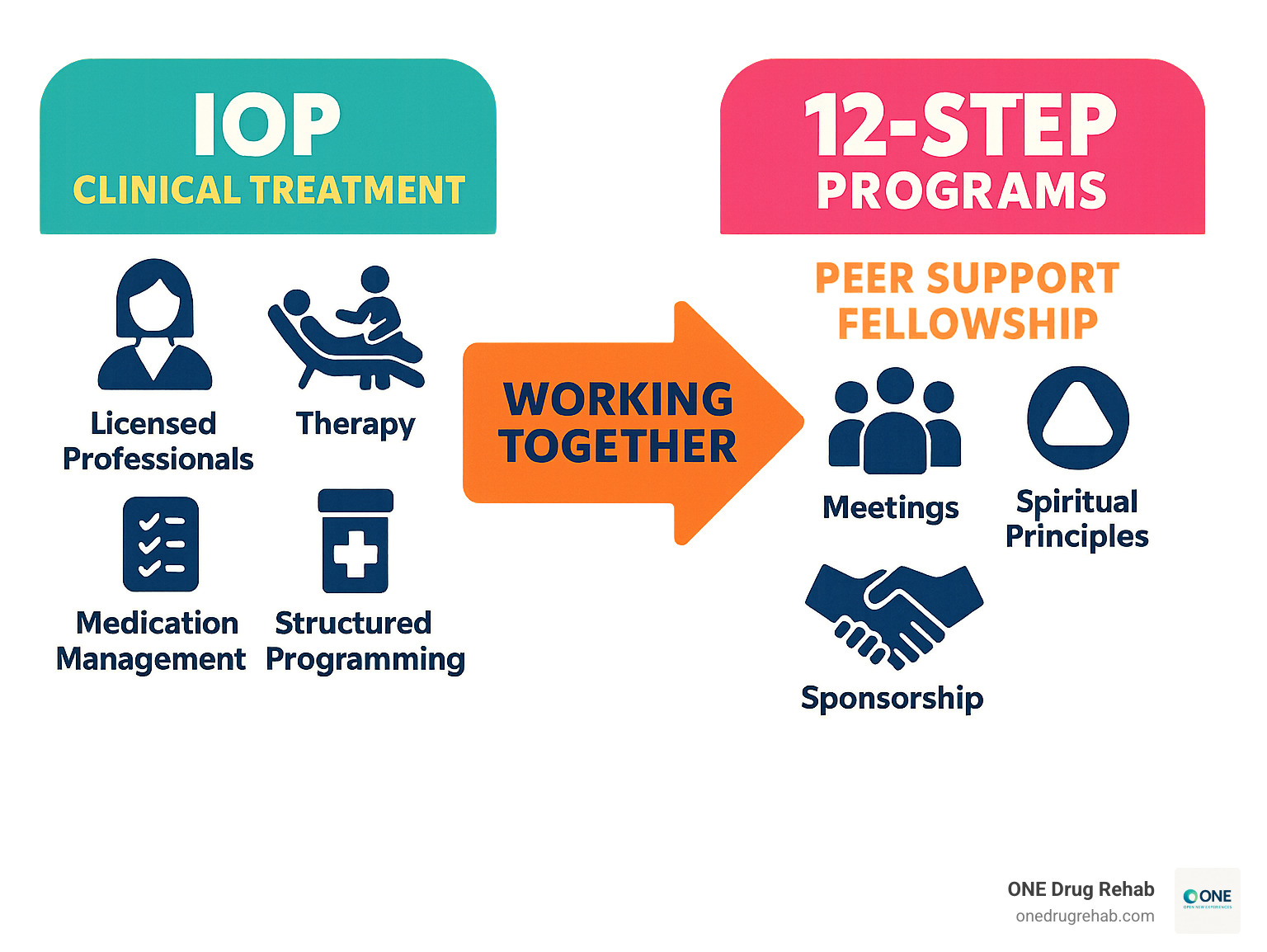
Is intensive outpatient rehab a 12 step program glossary:
Defining the Core Components: IOP vs. 12-Step Programs
To clarify the answer to is intensive outpatient rehab a 12 step program, understand what each one is. Think of them as two different tools for recovery that work in distinct ways.
What is an Intensive Outpatient Program (IOP)?
An Intensive Outpatient Program is clinical treatment provided by licensed professionals in a structured medical setting. It offers an intensive therapy schedule while you continue to live at home.
An IOP provides comprehensive treatment while allowing you to maintain your daily life, such as work or school. It’s designed for people who need more than weekly therapy but do not require 24/7 residential care.
Key features of an IOP include:
IOPs require a significant time commitment, typically 9 or more hours per week spread across several days. The schedule may be more intensive at the beginning of treatment.
Treatment is comprehensive and evidence-based. It includes individual therapy with licensed therapists to address the underlying causes of addiction and cornerstone group therapy sessions for peer connection and learning. Many programs also include family counseling, as addiction impacts the entire family unit.
IOPs are ideal as a step-down from inpatient rehab or for individuals with a stable home environment who don’t require round-the-clock supervision. Research shows IOPs can be as effective as inpatient treatment for many people, offering professional support while you apply new skills in your daily life. For more info about Intensive Outpatient Rehab Programs, we have detailed information to help you explore this option.

What is a 12-Step Program?
In contrast, 12-Step programs are not clinical treatment; they are peer support fellowships. These are communities of people with shared experiences in recovery who help one another.
The model began with Alcoholics Anonymous (AA) in 1935 and has since been adapted for other addictions, including Narcotics Anonymous (NA) and Cocaine Anonymous (CA).
The heart of these programs is the “12 Steps,” a set of guiding principles for recovery. Key concepts include admitting powerlessness over addiction, surrender to a higher power (interpreted individually), making amends to those harmed, and experiencing a spiritual awakening.
What makes 12-Step programs unique is their structure:
- Meetings are the primary venue for sharing stories and mutual support. They are member-run and free to attend.
- Sponsorship is also key. A sponsor is an experienced member who mentors a newcomer through the steps.
The programs are spiritual, not religious, and the concept of a “higher power” is broad and open to individual interpretation. The main benefits of 12-Step programs are their accessibility and longevity. Meetings are available almost anywhere at no cost, providing a lifelong community of support that many people rely on for years or even decades.
So, Is Intensive Outpatient Rehab a 12-Step Program? The Integration Model
Now that we’ve defined each approach, let’s directly address the question: is intensive outpatient rehab a 12 step program?
The Short Answer: No, But They Often Work Together
The straightforward answer is no. An IOP is not a 12-Step program. They are fundamentally different approaches to addiction recovery.
The key distinction is that IOPs are a level of care, while 12-Step programs are a recovery philosophy. An IOP is like a classroom where you learn recovery skills from licensed therapists. A 12-Step program is like a support group where you learn from peers who have walked the same path.
IOPs are clinical treatment programs with structured schedules, evidence-based therapies, and professional oversight. In contrast, 12-Step programs are peer-led fellowships based on shared experience and spiritual principles, run by members, not professionals.
However, they work together effectively. According to SAMHSA, 65.5% of treatment centers use 12-Step models in some capacity. This integration of professional treatment and peer support creates a powerful foundation for lasting recovery.
Understanding 12-Step Facilitation in an IOP Setting
Many IOPs use 12-Step Facilitation Therapy (TSF). This means the clinical team helps you understand and connect with 12-Step fellowships as part of your broader recovery plan, rather than the IOP itself being a 12-Step program.
In an IOP using TSF, your treatment may include:
- Encouraging meeting attendance: Your therapist helps you find local AA, NA, or other meetings.
- Step work introduction: Your therapist may discuss 12-Step concepts like acceptance and making amends to support your clinical goals.
- Connecting with sponsors: Your team educates you on the role of a sponsor and how to find one.
This integration creates a seamless transition from the intensive clinical support of an IOP to the long-term community support of a 12-Step fellowship. Research shows that beginning 12-Step participation during treatment leads to better outcomes. Early, frequent, and active involvement is linked to stronger recovery and relapse prevention.
This integrated approach offers the best of both worlds: professional clinical guidance and a supportive community. To explore how this fits into the broader landscape of recovery options, check out our guide to different Types of Addiction Treatment.
Comparing the Paths: Benefits of 12-Step and Non-12-Step IOPs
Understanding that IOPs can integrate 12-Step principles helps answer the deeper question behind is intensive outpatient rehab a 12 step program: which path is right for you? Both approaches have powerful advantages, and the best fit depends on your personal needs.
Benefits of an IOP with a 12-Step Model
When an IOP incorporates 12-Step principles, it combines professional clinical care with a time-tested recovery framework.
- Built-in Support Network: The most immediate benefit is a community of people who understand the struggle, offering support and celebrating milestones.
- Sponsorship: This provides personal guidance from an experienced member who helps you work through the 12 Steps.
- Clear Structure: The 12 Steps offer a clear structure for recovery, providing a straightforward roadmap that can be reassuring in early recovery.
- Long-Term Aftercare: 12-Step programs offer a long-term aftercare plan through a lifelong fellowship, ensuring continuous support after IOP completion.
- Proven Effectiveness: Research shows the proven effectiveness of active 12-Step participation, linking it to significantly better long-term outcomes.
Benefits and Alternatives: The Non-12-Step IOP Approach
12-Step programs aren’t for everyone, and non-12-Step IOPs offer compelling advantages that may better suit your beliefs and recovery style.
- Focus on Empowerment: These programs often focus on empowerment and individual control. You learn to rely on your internal strength to make changes, rather than surrendering to a Higher Power.
- Secular Approach: They offer a secular approach with no “higher power” requirement, which is ideal for those who are atheist, agnostic, or prefer to separate spirituality from treatment.
- Evidence-Based Alternatives: They use evidence-based alternatives like Cognitive Behavioral Therapy (CBT) to change thinking patterns and SMART Recovery for practical craving management tools.
- Holistic Options: Many incorporate Holistic Treatment Programs, addressing the whole person through activities like yoga, mindfulness, and nutrition.
- Addressing Co-occurring Disorders: Non-12-Step IOPs often excel at this. Specialized programs can provide comprehensive Co-occurring Disorder Treatment to address addiction alongside mental health challenges like depression or anxiety simultaneously.
This approach is a good fit for those who find the spiritual language of 12-Step programs off-putting, prefer professional guidance over peer support, or thrive with highly individualized treatment. The best program is the one that aligns with your needs and helps you maintain sobriety.
How to Choose the Right IOP For You
Choosing an IOP can feel overwhelming, especially when trying to determine if a 12-Step approach is right for you. The “best” program is the one that fits your personality, beliefs, and recovery goals.
Here’s a comparison table to help you see the key differences:
| Factor | 12-Step Integrated IOP | Non-12-Step IOP |
|---|---|---|
| Philosophy | Emphasizes surrender, spiritual principles (Higher Power), peer support, and a structured recovery path | Focuses on individual empowerment, self-reliance, scientific methods, and secular approaches |
| Core Focus | Combines clinical therapy with engagement in 12-Step philosophy and community for long-term sobriety | Clinical therapy using diverse evidence-based modalities (CBT, DBT, SMART Recovery) without 12-Step affiliation |
| Approach to Sobriety | Often views addiction as a disease requiring spiritual and community-based solutions, alongside clinical care | Views addiction as a treatable condition influenced by psychology and behavior, manageable through learned skills and self-control |
| “Higher Power” | Integral to the philosophy, though interpreted individually (spiritual, not necessarily religious) | Not a component; recovery is typically framed within a secular or humanistic context |
| Community | Strong emphasis on peer fellowship, sponsorship, and a built-in, lifelong support network | Community support derived from therapy groups and encouragement to build healthy social connections, potentially including secular groups |
| Best Fit For | Individuals open to spiritual concepts, seeking strong peer community, and a structured, time-tested framework | Individuals preferring a secular approach, emphasizing personal control, or those with negative experiences with 12-Steps |
Factors to Consider When Making Your Decision
When weighing your options, several key factors can guide your decision:
- Personal Beliefs and Spirituality: Decide if you prefer a spiritual path involving surrender to a Higher Power or a secular approach focused on personal control and evidence-based strategies.
- Co-occurring Conditions: If you have mental health challenges like depression or anxiety, ensure the program offers integrated treatment for dual diagnosis.
- Treatment Philosophy Preference: Do you prefer admitting powerlessness and surrendering, or building skills for direct control over your recovery?
- Past Experiences: Reflect on past recovery attempts. If you’ve had positive experiences with 12-Step meetings, an integrated IOP may be a good fit. If not, consider non-12-Step alternatives.
- Program Structure: Also consider practical factors like scheduling flexibility and the aftercare plan.
How to find out if an intensive outpatient rehab is a 12 step program
To determine a program’s philosophy, you’ll need to do some research.
- Research facilities online. Look for terms like “12-Step based,” “12-Step facilitated,” or “non-12-Step approach” on their websites, but be aware that marketing language can be vague.
- Ask direct questions when you contact a facility. Inquire if they use 12-Step principles, encourage meeting attendance, and what their primary therapeutic approaches are. Ask about non-12-Step alternatives.
- Inquire about their treatment philosophy. Ask if they view addiction as a disease requiring spiritual intervention or a condition managed through learned skills. This reveals their core approach.
Our platform at ONEDrugRehab.com makes it easier to Compare Rehab Centers and gather the information you need to make an informed decision. Asking these questions is a smart way to take charge of your recovery.
Frequently Asked Questions about IOP and 12-Step Programs
Here are answers to common questions about the relationship between IOPs and 12-Step programs.
What are the key differences between a 12-Step program and other outpatient treatments?
The core question “is intensive outpatient rehab a 12 step program” highlights these fundamental differences. In short, a 12-Step program is a peer support group, while an IOP is a clinical treatment program.
- Leadership: 12-Step meetings are peer-led by volunteers. IOPs are staffed by licensed addiction counselors, therapists, and medical professionals.
- Cost: 12-Step meetings are free. IOPs have a cost, though they are often covered by insurance.
- Services: 12-Step programs offer peer support and a spiritual framework. IOPs provide structured therapy, evidence-based coping skills, and professional assessment.
They are designed to work together, not replace each other. An IOP provides professional tools, while 12-Step meetings offer a supportive community.
Can I attend 12-Step meetings while in a non-12-Step IOP?
Absolutely yes. You are not choosing sides. Even if your IOP follows a completely secular, non-12-Step approach, you can still attend any 12-Step meetings you find helpful.
This combination can be incredibly powerful. Your IOP provides structured learning and professional guidance, while 12-Step meetings offer daily access to a community that understands your journey. When your IOP ends, those meetings can continue providing support for as long as you need.
The choice is entirely yours. There’s no wrong way to combine resources if they are helping your recovery.
How do I know if an IOP is right for me?
A professional assessment is the best starting point, but these factors can help you determine if an IOP is a good fit:
- Addiction Severity: IOPs are best for mild to moderate substance use issues that don’t require 24/7 medical supervision. Severe cases may need inpatient treatment first.
- Home Situation: A safe, supportive living environment is crucial for IOP success, as you will be returning home each day.
- Co-occurring Disorders: An IOP specializing in dual diagnosis is ideal if you have mental health issues like depression or anxiety alongside addiction.
- Motivation Level: High motivation is key, as IOPs require a significant time commitment (usually 9+ hours per week) and active participation.
- Life Responsibilities: IOPs are perfect if you need to maintain work, school, or family duties, with many offering flexible evening or weekend schedules.
If you are motivated, have a stable living situation, and need more support than weekly therapy but less than residential treatment, an IOP could be the right level of care for you.
Conclusion: Building a Comprehensive and Personalized Recovery Plan
Your recovery journey is unique. By now, you understand that the answer to is intensive outpatient rehab a 12 step program is not a simple yes or no. An IOP is a clinical level of care, while a 12-Step program is a peer-support fellowship. The beauty lies in how these two approaches can work together, bridging professional treatment and community support.
Your Path to Recovery
Personalization is everything in recovery. There is no one-size-fits-all solution.
- A 12-Step integrated IOP may be right if you value community, a structured framework, and spiritual elements.
- A non-12-Step IOP might be a better fit if you prefer a secular, empowerment-focused approach using therapies like CBT or SMART Recovery.
The most effective recovery plans combine professional guidance with ongoing support. Whether that support comes from 12-Step meetings, secular recovery groups, or family therapy, having multiple pillars of support gives you the best chance at lasting success.
At ONEDrugRehab.com, we are your trusted companion in researching treatment options. We provide the information you need to make the best decision for your unique situation, without pressure or bias. Recovery is possible, and it starts with taking that first step. Seeking help is a sign of strength.
Explore your treatment options today and take the next step toward the life you deserve. Your journey to healing and lasting sobriety is waiting for you.