

Understanding Recovery Support Groups: Your First Step to Finding Help
Recovery support groups are free, peer-led organizations where people affected by substance use share experiences, offer encouragement, and learn strategies for maintaining sobriety. They operate on the principle that shared experience offers unique support beyond what professional treatment alone can provide.
Quick Overview: Types of Recovery Support Groups
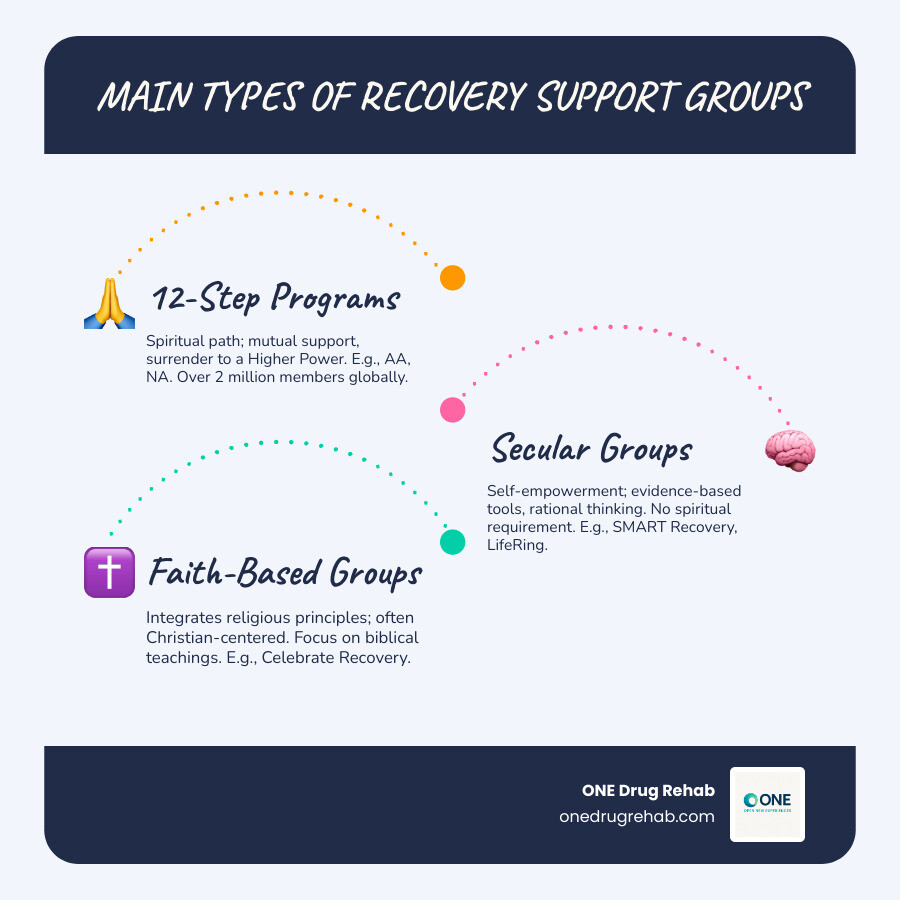
- 12-Step Programs (AA, NA) – Spiritual approach emphasizing powerlessness and surrender to a Higher Power; 2+ million members worldwide
- Secular Groups (SMART Recovery, LifeRing) – Evidence-based, self-empowerment approach using cognitive-behavioral tools; no spiritual component required
- Faith-Based Groups (Celebrate Recovery) – Christian-centered recovery using biblical principles; 17,000 groups globally
- Specialized Groups – Women-only, LGBTQ+, young adult, dual diagnosis, and family support groups
Groups exist for various addictions and for family members seeking support.
Research shows these groups work. The 2016 U.S. Surgeon General’s Report on Alcohol, Drugs, and Health concluded that linking people to mutual-help groups has strong scientific support. Studies find that groups like AA and NA help people maintain abstinence by boosting coping skills, building confidence, strengthening motivation, and creating sober social networks.
This guide covers the types of recovery support groups, the science behind them, and how to find one that fits your needs.
Why Peer Support Works: The Science of Connection in Recovery
Peer support is a powerful, science-backed tool in recovery. Connecting with someone who understands the journey is deeply healing and combats the isolation of addiction.
The Power of Shared Experience and Peer Support
In your first recovery support groups meeting, you realize your struggles with shame and despair are shared experiences. This immediate sense of belonging helps break down the walls of isolation. This connection follows the reciprocal helping model: helping others reinforces your own recovery. By sharing your experience with a newcomer, you strengthen your own commitment.
Sponsorship, common in 12-step programs, deepens this connection. A more experienced member guides a newcomer, providing accountability, compassionate support, and living proof that long-term sobriety is possible.
Mechanisms of Change: Boosting Coping Skills and Motivation
Research shows that participation in recovery support groups creates measurable change. It’s not magic; it’s a combination of practical skills and psychological shifts.
- Boosting coping skills happens as you hear real-world, battle-tested strategies for handling triggers and stressful situations.
- Increasing abstinence self-efficacy—your confidence that you can stay sober—grows as you see others achieve recovery milestones. You start to believe, “If they can do it, maybe I can too.”
- Strengthening recovery motivation occurs through the group’s collective energy. The encouragement and accountability fuel your commitment when your own willpower is low.
Building a Sober Social Network
Recovery often requires changing your social environment. Old friends and hangouts can work against your sobriety. Recovery support groups provide a ready-made sober social network. You build new friendships based on mutual support and healthy activities. This shift from unsupportive contacts to a recovery-focused community is crucial. Research consistently shows that positive social connections are one of the strongest predictors of long-term sobriety.
The Evidence Base
The effectiveness of peer support is well-documented. The 2016 United States’ Surgeon General’s Report on Alcohol, Drugs, and Health concluded that professional treatments connecting people to mutual-help groups have strong scientific support. Study after study links participation in 12-step groups to higher rates of abstinence over time. The science confirms what many in recovery already know: connection is a fundamental ingredient in lasting recovery.
Exploring the Landscape of Recovery Support Groups
Choosing a recovery support group can feel overwhelming, but the variety of options means you can find a perfect fit. No single path is right for everyone; what matters is finding a group that aligns with your personal beliefs and needs. We can organize the landscape into three main categories: 12-Step programs, Secular alternatives, and Faith-Based groups.

The 12-Step Model: A Spiritual Path to Sobriety
The core philosophy of 12-step programs is admitting powerlessness over addiction and surrendering to a “Higher Power.” This concept is open to personal interpretation—it can be God, the group itself, nature, or any power greater than oneself. The focus is on spiritual and emotional growth through the twelve steps.
The two biggest organizations are Alcoholics Anonymous (AA) for alcohol use disorder and Narcotics Anonymous (NA) for drug addiction. AA has over 2 million members worldwide, and NA has 67,000 groups in 139 countries. You’ll also find specialized 12-step groups for other addictions, such as Cocaine Anonymous (CA) and Gamblers Anonymous (GA), as well as groups for sexual addiction like Sex Addicts Anonymous in New York City and Sexaholics Anonymous Dallas. Our directory also lists local AA groups such as Bills Friends AA Group, Jovenes Brooklyn AA, and Northern New Jersey Alcoholics Anonymous, along with NA groups like Narcotics Anonymous and Fort Worth Area of Narcotics Anonymous.
The structure is democratic, with each group being self-run (group autonomy). Anonymity is a core principle. Sponsorship, a one-on-one guidance relationship between a newcomer and an experienced member, is a key feature. Meetings vary, including speaker and discussion formats.
Secular Alternatives: Empowerment and Evidence-Based Tools
If you prefer a scientific, psychology-based approach, secular recovery support groups focus on personal empowerment and practical tools.
The core philosophy emphasizes self-empowerment. Instead of powerlessness, these groups teach that you are capable of change through rational thinking and evidence-based strategies. From cognitive-behavioral principles, they focus on changing unhelpful thought patterns and behaviors without a spiritual component.
Key organizations include SMART Recovery (Self-Management And Recovery Training), which uses a 4-point program grounded in CBT and offers over 3,000 weekly meetings worldwide. LifeRing Secular Recovery emphasizes the “sober self,” and Women for Sobriety is designed for women, focusing on self-esteem. Other options include Secular Organizations for Sobriety (SOS).
The structure of secular groups often involves vertical governance, with a national organization overseeing trained facilitators and standardized programs. Meetings, led by trained facilitators, are educational and focus on practicing specific, scientifically validated tools and techniques.
Faith-Based Groups: Integrating Religion and Recovery
For those whose faith is central to their identity, faith-based recovery support groups integrate religious beliefs into the recovery journey.
The core philosophy is rooted in specific religious teachings. Christian-based programs, the most common, use Christ-centered principles and biblical teachings to overcome “hurts, habits, and hang-ups.” Healing is seen as coming through a relationship with God and the support of a faith community.
The biggest organization is Celebrate Recovery, with 17,000 groups worldwide. Other groups serve specific communities, such as Jewish Alcoholics, Chemically Dependent Persons, and Significant Others (JACS) and Millati Islami for Muslims.
The structure is typically church-affiliated. These programs often use a modified 12-step model where the Higher Power is explicitly defined as God or Jesus Christ. Meetings might include worship, teaching, and gender-specific small groups, following a standardized curriculum.
Comparing the Models: Which Group is Right for You?
Choosing the right recovery support groups is about finding a philosophy that resonates with your personal beliefs and goals. There’s no universal “best” option, only the path that is right for you.

Here’s a quick comparison to help you in finding your personal philosophy:
-
12-step programs (AA, NA) view addiction as a disease requiring spiritual awakening and surrender to a flexible “Higher Power.” They are peer-led, free (with voluntary donations), and focus on group discussion and shared experience.
-
Secular groups (SMART Recovery) see addiction as a learned behavior that can be changed with evidence-based tools from cognitive-behavioral therapy. They focus on self-empowerment, are led by trained facilitators, and require no spiritual component.
-
Faith-based groups (Celebrate Recovery) view addiction as a spiritual problem requiring divine intervention. They are explicitly Christ-centered, using biblical principles and prayer as core tools. Meetings are often church-affiliated and follow a set curriculum.
The role of spirituality is a key differentiator: it’s flexible in 12-step, absent in secular, and central and defined in faith-based programs. Don’t be afraid to try a few different types to find your fit.
The evidence behind recovery support groups
The amount of research varies by model. The 12-step model is the most studied; studies consistently show that AA participation helps promote better alcohol outcomes. The 2016 Surgeon General’s Report confirms that 12-step facilitation approaches have strong scientific support for boosting coping skills and building sober social networks as shown in other research.
Secular group effectiveness is promising, though these groups are newer and less researched. Initial studies on SMART Recovery show positive outcomes, but more long-term research is needed.
Religious group effectiveness has the least scientific data, despite countless powerful success stories. This doesn’t mean they don’t work, only that rigorous research has not yet caught up with their growth.
Finding the right recovery support groups for your needs
Beyond the main categories, specialized groups serve specific communities.
For co-occurring disorders (substance use and mental health conditions), groups like Dual Recovery Anonymous offer integrated support, addressing both issues simultaneously.
Meetings for specific demographics like women-only groups, LGBTQ+ meetings, and young people’s groups can increase group cohesion and identification, making it easier to stick with the program.
Addiction affects loved ones, too. Support for family and friends is available through groups like Al-Anon and Alateen, Nar-Anon Family Groups, and Families Anonymous. These groups provide a space for loved ones to learn coping strategies and find their own support.
Practical Steps to Joining a Recovery Support Group
Taking the leap to attend a meeting can be intimidating, but the recovery community is built on welcoming newcomers. Here’s how to get started.
Finding Meetings Near You
Finding meetings is easier than ever. Major organizations like Alcoholics Anonymous (AA) and Narcotics Anonymous (NA) have online directories. The U.S. government’s FindTreatment.gov and the Substance Abuse and Mental Health Services Administration (SAMHSA) are also excellent resources. Also, check for meetings in local community centers, churches, and libraries.
The Cost Question
Recovery support groups are almost universally free. There are no dues or fees. You may see a basket passed for voluntary donations to cover expenses like rent and coffee, but contributing is entirely optional. Financial barriers should never prevent anyone from getting help.
Understanding Different Meeting Formats
Meetings come in various formats. Understanding them can help you find the right fit.
- In-person vs. Online: Traditional meetings offer face-to-face connection, but the rise of online meetings (often on Zoom) has been a game-changer, increasing accessibility for those in rural areas, with mobility issues, or who simply prefer starting from home.
- Open vs. Closed: Open meetings welcome anyone, including family or students. Closed meetings are reserved for those who identify with the group’s specific addiction.
- Speaker vs. Discussion: Speaker meetings feature one or more members sharing their full recovery story. Discussion meetings involve members sharing thoughts on a specific topic.
Your First Meeting: What to Really Expect
When you attend your first meeting, remember this: no one will pressure you to share. You can sit quietly and just listen. Anonymity is a cornerstone, so people typically use first names only, and what’s said in the meeting stays there. This creates a safe, non-judgmental space. The atmosphere is usually warm and welcoming, as members remember what it felt like to be new.
Finding Your Home Group
Try several different meetings before settling on one. Each meeting has its own personality. When you find one where you feel comfortable and connected, it can become your “home group”—your consistent anchor in recovery. Many people attend their home group weekly while also visiting other meetings.
Frequently Asked Questions about Recovery Support Groups
It’s natural to have questions before attending a group. Here are answers to some of the most common concerns.
Do I have to be religious to attend a 12-step meeting?
No. While 12-step programs like AA and NA are spiritual, they are not religious. The term “Higher Power” is intentionally left open to your personal interpretation. For some, it’s God; for others, it’s the group itself, nature, or a set of principles like honesty and humility. Many agnostic and atheist members thrive in these programs by focusing on the spiritual principles rather than any doctrine. If the spiritual language is a barrier, secular groups like SMART Recovery are excellent alternatives.
How do I know if a support group is working for me?
You’ll know a group is working if you feel a genuine feeling of connection with other members, are gaining useful tools for daily life, and notice reduced cravings and an improved sense of well-being. If a particular meeting doesn’t click, that’s okay. It’s okay to try different groups to find the right fit. Different meetings have different personalities, and finding your “home” is a process.
Can support groups replace professional treatment?
Usually, no. They serve complementary roles. Professional treatment—such as medically supervised detox, therapy, or medication management—is often essential for the initial stages of recovery to ensure safety and address underlying issues. Support groups then provide vital aftercare. They are the ongoing community, accountability, and daily reinforcement needed to maintain long-term sobriety.
At ONEDrugRehab.com, we see this partnership as key. Our directory can help you research professional treatment options that might be the crucial first step you need. These formal treatments, combined with the long-term community of recovery support groups, offer the best chance at lasting recovery.
Conclusion: Your Journey to a Supported Recovery Starts Here
Recovery is a journey best taken with others. We’ve explored the diverse landscape of recovery support groups, from the spiritual foundation of 12-step programs like AA and NA, to the evidence-based tools of secular groups like SMART Recovery, and the Christ-centered healing of faith-based communities like Celebrate Recovery.
The common thread is the power of peer connection. Sharing with others who understand reduces isolation, teaches coping skills, and builds a sober social network—all factors that research shows are key to long-term sobriety. There is no single “right” way to recover. The goal is to find a group that aligns with your beliefs and where you feel supported. Don’t be afraid to try several options before finding your home.
Your journey begins with that first step into a meeting, whether physical or virtual. The right recovery support group can become a cornerstone of your new life, a place to find support in tough times and celebrate your successes.
At ONEDrugRehab.com, we’re here to help you explore all your options. While support groups offer vital peer connection, many people begin their journey with professional treatment. Our directory is a resource for researching these options, from medically supervised detox to individual therapy, which complement the long-term support found in groups.
Recovery is possible, and you don’t have to do it alone. To explore the full spectrum of professional care available, from detox programs to various therapy approaches, browse our comprehensive guide on the types of addiction treatment. Whatever path you choose, we’re rooting for you.