

Why Group Therapy Is a Game-Changer for Addiction Recovery
How does group therapy help addiction? Group therapy transforms addiction treatment by using the natural human need for connection to break through isolation, shame, and denial that fuel substance abuse. Instead of facing recovery alone, people find they’re part of a community that truly understands their struggles.
Quick Answer: The 5 Key Ways Group Therapy Helps Addiction:
- Reduces Isolation – Connects you with others who share similar experiences
- Provides Accountability – Group members support and motivate each other to stay sober
- Builds Social Skills – Practice healthy communication and relationships in a safe space
- Offers Hope – See others succeed in recovery and believe it’s possible for you too
- Creates Cost-Effective Treatment – Get professional help at a fraction of individual therapy costs
Addiction thrives in secrecy and isolation. It tells you that you’re different, broken, or beyond help. But group therapy flips this script entirely. When someone shares an issue in group, others realize “I can relate to that issue as well,” creating powerful moments of connection and understanding.
Research shows that group therapy is as effective as individual therapy for treating substance use disorders – and sometimes even more beneficial. People who engage in group therapy tend to be more committed to maintaining abstinence because they’re not just accountable to themselves, but to their group family.
This guide will walk you through exactly how group therapy works, what types are available, and why it might be the missing piece in your recovery journey.
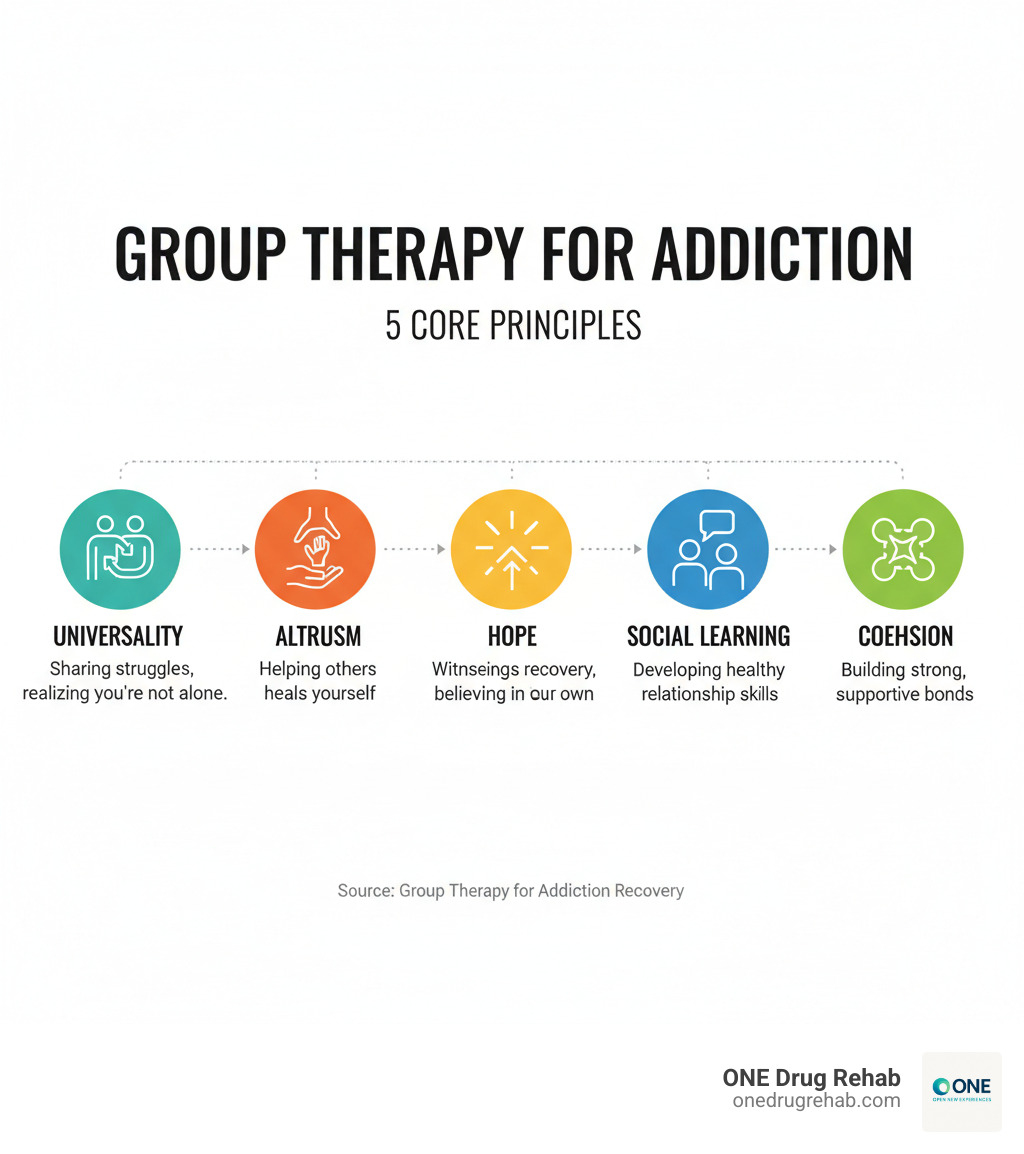
The Core of Connection: Understanding Group Therapy’s Role in Recovery
Addiction thrives in isolation, creating a wall of shame and fear that separates you from others. How does group therapy help addiction break this cycle? It brings people together who genuinely understand the struggle, creating a powerful sense of connection that combats loneliness.
Imagine walking into a room where you’re not the only one carrying heavy feelings of anxiety or shame. Hearing others voice your exact thoughts creates a bridge of shared experience. This is the heart of group therapy: replacing the isolation that fuels addiction with genuine human connection and a supportive community.

The Primary Purpose: Creating a Safe Space for Healing
Group therapy is a structured, therapist-led environment designed for healing. A trained professional guides sessions to ensure conversations are productive and everyone feels safe to be vulnerable. This guidance is what distinguishes group therapy from a casual support group.
The process normalizes the struggles of addiction. Hearing others describe similar thoughts and behaviors helps you realize you’re not uniquely broken. This shared understanding fosters mutual trust and allows members to gain new perspectives on their own challenges. Witnessing others at different stages of recovery provides a living, breathing example that healing is possible, instilling hope when it’s needed most.
Breaking the Chains of Isolation
Group therapy directly challenges addiction’s loneliness by creating meaningful peer connections. The moment of “me too” when someone shares their story breaks through the walls addiction builds. This mutual understanding, built on shared experience, fosters trust and allows for honest communication—skills that transform all relationships in your life.
The Transformative Benefits of Group Therapy for Addiction
How does group therapy help addiction transform lives? It combines professional guidance with peer support to create an environment where accountability, social connection, and hope flourish. It offers unique benefits that individual therapy can’t match, turning a lonely battle into a shared journey.
Fostering Accountability and Motivation
Making a commitment to sobriety in front of peers creates a powerful circle of support. Sharing progress becomes a celebration, and the group’s collective encouragement strengthens your commitment to abstinence. This shared accountability transforms recovery from a solitary struggle into a team effort, providing an extra push when you’re tempted to give up.
Rebuilding Social and Communication Skills
Addiction often erodes social skills. Group therapy provides a safe training ground to rebuild them. In this re-socialization process, you practice essential skills for healthy relationships, including:
- Practicing assertiveness to state your needs clearly.
- Active listening to better understand others.
- Giving and receiving feedback constructively.
- Healthy conflict resolution to steer disagreements respectfully.
Gaining Perspective and Improving Self-Esteem
Hearing your own struggles reflected in others helps you realize you’re not alone, which diminishes shame. Peer validation from those who’ve walked a similar path carries special weight, helping you see the strength in yourself that others see in you. By learning from others’ experiences and coping strategies, you gain new perspectives and build the improved confidence needed for lasting recovery.
Exploring the Different Types of Group Therapy for Addiction
Recovery isn’t one-size-fits-all, which is why various group therapy approaches exist. Understanding these options helps answer how does group therapy help addiction from multiple angles, allowing you to find the best fit for your situation.
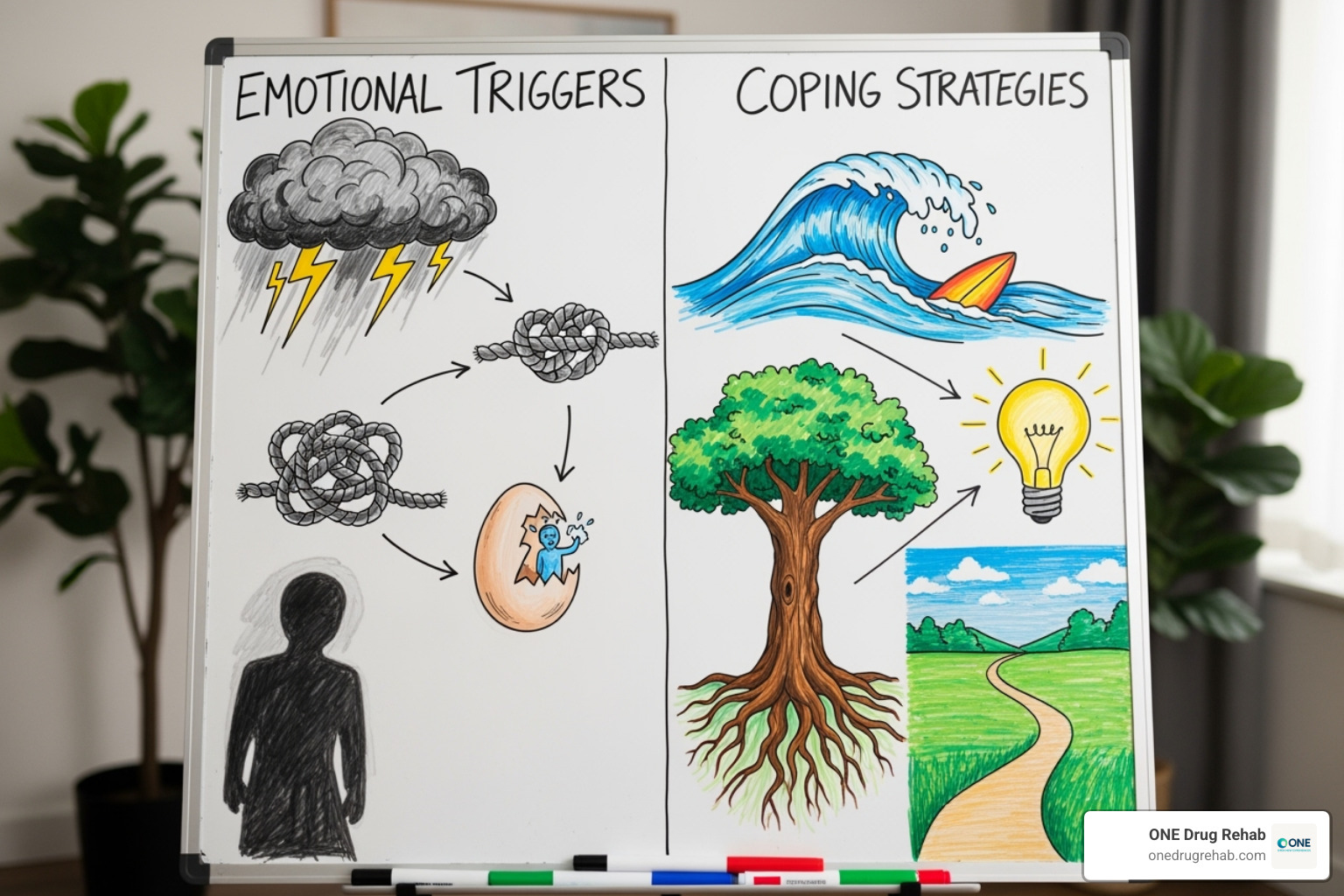
Educational and Skill-Building Groups
These groups function like a recovery classroom, providing knowledge and practical tools.
- Psychoeducational groups teach the science behind addiction, including how substances affect the brain and why cravings occur.
- Skills development groups offer a space to practice new ways of handling stress, anger, and social triggers, often through role-playing.
- Relapse prevention groups focus on identifying personal triggers, recognizing warning signs, and creating a solid plan to stay on track.
How does group therapy help addiction using therapeutic models?
Many evidence-based therapies are adapted for group settings to maximize their impact.
- Cognitive Behavioral Therapy (CBT) groups help you identify and change the negative thought patterns that fuel addiction.
- Dialectical Behavior Therapy (DBT) groups teach skills for managing intense emotions, tolerating distress, and improving relationships.
- Motivational Interviewing techniques are used to help members resolve ambivalence and build intrinsic motivation for change.
- Seeking Safety groups are for those with co-occurring trauma and substance use, focusing on building coping skills to establish safety.
A comprehensive review of these treatments confirms their effectiveness. You can explore the evidence by reading A review of group therapy for substance use disorders.
Process-Oriented and Support Groups
These groups emphasize authentic connection and shared experience.
- Interpersonal process groups use the group itself as a lab to explore relationship patterns and practice healthier ways of connecting.
- Peer-led support groups, such as those based on the 12-Step model, rely on the collective wisdom of members to provide ongoing community support.
How Does Group Therapy Help Addiction: The Scientific Evidence
When we explore how does group therapy help addiction, we rely on solid scientific research. The evidence consistently shows that group therapy is a highly effective, evidence-based practice for treating substance use disorders, leading to improved abstinence rates and overall well-being.
Science confirms that “Group therapy is as effective in the treatment of substance use as individual therapy, and, in certain instances, may be even more beneficial.” Participants often show greater commitment to long-term sobriety due to the strong peer support system.
Effectiveness for Stimulant and Marijuana Use Disorders
Research shows strong results for various substances:
- Cocaine and Methamphetamine: Group approaches like Cognitive Behavioral Therapy (CBT) and especially Contingency Management (CM), which uses incentives to reward abstinence, are highly effective at reducing stimulant use.
- Marijuana: Relapse prevention, motivational interviewing, and social support groups have all proven more effective at reducing marijuana use than delayed treatment.
Effectiveness for Opioid Use and Co-Occurring Disorders
Group therapy is a vital component of comprehensive treatment, especially for complex cases.
- Opioid Use: Studies show that “Group therapy or group CBT plus pharmacotherapy are more effective at decreasing opioid use than pharmacotherapy alone.” The combination of medication and group support creates a powerful synergistic effect.
- Dual Diagnosis: Group therapy excels at treating co-occurring mental health issues like anxiety, depression, or PTSD alongside addiction. Models like Seeking Safety (for trauma) and Dialectical Behavior Therapy (DBT) (for emotional dysregulation) are particularly effective at reducing both substance use and psychiatric symptoms. For more on integrated treatment, see this research on treating dual diagnosis.
Group Therapy vs. Individual Therapy: Which Is Right for You?
Choosing the right therapy for addiction recovery can feel overwhelming, but you don’t have to pick just one. Many people find success by combining group and individual therapy. Each has distinct strengths: group therapy excels at building community, while individual therapy offers personalized attention.
How does group therapy help addiction compared to one-on-one sessions? The table below breaks down the key differences.
| Feature | Group Therapy | Individual Therapy |
|---|---|---|
| Cost | Typically less expensive | Generally more expensive |
| Structure | 5-15 participants, 1-2 therapists; structured or unstructured | One-on-one with a therapist; highly individualized |
| Focus | Peer interaction, shared experiences, community, social skills, universalization | Deep dive into personal history, specific triggers, individualized coping, intense focus on one person |
| Key Benefits | Reduces isolation, builds social skills, peer accountability, diverse perspectives, hope, validation | Privacy, intense focus, custom interventions, addressing specific trauma, deeper therapeutic alliance |
| Potential Drawbacks | Confidentiality concerns, less individual attention, discomfort for shy individuals, group dynamics challenges | Can be isolating, higher cost, lack of peer perspective, reliance on one relationship, can be slow-paced for some |
How does group therapy help addiction when considering its limitations?
Group therapy’s main strengths are its ability to build community, reduce isolation, and provide peer accountability at a lower cost. However, some may have concerns about confidentiality or feel shy about sharing. It also offers less one-on-one time with the therapist.
Individual therapy offers complete privacy and a highly customized approach, which is ideal for addressing specific trauma or deeply personal issues. Its main drawbacks are the higher cost and potential for isolation.
The best choice depends on your personality, comfort level, and specific needs. Many find that a combination of both provides the most comprehensive support: individual therapy for deep personal work and group therapy for community and accountability. Discuss your options with a healthcare professional to create the right plan for you.
Integrating Group Therapy for Long-Term Recovery and Relapse Prevention
Recovery is an ongoing journey, not a destination. Group therapy provides the lifelong skills and community connections needed to maintain sobriety long-term. How does group therapy help addiction in the long run? It weaves support and accountability into your daily life, creating a safety net that lasts long after formal treatment ends.

Building a Sober Support System
Group therapy helps you build a new network of people who understand your journey. This is crucial when transitioning from treatment back to daily life. This ongoing peer support can be found in:
- Alumni groups connected to treatment centers.
- 12-step meetings and other community-based support groups.
- Healthy friendships formed with peers who are also committed to recovery.
This network provides a defense against the isolation that can lead to relapse.
Applying Group Skills to Everyday Life
The goal is to make the skills learned in group therapy second nature. You’ll be better equipped for navigating real-world triggers because you’ve already role-played and discussed scenarios with your group. The communication skills you practice will help in improving family dynamics and learning to set healthy boundaries. Being part of a recovery community also helps in maintaining motivation, as the group’s collective strength can carry you through difficult days.
Frequently Asked Questions about Group Therapy for Addiction
It’s natural to have questions when considering group therapy. Here are answers to some of the most common concerns.
Is group therapy as effective as individual therapy for addiction?
Yes. Research consistently shows that group therapy is as effective as individual therapy for treating addiction. For some, it’s even more beneficial for long-term abstinence because the strong peer support network creates a unique level of accountability and motivation that is difficult to replicate in one-on-one sessions.
What if I’m not comfortable sharing in a group?
This is a very common concern. A trained facilitator creates a safe, non-judgmental space, and you don’t have to share until you’re ready. Simply listening to others is a powerful part of the healing process, as it helps you feel less alone. You can participate at your own comfort level, and the group will be there to support you when you decide to speak.
How do I find a quality group therapy program?
Finding the right program is key. When researching how group therapy can help your addiction, look for these signs of a quality program:
- Led by licensed therapists with specific training in addiction.
- Uses evidence-based models like CBT or DBT.
- Has clear rules for confidentiality and respectful conduct.
Reputable treatment directories can help you vet programs and compare options in your area. Don’t be afraid to ask questions before committing.
Conclusion: Take the First Step Toward Healing Together
Recovery from addiction doesn’t have to be a solo journey. We’ve explored how does group therapy help addiction by changing isolation into connection and shame into understanding. Its power lies in the shared experience with others who truly know what you’re going through.
Group therapy works because it rebuilds the genuine human connection that addiction takes away. It offers accountability, motivation, and practical skills in a supportive community setting. The scientific evidence is clear: group therapy is as effective as individual therapy and is often more beneficial for maintaining long-term recovery.
You don’t have to figure this out alone. The shame that fuels addiction loses its power in a group setting. Every story shared is proof that recovery is possible, and every skill learned is a tool for your future. The journey is challenging, but it’s filled with hope.
If you’re ready to heal together, know that help is available. Quality group therapy programs, led by licensed professionals, create safe spaces for growth. The community you need is waiting.
You are not alone in this. There is hope, help, and a path forward. Find the right addiction treatment program for you and find how the power of connection can transform your recovery journey.