

Why Understanding How Much Rehab Costs Matters Before You Commit
How much rehab costs depends on several key factors. While the cost shouldn’t stop you from getting help, it’s smart to understand the financial side of treatment.
Quick Cost Overview:
| Program Type | Duration | Average Cost Range |
|---|---|---|
| Detox | 3-7 days | $1,000 – $1,500 |
| Inpatient Rehab | 30 days | $6,000 – $20,000 |
| Inpatient Rehab | 60-90 days | $12,000 – $60,000 |
| Outpatient Rehab | 3 months | $5,000 – $10,000 |
| Luxury Inpatient | 30 days | $30,000 – $100,000+ |
Rehab costs vary wildly. Some programs are free, while others cost thousands per day. A 30-day inpatient program might be $6,000 at one facility and $20,000 at another, with luxury centers running from $30,000 to $100,000 for the same period.
Unlike a car’s sticker price, rehab pricing depends on the type of treatment, length of stay, location, and services offered. A state-funded program may be free, while a private facility with premium amenities will cost significantly more.
Most importantly, research shows that treatment works, especially when it lasts 90 days or longer. For every dollar spent on substance abuse treatment, society saves $4-$7 in drug-related criminal costs, and healthcare savings jump to a 12:1 ratio. Compared to the average annual cost of active addiction—roughly $11,487 per person—treatment is an investment, not just an expense.
This guide will help you understand what you’re paying for, what influences the final bill, and how to make treatment affordable.
Understanding the Building Blocks of Rehab Costs

To understand how much rehab will cost, it helps to know what goes into the price tag. The final cost depends on the level of care, services, and support you need to rebuild your life.
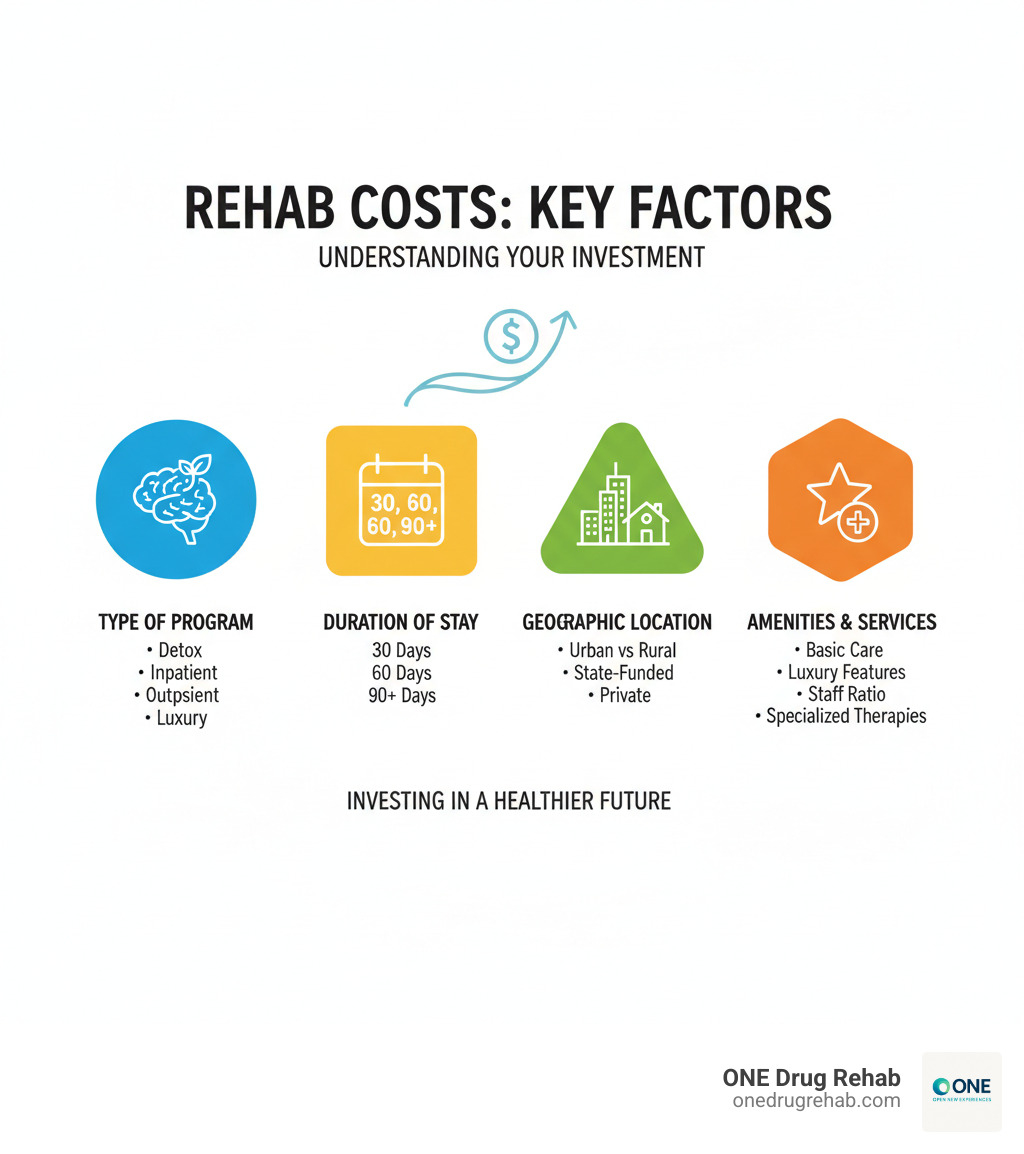
Key Factors That Influence Price
Several core factors determine the cost of treatment:
- Program duration: A 30-day stay costs less than 90 days, but the daily rate often drops for longer commitments.
- Level of care: Medical detox and residential treatment with 24/7 supervision cost more than outpatient programs where you go home each night.
- Location: A facility in a major city like Manhattan or Toronto will have higher operating costs and charge more than one in a rural area.
- Staff-to-patient ratio: A lower ratio means more individualized attention but also a higher cost.
- Rehab accreditation standards: Accredited facilities meet higher standards of care and employ more credentialed professionals, which is reflected in their rates.
- Treatments offered: Programs with specialized therapies like EMDR, equine therapy, or holistic treatments cost more than those offering basic counseling. Medications can also add several thousand dollars to the bill.
How Program Duration Affects Your Bill
The length of your stay is about giving yourself enough time to heal. While 30-day programs are a common starting point ($6,000 – $20,000), research shows that longer stays lead to better outcomes.
- 30-day programs are a good start for those new to treatment or with less severe addiction.
- 60-day programs provide more time to address underlying issues and build coping skills.
- 90-day rehab is widely considered the gold standard for lasting recovery. A 60- to 90-day inpatient stay can cost between $12,000 and $60,000. A three-month outpatient program might cost around $5,000 to $10,000.
- Long-term treatment (6+ months) costs more upfront but has been linked to abstinence rates as high as 71% for some demographics.
Research on treatment effectiveness consistently shows that longer programs reduce relapse rates. The higher cost is an investment in a better chance at long-term sobriety.
Public vs. Private vs. Luxury: What’s the Difference?
The type of facility you choose significantly impacts how much rehab will cost.
| Feature | Public/State-Funded Rehab | Private Rehab | Luxury Rehab |
|---|---|---|---|
| Cost | Free – Low Cost | $5,000 – $80,000+ | $30,000 – $100,000+ |
| Wait Times | Often weeks to months | Minimal to none | Immediate admission |
| Amenities | Basic accommodations | Comfortable, varied | High-end, resort-like |
| Customization | Standardized programs | Individualized plans | Highly personalized |
Public or state-funded programs are often free or use a sliding scale based on income, making them accessible to many. Data on publicly funded treatment shows they serve a huge population. The trade-offs are often long wait times, higher staff-to-patient ratios, and basic accommodations. However, the core treatment can be very effective.
Private rehab centers charge for services but offer immediate admission, individualized treatment plans, and more comfortable settings. Costs can range from $5,000 to $35,000 or more, depending on the program’s length and intensity.
Luxury rehab costs $30,000 to $100,000+ for a 30-day stay. You’re paying for privacy, comfort, and a resort-like atmosphere with amenities like gourmet meals, spa services, and private suites. While the environment is exceptional, the clinical treatment isn’t necessarily superior to a high-quality private program.
The best choice depends on your budget and needs. Good care is available at every price point.
How Much Rehab Costs: A Breakdown by Program Type
To understand how much rehab costs, it helps to look at specific program types. Different levels of care have different price tags based on the resources required.
How Much Rehab Costs for Medical Detox
Medical detox is often the first step, where your body safely clears substances under medical supervision. Withdrawal can be dangerous, making professional oversight crucial.
- Outpatient detox involves daily medical check-ins while you live at home. It’s suitable for milder dependencies and costs around $1,000 to $1,500 for the entire process.
- Inpatient detox provides 24/7 medical care, which is essential for substances like alcohol or benzodiazepines. The cost is often bundled into a residential rehab stay.
For a complete 3- to 7-day detox program, most people can expect to pay in the $1,000 to $1,500 range.
How Much Rehab Costs for Inpatient Programs
Inpatient (or residential) treatment involves living at the facility full-time. This immersive environment removes you from triggers and provides comprehensive, 24/7 support. It is typically the most expensive option.
- A 30-day inpatient program generally costs between $6,000 and $20,000.
- 60- and 90-day programs offer more time for healing and skill-building, with costs ranging from $12,000 to $60,000.
Prices vary based on location, amenities, and staff expertise. You can use our Compare Rehab Centers tool to see what different facilities offer.
The Cost of Outpatient and Partial Hospitalization Programs (PHP)
Outpatient programs allow you to live at home while attending treatment, making them more affordable as you aren’t paying for room and board.
- Partial Hospitalization Programs (PHPs) are the most intensive outpatient option, requiring several hours at the facility on multiple days per week. A 30-day PHP can cost between $7,000 and $20,000.
- Intensive Outpatient (IOPs) and standard outpatient treatment offer more flexibility. A typical three-month outpatient program costs around $5,000, though some well-known centers may charge up to $10,000. Individual sessions can range from free to $500.
These options work well for those with a stable home environment and less severe addiction. If you’re looking for alcohol-specific options, our guide to Alcoholism Rehabilitation Programs lists many outpatient choices.
The Real Cost: Is Rehab a Worthwhile Investment?
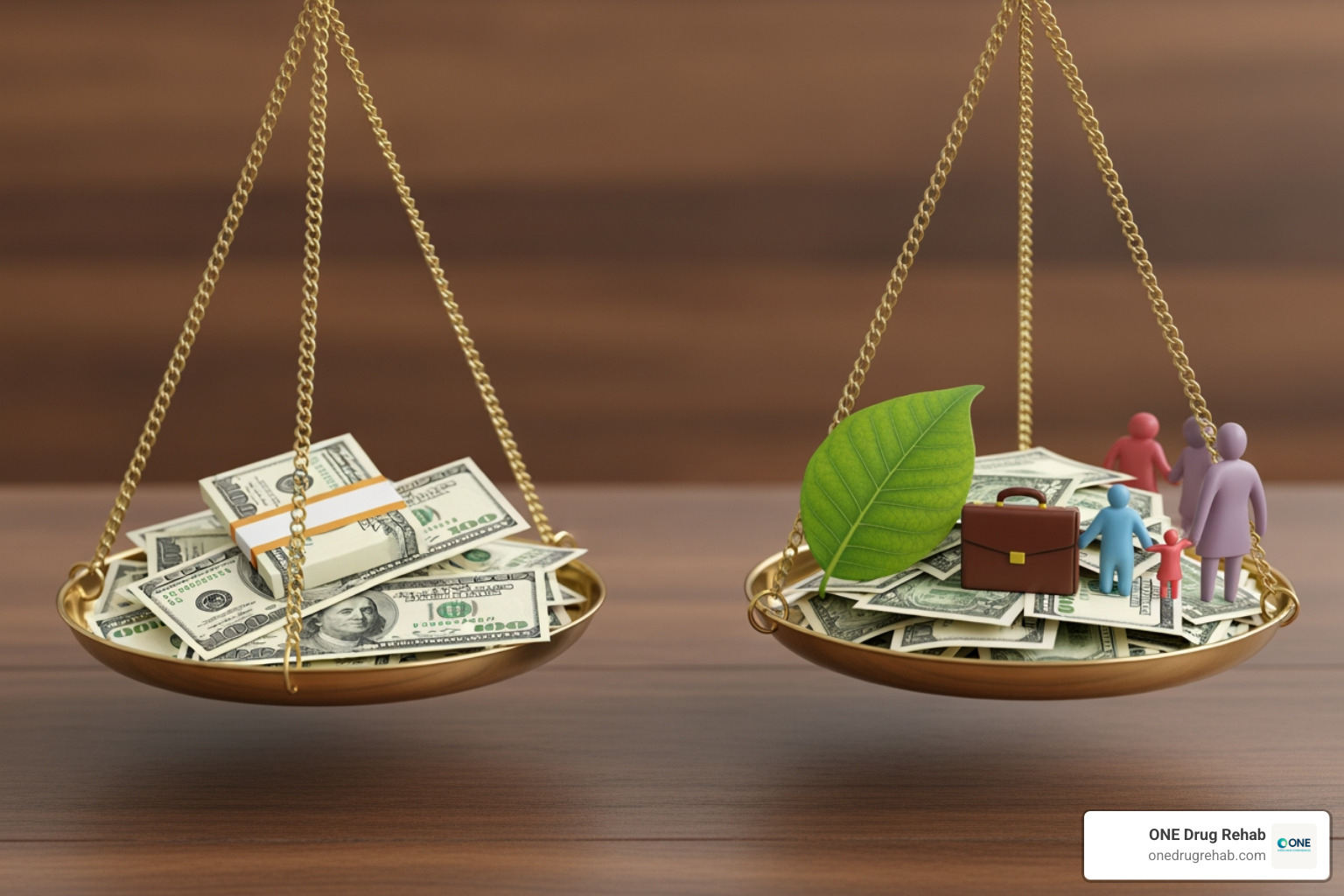
When looking at a treatment estimate, it’s easy to focus on the expense. But the real question is, what is the cost of not getting help? Viewing treatment as an investment in your future tells a different story.
The Hidden Costs of Addiction
Addiction drains finances, careers, and health in ways that aren’t always obvious.
- Cost of substances: A daily habit can cost anywhere from $2,000 a year for alcohol to over $55,000 for heroin.
- Lost income: Addiction often leads to missed work, poor performance, and job loss.
- Legal troubles: DUIs and other charges bring fines, court fees, and lawyer bills. One year in jail costs society roughly $24,000.
- Health issues: Chronic substance use results in costly emergency room visits, hospitalizations, and ongoing medical care.
- Strained relationships: The emotional toll of broken trust with family and friends is incalculable.
When added up, the average annual cost of active addiction is around $11,487 per person. Nationally, illegal drug abuse costs the United States $193 billion each year.
The Return on Investment (ROI) of Treatment
Investing in treatment yields remarkable returns. For every dollar spent, society saves $4 to $7 in drug-related crime costs. Including healthcare, that ratio jumps to 12 to 1.
Consider this: one year of methadone maintenance treatment costs about $4,700, while one year in jail costs $24,000. The better investment is clear. You can explore more data at Drug Abuse Statistics.
Beyond finances, treatment restores physical and mental health, rebuilds careers, and repairs relationships. While relapse is a risk (rates are 40-60%, similar to other chronic diseases), success is achievable. About 30% of people who complete an inpatient program achieve lasting recovery. Furthermore, nearly 9 out of 10 people who stay sober for two years remain sober for ten. Learn more about these outcomes at What is the Success Rate of Rehab?.
The cost of rehab is a finite investment. The cost of addiction is a bill that never stops coming. Treatment isn’t an expense; it’s the smartest financial decision you can make.
Making Treatment Affordable: How to Pay for Rehab
The thought, “I can’t afford rehab,” is a common barrier to recovery. However, how much rehab costs doesn’t have to stop you. There are more pathways to affordable treatment than most people realize.
Using Health Insurance to Cover Costs
If you have health insurance, you have a powerful tool. The Affordable Care Act (ACA) made addiction treatment an essential health benefit, meaning most plans must cover it.
- Call your insurance company: Ask specifically what they cover for inpatient, outpatient, and detox services.
- Understand your network: In-network facilities have pre-negotiated rates and will be much cheaper than out-of-network providers.
- Know your costs: Get clear on your deductible (what you pay before insurance kicks in) and copays (your share of costs after the deductible).
- Check for pre-authorization: Many plans require approval before you start treatment to ensure coverage. The rehab facility can usually help with this process.
What If I Don’t Have Insurance?
Not having insurance isn’t a dead end. For a comprehensive look at your options, see our guide on Addiction Treatment Without Insurance. Here are some common strategies:
- Sliding scale fees: Many facilities adjust their costs based on your income and ability to pay.
- Rehab scholarships and grants: Nonprofits and some rehabs offer funds to help cover the cost of treatment.
- Payment plans: Most private rehabs offer in-house financing, allowing you to pay the cost over several months or years.
- Personal loans or financing: Medical loans can provide the upfront funds needed for treatment. While it means taking on debt, it’s often a better alternative than the ongoing cost of addiction.
- Crowdfunding: Platforms like GoFundMe allow you to ask for support from your community.
- Family and community support: Pooling resources with loved ones or seeking aid from religious or cultural organizations can help cover costs.
While free programs are an option, they often have long waiting lists. Financing treatment may be a better choice than waiting months when you’re ready for help now.
Finding Low-Cost and Free Programs
For those with significant financial hardship, several options provide a lifeline.
- State-funded facilities: These government-run programs offer services at little to no cost. Be prepared for a potential waiting list and fewer amenities.
- Nonprofit organizations: Groups like The Salvation Army have provided free or low-cost rehab for decades, often addressing life circumstances alongside addiction.
- Community-based support: Free resources like Alcoholics Anonymous (AA), Narcotics Anonymous (NA), and local health centers offer crucial support during and after treatment. For alcohol-specific help, see our page on Free Alcohol Rehab.
The path to affordable treatment requires research and asking for help, but it is possible. For more ideas, visit our guide on How to Afford Rehab.
Frequently Asked Questions about Rehab Costs
Figuring out how much rehab will cost brings up many questions. Here are answers to some of the most common concerns.
Are luxury amenities worth the extra cost?
This is a personal decision. Luxury rehabs ($30,000 – $100,000+ per month) offer amenities like gourmet meals, spa treatments, and private rooms that can make the experience more comfortable. Some research suggests comfort is a valued part of the treatment experience.
However, the core of recovery happens in therapy. Fancy surroundings do not guarantee better clinical care. If your budget is tight, prioritize a facility with strong clinical credentials, proper accreditation, and a good staff-to-patient ratio. Treatment quality should always come before luxury. If you can afford it and believe the environment will help you focus, it may be a worthwhile investment.
Does a longer rehab program mean a lower daily rate?
Often, yes. Many facilities offer package pricing that rewards longer commitments, so the per-day cost of a 90-day program may be lower than a 30-day one. This encourages longer stays, which are linked to better outcomes.
However, this isn’t universal. Some specialized programs have a fixed daily rate regardless of stay length. Always ask for a cost breakdown for 30, 60, and 90 days to compare the daily rates yourself.
Can I use a payment plan to cover the cost of rehab?
Absolutely. This is a common way to make treatment affordable. Most private facilities understand that paying the full cost upfront is unrealistic for many.
- In-house payment plans are offered directly by many centers, allowing you to pay in installments.
- Third-party medical financing through healthcare loan companies is another option. These work like personal loans with interest rates based on your credit.
Have an honest conversation with the admissions team at any facility you’re considering. They can guide you to the best financing options for your situation. For a full overview, see our guide on How to Afford Rehab.
Conclusion
Understanding how much rehab costs is the first step toward making an informed decision. While the prices vary widely—from free programs to luxury centers costing tens of thousands—they reflect real differences in care, duration, and services.
A 30-day inpatient stay can range from $6,000 to $20,000, while a 90-day program may cost $12,000 to $60,000. Outpatient care is often more affordable, around $5,000 for three months.
Treatment is an investment that pays dividends for life. The average annual cost of active addiction is nearly $12,000, not including the devastating toll on health, careers, and relationships. In contrast, every dollar spent on treatment saves society up to $12 in related costs.
The cost of addiction is endless; the cost of rehab is a finite investment in a new future.
If you’re worried about affording care, know that options exist for nearly every budget. From insurance and payment plans to sliding scale fees and state-funded programs, the financial barriers to recovery can be overcome.
Don’t let cost be the reason you wait. The price of delaying help—in lost time, health, and opportunities—is far greater than any rehab bill. Recovery is possible, and it’s more accessible than you might think.
Ready to take the next step? The ONE Drug Rehab directory can help you find a program that fits your needs and budget. Start your search for the right rehab program today.