

Understanding Integrated Health Rehab: What You Need to Know
Integrated health rehab is a comprehensive approach to recovery that treats the whole person—mind, body, and spirit. It brings medical care, mental health services, and behavioral support together in one coordinated setting. Instead of you navigating separate specialists, a unified team creates one plan to address all aspects of your health at once.
This model offers seamless, whole-person care that respects your choices and is proven to lead to better outcomes. For anyone who has felt lost in a fragmented healthcare system—seeing a doctor for physical symptoms, a therapist for mental health, and a substance abuse counselor elsewhere—integrated care is the solution. It ends the cycle of conflicting treatment plans and repeating your story to providers who don’t communicate with each other.
Integrated health rehab recognizes that behavioral health, medical illness, and substance use are all connected. For example, addiction often co-occurs with depression, anxiety, and physical health problems. Treating these issues separately doesn’t work as well as addressing them together. This shift is so significant that the World Health Organization considers it essential for universal health coverage, making integrated rehab the new standard for high-quality treatment.
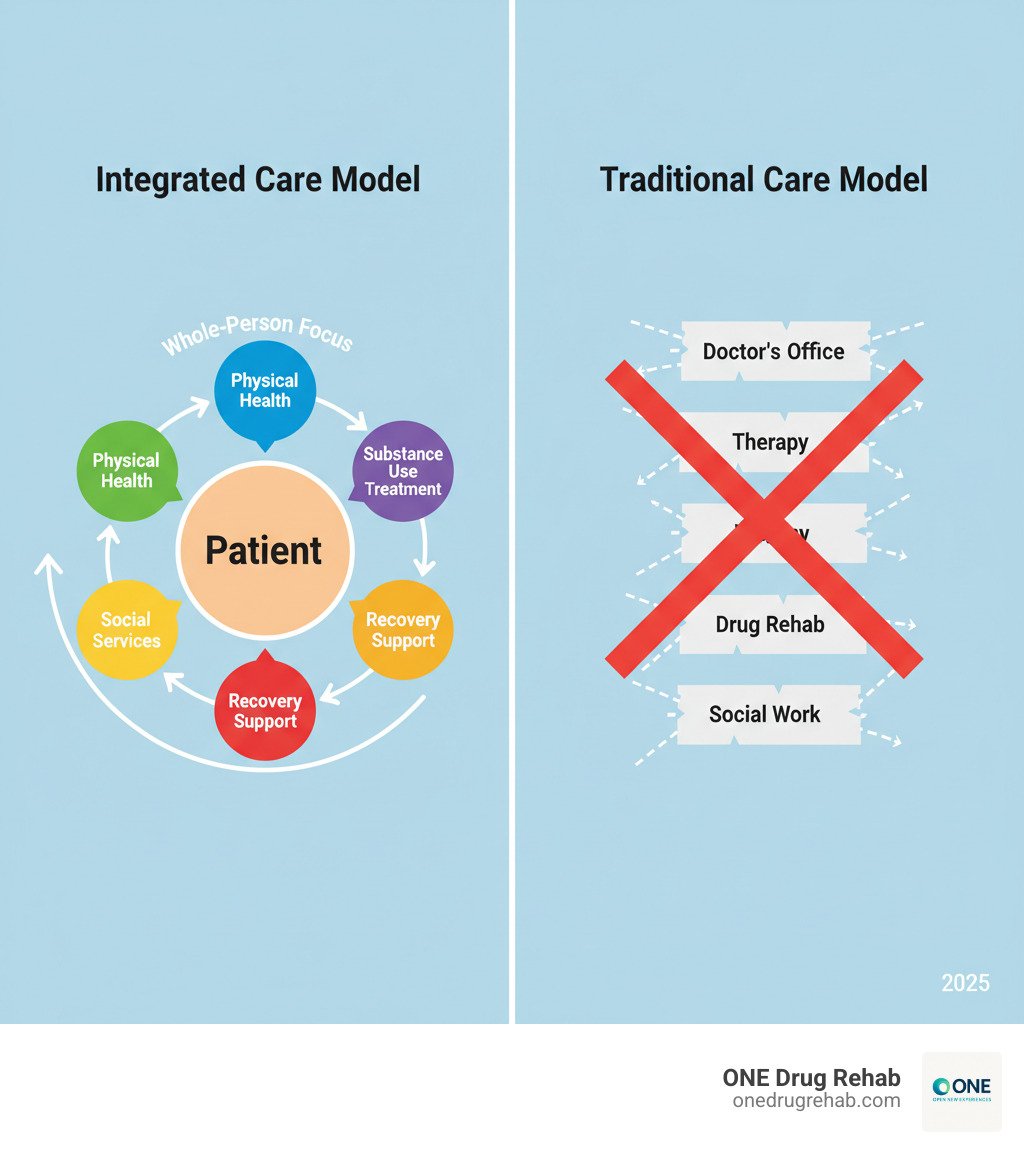
Understanding Integrated Health Rehab: A Unified Model of Care
Think of integrated health rehab as an orchestra performing a symphony, rather than talented musicians each playing their own song. Instead of treating addiction separately from depression or chronic pain separately from anxiety, integrated care brings it all together under one team and one plan.
This model is built on a few core principles. First, it’s a patient-centered approach where your values, goals, and preferences guide every decision. The team works with you, not on you, building on your strengths in a judgment-free environment. This aligns with Recovery-Oriented Care, which focuses on building a meaningful life, not just treating symptoms.
Second, collaborative care is made possible by an interdisciplinary team. Your doctors, psychologists, physical therapists, dietitians, and case managers all communicate regularly. They meet to discuss your progress, adjust the plan together, and ensure nothing falls through the cracks. This eliminates conflicting advice and the burden of you coordinating your own care. This structure is especially effective for addressing co-occurring disorders—like depression and substance use or trauma and addiction—simultaneously, which research shows leads to better, more lasting outcomes.
The ‘Whole Person’ Philosophy and the Interdisciplinary Team
The core of integrated care is the ‘whole person’ philosophy: you can’t heal one part of yourself while ignoring the rest. Your mind, body, and spirit are completely intertwined. Mental well-being affects physical healing, physical pain impacts your mood, and a sense of purpose can provide the hope needed for recovery. Integrated programs weave mental health counseling, physical therapy, and even spiritual support into every aspect of treatment. They also address emotional regulation and social connections, like family therapy or employment assistance, recognizing that your environment is part of your health. You can learn more about how this approach works in practice through holistic treatment services.
This is all made possible by the interdisciplinary team. Instead of you repeating your story to a dozen specialists in different buildings, your team—including doctors, therapists, and social workers—already knows your history. They work in sync, providing medical oversight, psychological support, and practical help with real-world challenges. This seamless approach is the foundation of Integrated Treatment for Co-occurring Disorders, where you tell your story once and receive truly coordinated care.
Integrated vs. Traditional Rehab: A Clear Comparison
Understanding the difference between integrated health rehab and traditional models can help you make an informed choice. Traditional rehab often feels like solving a jigsaw puzzle by working on each piece in a different room. You might see a physical therapist for pain, a psychiatrist for depression, and a counselor for addiction, with no one connecting the dots. You become the messenger, trying to coordinate your own care.
Integrated health rehab brings everyone to the same table. It’s collaborative rather than siloed and team-based rather than specialist-driven. Your care team works together, sharing information and coordinating a treatment plan that sees how all the pieces of your health connect.
| Feature | Integrated Health Rehab | Traditional Rehabilitation |
|---|---|---|
| Approach | Collaborative, unified, holistic, patient-centered | Siloed, fragmented, symptom-focused, specialist-driven |
| Focus | Whole-person (mind, body, spirit, social, emotional) | Specific physical injury/illness OR mental health condition OR substance use disorder |
| Coordination | Interdisciplinary teams, shared treatment plans, seamless communication | Separate providers, limited communication, patient often coordinates own care |
| Treatment of Co-occurring Conditions | Concurrent, integrated | Sequential or separate |
| Patient Role | Empowered, active participant, decision-maker | Passive recipient, follows specialist instructions |
| Outcome Goal | Long-term wellness, improved quality of life, sustainable recovery, addressing root causes | Symptom reduction, functional improvement for specific condition |
| Efficiency | Improved health, patient experience, reduced unnecessary costs, less duplication | Potential for delays, repeat information, higher costs due to lack of coordination |
A key difference is the focus on root causes versus symptoms. Traditional care often treats what’s visible, like an injured knee, without exploring the depression that might be hindering recovery. Integrated health rehab digs deeper, addressing the underlying factors that contribute to your health challenges.
This leads to a dramatically different patient experience. Instead of the exhaustion of juggling appointments and repeating your history, you experience a seamless flow of care. Research on whole-person care also shows this model is more cost-effective, reducing unnecessary services and preventing crises. Most importantly, you are an empowered partner in your recovery, working with a unified team that respects your goals.

The Core Services and Benefits of Integrated Health Rehabilitation
An integrated health rehab program provides a complete wellness toolkit designed to build a stronger, healthier life. The benefits are clear: improved health outcomes, the convenience of coordinated care, reduced stigma around mental health, and patient empowerment. This approach is also more cost-effective and, most importantly, makes long-term recovery more achievable by addressing root causes, not just symptoms.
Mental and Behavioral Health Services
Mental and behavioral health are woven into the fabric of your overall treatment. Services are designed to address anxiety, depression, trauma, and substance use as interconnected issues.
- Individual and group therapy provide safe spaces to explore challenges, develop coping strategies, and connect with peers who understand your journey.
- Evidence-based therapies like Cognitive Behavioral Therapy (CBT) and Dialectical Behavioral Therapy (DBT) offer practical tools to change unhelpful thought patterns and regulate emotions.
- Trauma-informed care is a core principle, ensuring a safe environment for healing. Specialized Holistic Trauma Therapy services are often available.
These services are crucial for anyone battling depression, and you can explore more about Holistic Depression Treatment options that fit this model.
Physical Rehabilitation Therapies
Physical rehabilitation focuses on restoring function, building strength, and reclaiming independence.
- Physical therapy uses targeted exercises and hands-on techniques to restore mobility and reduce pain.
- Occupational therapy helps you relearn daily activities and adapt to challenges, making life more manageable.
- Other specialized services may include kinesiology for movement science, speech therapy for communication or swallowing issues, and comprehensive chronic pain or concussion management programs.
Complementary and Holistic Therapies
Integrated care recognizes that healing happens in many ways. Complementary therapies nourish your mind and body, often easing anxiety and reducing pain.
- Nutrition planning provides the fuel your body needs to heal and supports your mood.
- Mind-body practices like yoga, meditation, and mindfulness help you reconnect with your body, calm your mind, and manage stress.
- Other therapies such as acupuncture, art therapy, and animal-assisted therapy offer alternative ways to process emotions, reduce anxiety, and find comfort.
These approaches are key components of Holistic Drug Treatment, creating a truly comprehensive healing experience.
Navigating Your Path to Integrated Care
Starting your recovery journey with integrated health rehab is a significant step, but the path is more accessible than you might think. It begins with acknowledging you deserve care that addresses all of you, not just one piece of the puzzle. If you’ve felt that something was missing from past treatments or feel overwhelmed by juggling multiple health challenges, an integrated program with a team that sees you as a whole person may be the right fit.

How to Access Integrated Health Rehab Programs
As healthcare systems recognize its value, integrated care is becoming more common. The World Health Organization emphasizes integrating rehabilitation into all levels of healthcare. Here are some common starting points:
- Your primary care doctor can assess your needs and refer you to appropriate programs.
- Hospital-based programs often offer integrated services for post-surgical care, stroke recovery, or traumatic brain injuries.
- Private clinics specializing in integrated care provide a full spectrum of services under one roof. You can find local options by exploring resources like Integrated Health Clinics.
- Community health centers are excellent resources that often provide integrated behavioral and primary care on a sliding fee scale.
- Your insurance network can help you find in-network providers. A call to your insurance company can clarify coverage.
Challenges and the Future of Integrated Health Rehab
While the integrated model is superior, challenges remain. System fragmentation, the need for workforce training in collaborative care, and outdated funding and policy structures can slow progress. Securely sharing information between providers while protecting privacy is another hurdle.
Despite these obstacles, the future is bright. The global movement toward universal health coverage recognizes rehabilitation as an essential service. Educational institutions are now training a new generation of providers for collaborative work, as seen in programs exploring the future of rehabilitation. Technology like telehealth and integrated electronic health records is also making coordinated care more accessible. As advocacy grows, integrated health rehab is becoming the standard, moving us toward a future where whole-person care is available to all.
Frequently Asked Questions about Integrated Health Rehab
It’s natural to have questions when considering a new approach to recovery. Here are answers to some of the most common questions about integrated health rehab.
What types of conditions does integrated health rehab treat?
This approach is designed for the interconnected reality of human health and is effective for a wide range of conditions, especially when they overlap. It’s ideal for:
- Substance use disorders, as it addresses not just the addiction but also the underlying anxiety, chronic pain, or depression.
- Co-occurring mental health conditions like anxiety, depression, bipolar disorder, and PTSD, treating them alongside any physical or substance use issues.
- Traumatic brain injuries (TBI), which affect physical, cognitive, and emotional well-being.
- Chronic pain, combining physical therapy with psychological support to manage its impact on mood and daily life.
- Complex conditions like Long COVID or neurological disorders (e.g., stroke, Parkinson’s), where symptoms are multi-faceted.
Essentially, any situation where you feel like you’re fighting on multiple health fronts is a good fit for integrated care.
Is integrated rehabilitation covered by insurance?
Yes, integrated health rehab is often covered by insurance, but specifics vary by plan.
- Major private insurance companies, as well as Medicaid and Medicare, increasingly cover integrated services because they are proven to be cost-effective.
- The distinction between in-network and out-of-network providers is crucial, as staying in-network significantly lowers your out-of-pocket costs.
- Always verify your benefits before starting a program. Call your insurance company to ask about your deductible, co-pays, and any pre-authorization requirements. The admissions team at most rehab facilities can also help you steer your coverage.
How do I know if an integrated approach is right for me?
An integrated approach might be what you need if you identify with any of the following:
- You’re dealing with multiple health issues at once, such as addiction and chronic pain, or an injury and depression.
- You’ve tried treatment before and it didn’t stick, possibly because it only addressed one part of the problem.
- You believe your mind, body, and spirit are connected and want a program that honors that connection.
- You have co-occurring conditions, where mental, physical, and behavioral health issues feed into each other.
- You’re looking for long-term wellness and sustainable recovery, not just a temporary fix for symptoms.
If you want coordinated care that treats you as a whole person, an integrated approach is likely your best path forward.
Conclusion: Embracing a Whole-Person Path to Recovery
You’ve now seen how integrated health rehab offers a new path to recovery—one that is becoming the gold standard for lasting wellness. By weaving together medical care, mental health support, and physical rehabilitation, this approach treats you as a whole person, not a collection of symptoms. It acknowledges that your mind, body, and spirit are interconnected.
The benefits are compelling: better health outcomes, the convenience of a single coordinated team, and the empowerment that comes from being an active partner in your healing. Integrated health rehab doesn’t just treat symptoms; it addresses root causes to build a foundation for a thriving, sustainable recovery.
This is the future of healthcare—a model that respects your dignity and meets you wherever you are on your journey. Whether you’re facing addiction, chronic pain, or co-occurring mental and physical health challenges, integrated care offers a comprehensive solution.
At ONEDrugRehab.com, we provide unbiased information to help you find the right path. If this whole-person philosophy resonates with you, we invite you to explore the holistic treatment programs in our directory. Your healing journey is yours to define, and you deserve care that honors all of you.