

Why Understanding 90-Day Rehab Costs Matters for Your Recovery Journey
What is a 90-Day Inpatient Rehab Program?
A 90-day inpatient rehab program is like giving yourself permission to truly heal. Instead of rushing through treatment, you get three full months to live at a residential facility where recovery becomes your only job.
This isn’t just about getting clean or sober – it’s about rebuilding your life from the ground up. While shorter programs focus on crisis stabilization, a 90-day stay lets you dig deep into the root causes of addiction and develop lasting skills for sobriety.
You’ll have 24/7 medical support and supervision in a structured environment designed for healing. The extended timeframe means you can work through trauma, learn healthy coping mechanisms, and practice new behaviors without the pressure of returning to daily life too quickly.
The National Institute on Drug Abuse (NIDA) has found that treatment effectiveness increases significantly with longer stays. Their research shows that programs lasting 90 days or more consistently produce better outcomes than shorter alternatives. Types of Addiction Treatment vary widely, but extended residential care offers the most comprehensive approach to recovery.
The Difference Between 30, 60, and 90-Day Programs
Think of addiction treatment like learning a new language – you need time to become fluent. Each program length serves a different purpose in your recovery journey.
30-day programs are like crash courses. They help you get stable and learn basic survival skills for early recovery. You’ll master stabilization techniques and get your feet under you, but there’s limited time for deeper work. These programs typically cost between $6,000 and $30,000 without insurance.
60-day programs give you more breathing room. The extra month allows for intensive therapy and stronger skill development. You can start addressing underlying issues while building more robust coping strategies.
90-day programs offer the full experience. Three months provides enough time to move through all phases of recovery without feeling rushed. You can complete thorough detoxification, participate in extensive therapy, and develop solid relapse prevention skills.
The difference in long-term outcomes is striking. While 30-day programs focus on crisis management, 90-day stays allow you to build a foundation for lasting sobriety. You’ll have time to practice new behaviors, work through setbacks, and gain confidence in your recovery skills.
Research supporting NIDA principles consistently shows that longer treatment stays correlate with better success rates and lower relapse rates over time.
What to Expect During a 90-Day Stay
Your three-month journey unfolds naturally, with each phase building on the last. Most people find the structure comforting after the chaos of active addiction.
Medical detox typically happens first if you need it. This medically supervised process ensures you withdraw safely from substances. For alcohol use disorder, this step is especially important due to potentially dangerous withdrawal complications.
Individual therapy becomes the cornerstone of your treatment. You’ll work one-on-one with a counselor to explore personal triggers, trauma, and patterns that fuel your addiction. These sessions help you understand not just what you’re recovering from, but what you’re recovering toward.
Group therapy connects you with others who understand your struggle. These sessions reduce isolation and provide opportunities to practice new communication skills in a safe environment.
Family counseling helps repair relationships damaged by addiction. Your loved ones learn about addiction as a disease while you work together on rebuilding trust and healthy boundaries.
Holistic treatments round out your care with activities like meditation, art therapy, yoga, or recreational programs. These approaches address your whole person, not just your addiction.
Aftercare planning becomes increasingly important as your stay progresses. Your treatment team will help you prepare for life after residential care, connecting you with ongoing support and resources in your community.
The beauty of a 90-day program is that you’re not just surviving treatment – you’re learning to thrive in recovery. When 90 day rehab cost feels overwhelming, you’re investing in skills and insights that will serve you for life.
The Bottom Line: What is the Average 90 Day Rehab Cost?

Let’s cut straight to the numbers you’re probably most worried about. The 90 day rehab cost typically falls between $12,000 and $60,000 for standard facilities, with an average daily rate of around $575.
That might sound like a lot, but here’s some perspective: many people spend more than that on their addiction over the same three-month period. When you factor in the cost of substances, legal issues, lost wages, and health problems, treatment often costs less than continuing down the same path.
Standard facilities charge between $500 and $650 per day. Do the math, and you’re looking at $45,000 to $58,500 for a full 90-day stay. Luxury facilities can push costs well above $80,000, while basic programs might start closer to $12,000.
The wide price range exists because not all rehab programs are created equal. Some offer private rooms, gourmet meals, and spa-like amenities. Others focus on providing solid clinical care in a more basic setting. Both can be effective – it depends on what you need and what you can afford.
90 Day Rehab Cost Without Insurance
Facing the full sticker price can feel overwhelming, but don’t let it stop you from getting help. You have more options than you might think.
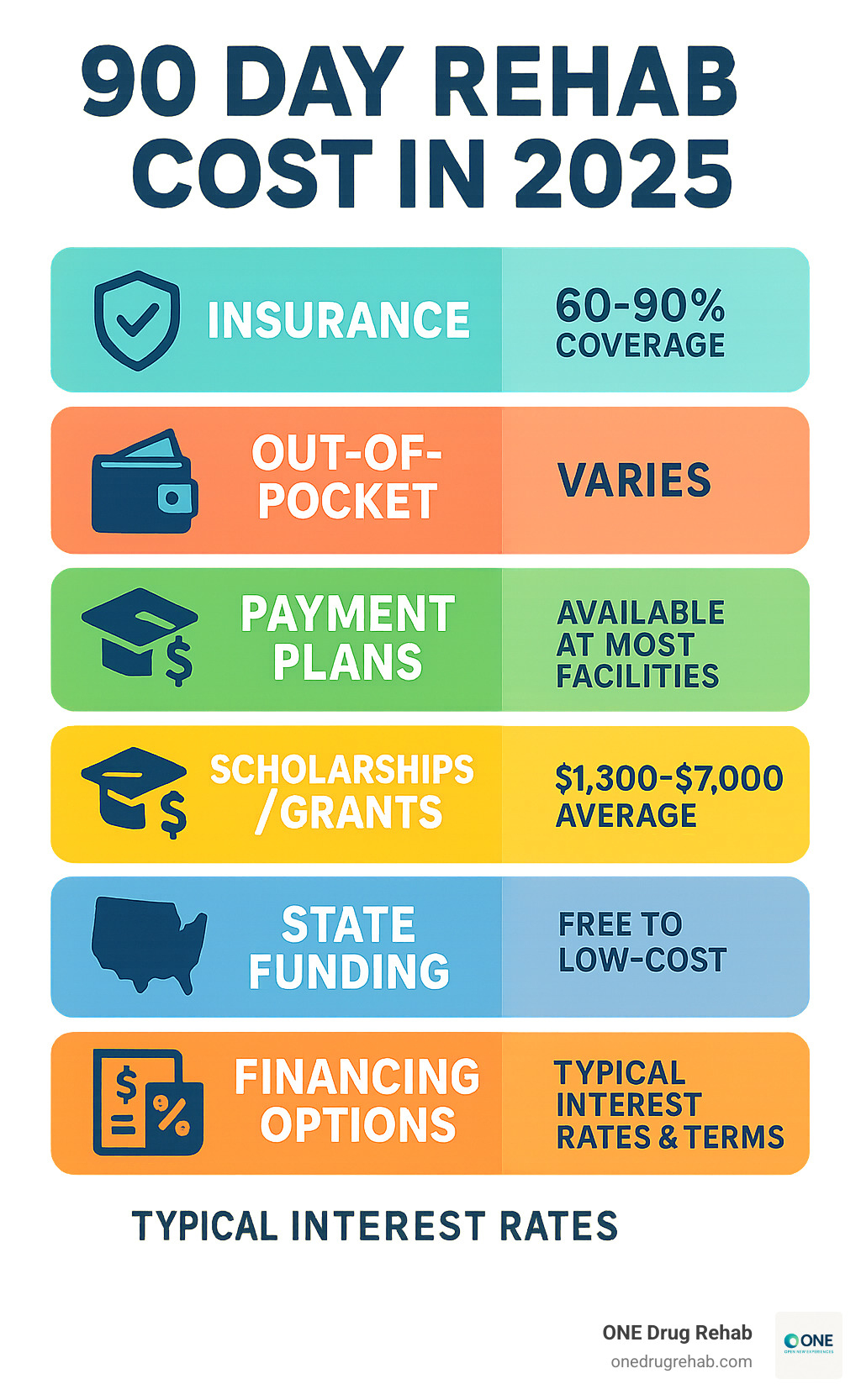
State-funded programs offer free or low-cost treatment in many areas. Yes, there might be waiting lists, but the care is real and effective. These programs receive government funding specifically to help people who can’t afford private treatment.
Non-profit facilities like the Salvation Army provide treatment based on charitable funding rather than profit. Many operate on a sliding scale, meaning you pay what you can afford based on your income.
Private facilities often offer payment plans or sliding-scale fees too. Many would rather work with you on payment than turn you away. The worst they can say is no, but many will surprise you with their willingness to help.
If you’re struggling to find affordable options, our Find Rehab Without Insurance resource can connect you with programs that fit your budget.
90 Day Rehab Cost With Health Insurance
Here’s where things get much more hopeful. Thanks to the Mental Health Parity and Addiction Equity Act, your insurance company must cover addiction treatment at the same level as other medical conditions.
Most ACA-compliant plans cover 60-90% of rehab costs after you meet your deductible. Some plans even cover 100% once you’ve hit your deductible. Medicare covers inpatient treatment for up to 90 days per benefit period, while Medicaid often covers substance abuse treatment with minimal out-of-pocket costs.
The key is understanding your specific plan. In-network facilities will always cost you less than out-of-network ones. You’ll likely need pre-authorization for treatment, so call your insurance company before you start looking at facilities.
Your copays and deductibles still apply, but even with these costs, insurance can reduce your out-of-pocket expenses by thousands of dollars. For detailed information about mental health coverage, check with your insurance provider directly.
Don’t assume you can’t afford treatment until you’ve explored all your options. Many people find their insurance covers more than they expected.
Key Factors That Determine Your Final Bill

When you’re researching 90 day rehab cost, you’ll quickly find that prices vary dramatically between facilities. The difference between a $12,000 program and a $60,000 program isn’t just random pricing – specific factors drive these costs up or down.
Think of it like buying a car. You can get reliable transportation for $20,000, or you can spend $80,000 for luxury features. Both will get you where you need to go, but the experience along the way differs significantly.
Here are the main factors that will impact your final bill:
Facility Type and Amenities
Standard facilities typically charge between $12,000 and $30,000 for 90 days. These programs focus on proven treatment methods without the bells and whistles. You’ll likely share a room with another person, eat cafeteria-style meals, and participate in group activities in basic meeting rooms.
Don’t let “standard” fool you – these facilities often provide excellent care. The therapy programs, medical supervision, and core treatment services are typically just as effective as their luxury counterparts.
Luxury rehab centers can cost anywhere from $30,000 to $80,000 or more. These facilities feel more like upscale resorts than medical facilities. You might have a private room with designer furnishings, gourmet meals prepared by professional chefs, and access to spa services.
Many luxury facilities also offer lower staff-to-patient ratios, which means more personalized attention. While a standard facility might have eight patients per counselor, luxury programs often maintain ratios of three or four patients per staff member.
Executive programs cater specifically to business professionals who need to maintain some work responsibilities during treatment. These programs often include private offices with internet access and flexible scheduling for important calls. The price reflects this specialized service.
Research shows that treatment effectiveness depends more on the quality of therapy and the length of stay rather than the thread count of your sheets. Compare Rehab Centers to find the right balance between cost and comfort for your situation.
Geographic Location
Where you choose to get treatment significantly impacts your 90 day rehab cost. It’s the same principle that makes a New York apartment cost more than a similar place in rural Kansas.
Urban centers like New York, Los Angeles, or San Francisco typically charge $20,000 to $40,000 for 90-day programs. These higher costs reflect the expensive real estate, higher staff salaries, and increased operating expenses in major cities.
Rural settings often provide similar quality programs for $10,000 to $25,000. The lower cost of living in these areas allows facilities to offer competitive pricing while maintaining quality care.
Don’t forget to factor in travel expenses when comparing locations. Sometimes traveling to a different state for treatment actually saves money overall. Plus, many people find that getting treatment away from their home environment helps them focus better on recovery.
Some insurance plans also have different coverage levels depending on the state where you receive treatment. Use Rehab Near Me to explore options in various locations and compare total costs including travel.
Intensity and Specialization of Care
The more specialized your treatment needs, the higher your costs will typically be. This isn’t about facilities trying to make extra money – it’s about providing the specific expertise and resources that complex cases require.
Dual diagnosis treatment adds approximately $1,000 to $5,000 to your base cost. This integrated approach treats both substance use disorders and co-occurring mental health conditions like depression, anxiety, or PTSD simultaneously. Since about 9.5 million adults in the United States have dual diagnoses, this specialized care is often essential for successful recovery.
Medication-Assisted Treatment (MAT) for opioid addiction involves ongoing medication costs and requires specialized medical supervision. While this evidence-based approach significantly improves outcomes for opioid use disorders, it does increase the overall program cost.
Specialized therapies like EMDR for trauma, equine therapy, or intensive family counseling add to the bottom line but can be crucial for certain individuals’ recovery. These aren’t luxury add-ons – they’re proven treatment methods that address specific aspects of addiction.
Facility accreditation from organizations like the Joint Commission or CARF indicates that a facility meets rigorous quality standards. While accredited facilities may charge more due to these higher standards, they often provide better outcomes and may be more likely to accept insurance.
The staff-to-patient ratio significantly impacts both cost and treatment quality. Premium facilities might offer ratios as low as 3:1 or 4:1, compared to standard facilities with 8:1 or higher ratios. More individualized attention typically means better outcomes, but it also means higher costs.
How to Pay for a 90-Day Rehab Program

Looking at that 90 day rehab cost can feel overwhelming, but here’s some good news: you have more payment options than you might think. Many people assume they can’t afford treatment, but with the right approach, most families can find a way to make it work.
The key is knowing where to look and what questions to ask. Between insurance coverage, government programs, and facility-based assistance, there’s usually a path forward that fits your budget.
Leveraging Insurance and Government Programs
Your health insurance is often your best starting point. Thanks to the Mental Health Parity and Addiction Equity Act, insurance companies must cover addiction treatment at the same level as other medical conditions. This means your plan likely covers a significant portion of your treatment costs.
Start by calling your insurance company directly. Ask specifically about inpatient substance abuse treatment coverage, not just general mental health benefits. You’ll want to know your annual benefit limits, whether you need pre-authorization, and which facilities are in your network. In-network facilities can save you thousands compared to out-of-network options.
Medicare provides solid coverage for those 65 and older or with qualifying disabilities. The program covers inpatient treatment for up to 90 days per benefit period and outpatient treatment at 80% of Medicare-approved amounts. If you’re on Medicare, your out-of-pocket costs are often quite manageable.
Medicaid often provides the most comprehensive coverage with minimal out-of-pocket costs. Each state runs its program differently, but many provide full coverage for medically necessary addiction treatment. Even if you think you won’t qualify, it’s worth checking – income limits are higher than many people expect.
State assistance programs fill gaps for residents who need treatment but lack adequate insurance. These vary widely by state, but many offer additional funding or direct treatment services.
Facility-Based Financial Aid
Most treatment centers understand that cost can be a barrier to getting help. They genuinely want to help people recover, not turn them away because of money concerns.
Sliding-scale fees adjust your payment based on your income and ability to pay. Some facilities offer discounts of 30-70% for qualifying individuals. The application process is usually straightforward – you’ll need to provide income documentation, but it’s worth the effort.
In-house financing lets you spread the cost over several months or years, often with low or no interest. This can turn a $30,000 bill into manageable monthly payments of $500-800. Many facilities are surprisingly flexible with payment terms.
Scholarships and grants are available at many facilities. For example, some treatment centers offer need-based financial assistance ranging from $1,300 to $7,000. These don’t need to be repaid, making them an excellent option if you qualify.
Work-study programs at some facilities allow you to work part-time during treatment to offset costs. This isn’t available everywhere, but it’s worth asking about if you’re physically able to work.
Other Financial Resources
Employee Assistance Programs (EAP) are an often-overlooked resource. Many employers offer EAPs that provide free, confidential services including treatment referrals and sometimes direct financial assistance. Check with your HR department – you might be surprised what’s available.
Personal loans from banks, credit unions, and online lenders can make immediate treatment possible. While this adds debt, the investment in recovery often pays for itself through improved earning potential and reduced costs associated with active addiction.
Crowdfunding through platforms like GoFundMe has become surprisingly common for addiction treatment. Many people are willing to support recovery efforts, especially when they understand how treatment works and why it’s important.
Non-profit organizations throughout the country provide grants or low-interest loans specifically for addiction treatment. These organizations understand that financial barriers shouldn’t prevent people from getting help.
Family support is often more available than people expect. Many families are willing to contribute to treatment costs when they understand it’s an investment in their loved one’s future. Don’t let pride prevent you from asking for help.
For more financial resources and regularly updated information about paying for treatment, visit Our Blog where we share practical tips and new funding opportunities.
Frequently Asked Questions about 90-Day Rehab Costs
Is a 90-day program worth the higher cost compared to a 30-day program?
This is one of the most common questions we hear, and the answer is a resounding yes. While the 90 day rehab cost is higher upfront, the long-term value makes it a smart investment in your future.
Think of it this way: a 30-day program might cost $6,000 – $30,000, while a 90-day program runs $12,000 – $60,000. That extra cost might seem steep, but consider what you’re getting for that investment.
Research consistently shows that longer treatment stays lead to better outcomes. The National Institute on Drug Abuse has found that people who stay in treatment for 90 days or longer have significantly lower relapse rates. When you factor in the cost of repeated shorter treatments, emergency room visits, legal troubles, and lost productivity from relapse, the 90-day program often costs less in the long run.
The extended timeframe allows for comprehensive healing rather than just symptom management. In 30 days, you’re mainly focused on getting stable and learning basic coping skills. But 90 days gives you time to dig deeper into the root causes of your addiction and develop stronger, more lasting recovery skills.
Skill mastery takes time. Just like learning to play piano or speak a new language, developing healthy coping mechanisms and new thought patterns requires practice. Three months provides adequate time to learn these skills and actually internalize them in a safe, supportive environment.
Addiction is a chronic condition that requires comprehensive treatment. You wouldn’t expect a 30-day treatment to cure diabetes or heart disease, and addiction often requires the same extended care approach for optimal outcomes.
Are there specific cost differences for alcohol rehab versus drug rehab?
The good news is that the base cost structure is typically similar whether you’re seeking treatment for alcohol use disorder or drug addiction. Most facilities charge the same daily rate regardless of your primary substance.
However, a few factors can create some cost differences that are worth understanding.
Detoxification needs can vary significantly. Alcohol withdrawal can be more medically complex and potentially dangerous than withdrawal from some other substances. This sometimes requires more intensive medical supervision and longer detox periods, which can add to the overall cost.
Medication-Assisted Treatment (MAT) is more commonly used for opioid addiction. If you’re dealing with opioid use disorder, your treatment might include medications like methadone, buprenorphine, or naltrexone. According to our research, methadone treatment costs about $4,700 annually, while naltrexone-assisted treatment costs about $14,112 per year. These ongoing medication costs can add to your overall treatment expenses.
Medical complications from alcohol use disorder often require additional medical care during treatment. Long-term alcohol use can cause liver damage, heart problems, and other health issues that need attention alongside addiction treatment.
The important thing to remember is that the overall treatment approach remains similar regardless of your primary substance. You’ll still participate in individual and group therapy, behavioral interventions, and aftercare planning. The core structure of recovery remains the same.
How much does dual diagnosis treatment add to the cost?
Dual diagnosis treatment typically adds $1,000 – $5,000 to the base cost of a 90-day program. While this represents a significant increase, it’s often essential for successful recovery.
This additional cost reflects the complexity of treating both substance use disorders and co-occurring mental health conditions like depression, anxiety, PTSD, or bipolar disorder. Research shows that 48.7% of those in brief rehab stays have dual diagnoses, making this specialized care crucial for many people seeking treatment.
Integrated care teams are necessary for dual diagnosis treatment. This means you’ll work with both addiction specialists and mental health professionals who coordinate your care. Having this level of expertise costs more but ensures you receive comprehensive treatment for all your conditions.
Psychiatric evaluations and ongoing medication management add to the expense. Many individuals with dual diagnoses require psychiatric medications that need careful monitoring and adjustment throughout treatment. This requires specialized medical staff and additional appointment time.
Specialized therapists with training in both addiction and mental health treatment command higher salaries, which gets reflected in treatment costs. These professionals understand how mental health conditions and addiction interact, providing more effective treatment.
The increased complexity of dual diagnosis treatment often requires more individualized care and sometimes longer treatment duration. However, treating both conditions simultaneously is considered the gold standard and leads to better long-term outcomes than addressing them separately.
While the additional cost might seem daunting, consider that untreated mental health conditions significantly increase relapse risk. The investment in dual diagnosis treatment often pays for itself by reducing the likelihood of needing repeated treatment in the future.
Conclusion
When you’re facing the reality of needing extended addiction treatment, understanding the 90 day rehab cost helps you make informed decisions about your recovery journey. Yes, the typical range of $12,000 – $60,000 may seem substantial at first glance. But here’s what many people don’t realize: this isn’t just an expense – it’s one of the most important investments you’ll ever make.
The research tells a compelling story. For every dollar invested in substance abuse treatment, there’s a reduction in health and social costs by an estimated $7. Think about what that means for your life. The 90 day rehab cost isn’t just about the treatment itself – it’s about avoiding the ongoing costs of addiction that can devastate your finances, health, and relationships.
Consider what continuing to live with addiction really costs. Emergency room visits, legal problems, lost income, damaged relationships, and declining health often add up to far more than comprehensive treatment. When you look at it this way, 90-day rehab becomes less of a financial burden and more of a smart investment in your future earning potential and overall well-being.
The good news is that quality treatment is more accessible than many people realize. With insurance coverage often providing 60-90% of costs, numerous payment options, and financial assistance programs available, don’t let financial concerns prevent you from getting the help you need. Longer treatment stays consistently produce better outcomes – and better outcomes mean you’re less likely to need repeated treatment down the road.
At ONE Drug Rehab, we understand that navigating treatment options and costs can feel overwhelming when you’re already dealing with addiction. That’s exactly why our directory exists. We provide unbiased information to help you find facilities that match both your treatment needs and budget constraints. We don’t endorse specific providers because we believe you deserve to make informed decisions based on complete, honest information.
Recovery is absolutely possible, and understanding your options is the first step toward reclaiming your life. The investment you make in 90-day treatment today can pay dividends in restored health, rebuilt relationships, and renewed hope for years to come.
Explore our directory to find a rehab that fits your needs and budget and take the first step toward lasting recovery today.