

Why IOP Drug Programs Are Changing Addiction Treatment
What is an Intensive Outpatient Program (IOP)?
Think of an iop drug program as the middle ground in addiction treatment – it’s more intensive than your typical weekly therapy session, but you don’t have to pack your bags and leave home like you would for residential treatment. The American Society of Addiction Medicine (ASAM) classifies IOPs as Level 2 care, which means they’re designed for people who need structured support but don’t require round-the-clock medical supervision. For a deeper look at ASAM’s full continuum of care, you can visit the American Society of Addiction Medicine page on Wikipedia.
IOPs work beautifully as stepping stones in your recovery journey. Maybe you’ve just completed an inpatient program and need continued support as you transition back to real life. Or perhaps your current outpatient counseling isn’t quite cutting it, and you need something more intensive. That’s exactly where IOPs shine – they can step you down from residential care or step you up from standard outpatient treatment.
The real magic of an iop drug program lies in its flexibility. You can keep your job, pick up your kids from school, and sleep in your own bed – all while getting the intensive treatment you need. This isn’t just convenient; it’s actually therapeutic. You’re learning and practicing recovery skills in your actual environment, not in a treatment facility bubble.
Defining the “Intensive Outpatient” Model
When we say “intensive,” we’re talking about both how often you attend sessions and how structured the program is. While standard outpatient counseling might involve one hour-long session per week, an iop drug program typically requires 9 or more hours of treatment spread across multiple days. You might attend three-hour sessions three times a week, for example.
This intensity creates a framework that really works. You get increased accountability because you’re checking in with your treatment team several times a week – it’s much harder to slip through the cracks. The structured programming gives you routine and stability when your life might feel chaotic. The peer support that comes from seeing the same group regularly can be incredibly powerful.
But here’s what makes IOPs special: you can practice what you learn immediately. Learn a new coping skill on Monday? You can try it out at work on Tuesday and discuss how it went on Wednesday. This real-world application is something you just can’t get in residential treatment.
The structure typically weaves together group therapy sessions, individual counseling, family therapy, and educational components about addiction and recovery. Many programs also focus heavily on relapse prevention planning and life-skills training, constantly adjusting based on how you’re progressing.
IOP vs. Other Levels of Care
| Treatment Level | Time Commitment | Living Arrangement | Level of Supervision | Ideal Candidate |
|---|---|---|---|---|
| Inpatient/Residential | 24/7 for weeks to months | Live at facility | Constant medical/clinical supervision | Needs detox, unstable living situation, severe addiction |
| Intensive Outpatient (IOP) | 9-20 hours/week | Live at home | Regular clinical contact, no 24/7 supervision | Stable housing, motivated, completed detox |
| Standard Outpatient | 1-3 hours/week | Live at home | Minimal supervision, scheduled appointments | Stable recovery, strong support system |
Looking at this comparison, you can see why IOPs fill such an important gap. Inpatient treatment is essential when you need medical detox or your home environment isn’t safe for recovery. Standard outpatient works great when you’re stable and just need ongoing support. But IOPs are perfect when you need intensive help but can’t or don’t want to leave your life behind.
This flexibility makes IOPs accessible to people who simply can’t disappear from their responsibilities for weeks or months. Parents, working professionals, students – they can all benefit from intensive treatment without completely disrupting their lives.
For more comprehensive information about different treatment approaches, visit our guide on Types of Addiction Treatment.
Typical Schedule and Duration of an IOP
Most iop drug programs ask you to commit to 3-5 days per week, with sessions typically lasting about three hours each. Your total weekly commitment usually falls somewhere between 9-20 hours, depending on your specific needs and the program’s approach.
Evening programs are incredibly popular because they work around your day job – you might attend from 6:00 PM to 9:00 PM, Monday through Friday. Day programs often run from 9:00 AM to 12:00 PM three days a week, which can work well if you have flexible work arrangements or are currently unemployed. Many programs offer both morning and evening options to accommodate different schedules.
How long will you be in an IOP? That’s one of those “it depends” answers that probably frustrates you, but it’s true. Short-term programs might last 6-12 weeks, while standard programs often run 12-16 weeks. Some people benefit from extended programs that last 90 days or more.
Many programs use a smart phased approach. You might start with more intensive participation – maybe five days a week – and gradually reduce to three days as you show progress and stability. This creates a smooth bridge to lower levels of care while keeping that therapeutic safety net in place.
The key is that your treatment duration should match your individual needs and progress, not some arbitrary timeline. Good programs will work with you to find the right balance of intensity and duration for your specific situation.
Core Components of a High-Quality IOP Drug Program

When you’re looking for an iop drug program, the quality of care can make all the difference in your recovery journey. The best programs don’t just treat addiction – they address the whole person, including mental health challenges, family relationships, and the practical skills you need to rebuild your life.
What sets a high-quality IOP apart is its foundation in evidence-based therapies and comprehensive care. These programs understand that addiction is complex, often involving trauma, co-occurring mental health disorders, and deeply ingrained patterns of thinking and behavior. That’s why they use proven therapeutic approaches alongside individualized treatment plans that adapt to your specific needs.
The most effective programs also recognize that recovery happens in community. They create supportive environments where you can practice new skills, build healthy relationships, and learn from others who understand what you’re going through. This combination of professional treatment and peer support creates a powerful foundation for lasting recovery.
Evidence-Based Therapeutic Approaches
The backbone of any quality iop drug program is its use of therapeutic approaches that have been proven to work. These aren’t just trendy techniques – they’re methods backed by years of research and real-world success stories.
Cognitive Behavioral Therapy (CBT) is often the cornerstone of IOP treatment. This approach helps you identify the thoughts and behaviors that lead to substance use, then teaches you practical ways to change them. It’s particularly powerful for developing coping strategies and preventing relapse because it gives you concrete tools to use in challenging situations.
Dialectical Behavior Therapy (DBT) takes a slightly different approach, focusing on four essential life skills: mindfulness, distress tolerance, emotional regulation, and interpersonal effectiveness. Originally developed for other mental health conditions, DBT has proven incredibly effective for addiction treatment, especially for people who struggle with intense emotions or difficult relationships.
Motivational Interviewing (MI) recognizes that not everyone enters treatment feeling completely ready to change. This gentle, client-centered approach helps you explore your own reasons for wanting recovery and work through any mixed feelings you might have about getting sober.
Many people with substance use disorders have also experienced trauma, which is why quality programs incorporate trauma-informed care. This approach understands how trauma affects the brain and behavior, integrating trauma treatment into addiction recovery rather than treating them as separate issues.
12-Step facilitation connects participants with time-tested peer support programs. While not right for everyone, these programs provide valuable community support and structured recovery principles. Common support groups include Alcoholics Anonymous (AA), Narcotics Anonymous (NA), and Cocaine Anonymous (CA).
Essential Program Services and Activities
A comprehensive iop drug program offers a rich variety of services designed to address every aspect of your recovery. Think of it as building a toolkit – each service gives you different tools to use in different situations.
Group therapy forms the heart of most IOPs, and for good reason. There’s something powerful about sitting in a circle with people who truly understand what you’re going through. Group sessions provide peer support, reduce the isolation that often comes with addiction, and allow you to learn from others’ experiences and insights.
Individual counseling complements group work by giving you one-on-one attention for personal issues, trauma, and individual treatment goals. These private sessions create a safe space to explore sensitive topics and work on challenges that might be difficult to discuss in a group setting.
Family therapy acknowledges that addiction affects entire families, not just the person using substances. These sessions help heal damaged relationships, improve communication patterns, and teach family members how to support your recovery without enabling harmful behaviors.
Psychoeducational groups provide essential information about addiction, recovery, mental health, and life skills. You might learn about how addiction affects the brain, how to manage stress, or how to build healthy relationships. This knowledge becomes a foundation for making better decisions in recovery.
Relapse prevention planning is crucial for long-term success. You’ll learn to identify your personal triggers, develop specific coping strategies, and create detailed plans for maintaining sobriety after treatment. This isn’t just theoretical – it’s practical preparation for real-world challenges.
Life skills training addresses the practical aspects of rebuilding your life. This might include job searching, financial management, communication skills, or stress management techniques. These skills help you create a stable, fulfilling life that supports your recovery.
For those with co-occurring mental health disorders or those receiving medication-assisted treatment, medication management provides regular monitoring and adjustments. Drug testing offers accountability and helps identify potential relapse early, allowing for quick intervention and support.
The Benefits and Ideal Candidate for an IOP
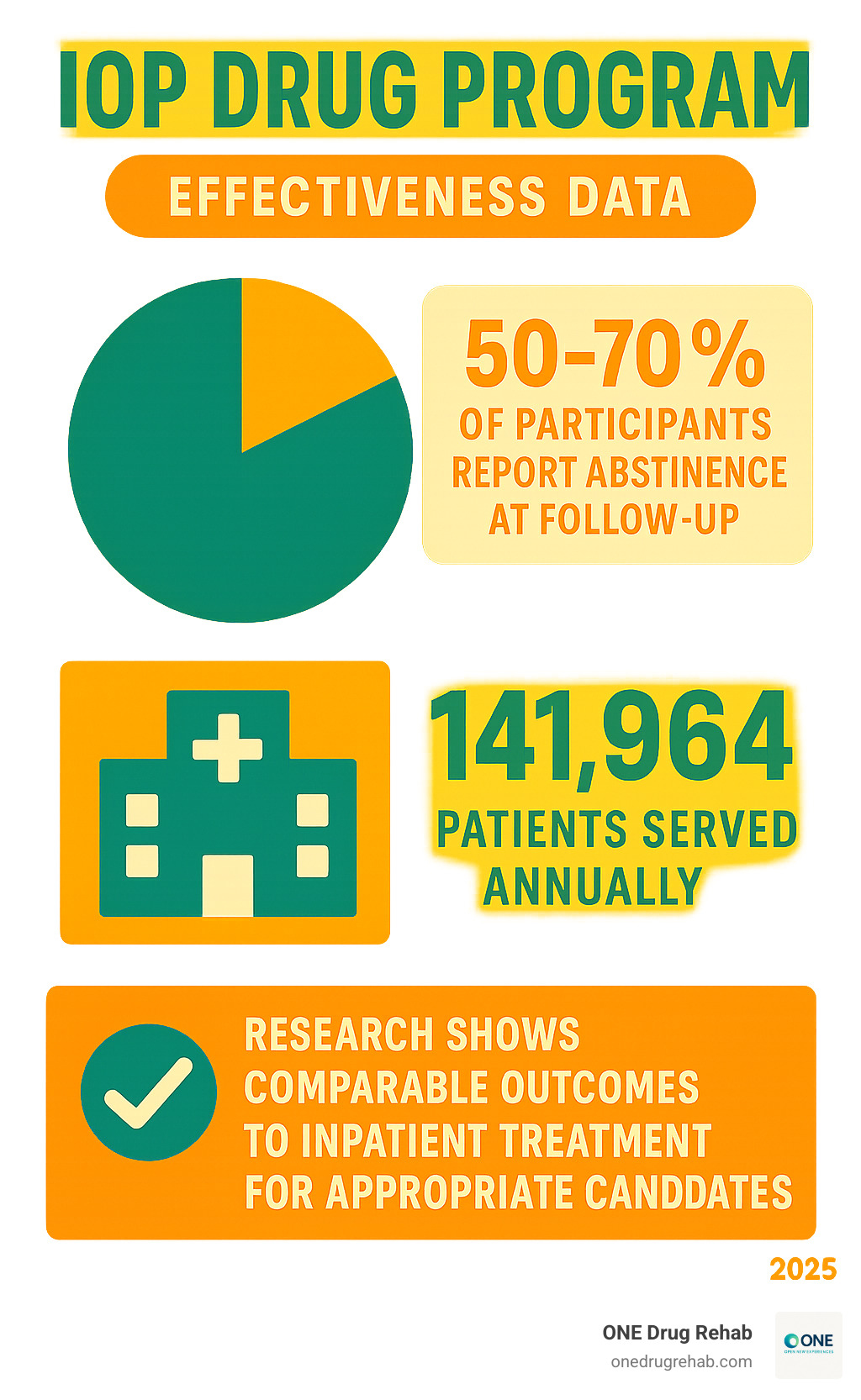
Research consistently demonstrates that iop drug programs are as effective as inpatient treatment for most individuals seeking addiction care. A comprehensive review of scientific literature found that IOPs produce substantial reductions in drug and alcohol use, with studies showing that 50% to 70% of participants report abstinence at follow-up periods.
The effectiveness of IOPs is particularly notable given their flexibility and lower cost compared to residential treatment. According to research published in the journal Psychiatric Services, IOPs can reduce treatment costs by almost half compared to inpatient programs while maintaining comparable outcomes.
Key Advantages of Choosing an IOP
Maintain Employment and Financial Stability: Unlike residential treatment, IOPs allow you to continue working, which is crucial for maintaining income, health insurance, and job security. This financial stability often improves long-term recovery outcomes.
Stay Connected with Family: Living at home enables you to maintain important family relationships and responsibilities. This is particularly important for parents who need to care for children while receiving treatment.
Practice Recovery Skills in Real-Time: IOPs provide the unique advantage of allowing you to immediately apply new coping skills in your actual environment. This real-world practice is invaluable for building confidence and competence in recovery.
Build a Local Support Network: By remaining in your community during treatment, you can develop and strengthen local support systems that will be available after treatment ends.
Lower Cost and Greater Accessibility: IOPs are significantly more affordable than residential treatment, making them accessible to people who might not otherwise be able to afford addiction treatment.
Smooth Transition from Higher Levels of Care: For those stepping down from inpatient or residential treatment, IOPs provide continued support while allowing gradual reintegration into daily life.
Who is a Good Fit for an IOP? (And Who Isn’t?)

Ideal candidates for an iop drug program typically have:
- Stable and supportive home environment: A living situation free from active substance use and supportive of recovery
- Motivation for recovery: Genuine desire to change and willingness to participate actively in treatment
- Completed detoxification: No need for medical detox or withdrawal management
- Reliable transportation: Ability to consistently attend treatment sessions
- Manageable co-occurring disorders: Mental health issues that don’t require 24/7 supervision
- Support system: Family, friends, or community members who support recovery efforts
- Ability to maintain responsibilities: Capacity to balance treatment with work, school, or family obligations
IOPs may not be appropriate for individuals with:
- Severe substance use disorders requiring 24/7 supervision: Those at high risk for dangerous withdrawal or who have repeatedly failed in outpatient settings
- Unstable or triggering home environment: Living situations that actively undermine recovery efforts
- Significant medical or psychiatric issues: Conditions requiring constant medical monitoring or intensive psychiatric care
- History of repeated relapse in less structured settings: Pattern of failing in outpatient treatment without residential stabilization
- Lack of motivation or insight: Unwillingness to participate in treatment or denial about the severity of addiction
- Active suicidal ideation or severe mental health crises: Immediate safety concerns requiring higher levels of care
These criteria aren’t absolute. A thorough assessment by addiction treatment professionals is essential to determine the most appropriate level of care for each individual.
Finding the Right Program and Supporting a Loved One
Choosing an iop drug program can feel daunting, but a few clear markers separate quality programs from the rest.
How to Choose the Best IOP Drug Program for Your Needs
- Accreditation – Look for facilities approved by JCAHO or CARF.
- Qualified staff – Confirm that counselors and medical professionals hold current licenses and addiction-specific training.
- Evidence-based care – Programs should use CBT, DBT, and trauma-informed approaches and offer dual-diagnosis services when needed.
- Family involvement – Quality IOPs include family therapy and education.
- Aftercare planning – Ask about alumni groups and relapse-prevention follow-up.
- Insurance & cost clarity – Verify coverage and out-of-pocket expenses; many centers have in-house financial counselors.
Practical factors matter, too. Evening or morning tracks can help you keep working, and some programs specialize in groups such as adolescents, professionals, or LGBTQ+ individuals. Compare options with our Compare Rehab Centers tool.
The Crucial Role of Family in the Recovery Process
Addiction affects the whole household; recovery does, too. Family sessions help repair trust, teach healthy boundaries, and show relatives how to offer support without enabling. Loved ones should also seek their own help – groups like Al-Anon or individual counseling provide space to process stress and learn effective communication.
Creating a recovery-friendly home includes removing substances, avoiding triggering situations, and celebrating progress. Change takes time; small, consistent steps build lasting results.
To locate programs in your region, visit our Find Rehab Facilities directory.
Frequently Asked Questions about IOP Drug Programs
Are IOPs as effective as inpatient rehab?
Often, yes. Research shows that, for people with stable housing and no need for medical detox, outcomes from an iop drug program are comparable to those from residential care.
How much does an IOP cost and does insurance cover it?
IOPs cost far less than inpatient treatment because you are not paying for room and board. Most private insurers, Medicare, and many state Medicaid plans cover IOP services. If you are uninsured, ask about sliding scales, payment plans, or state-funded slots. For additional guidance, see our resource on finding rehab without insurance.
What happens after I complete an IOP?
Graduates usually step down to weekly outpatient therapy, attend mutual-support groups like AA or NA, and stay connected through program alumni events. Your treatment team will craft an aftercare plan that includes relapse-prevention strategies and follow-up appointments, ensuring you have ongoing support.
Conclusion
Intensive Outpatient Programs represent a approach to addiction treatment, offering the perfect balance of intensive therapeutic support and real-world flexibility. As we’ve explored throughout this guide, iop drug programs provide comprehensive, evidence-based treatment while allowing you to maintain your job, family responsibilities, and community connections.
The research speaks volumes about their effectiveness. IOPs are as effective as inpatient treatment for appropriate candidates, with 50-70% of participants achieving abstinence at follow-up. With over 6,000 programs serving nearly 142,000 patients annually, IOPs have become a cornerstone of modern addiction treatment—and for good reason.
What makes IOPs so powerful? They provide intensive support (9-20 hours per week) without requiring hospitalization. They’re ideal for people with stable living situations who don’t need 24/7 medical supervision. They offer evidence-based therapies including CBT, DBT, and trauma-informed care. They’re significantly more affordable than residential treatment, and perhaps most importantly, they allow real-world practice of recovery skills in your actual environment.
This last point can’t be overstated. There’s something uniquely valuable about learning coping strategies on Tuesday night and then applying them at work on Wednesday morning. IOPs don’t just teach recovery—they help you live it.
Recovery is indeed a journey, not a destination. It’s not about reaching some perfect finish line where addiction never crosses your mind again. It’s about building the skills, support systems, and inner strength to steer life’s challenges without turning to substances. Finding the right level of care is a critical first step toward lasting sobriety.
Whether you’re considering an IOP as your primary treatment or as a step-down from residential care, the most important thing is taking that first step. And yes, it can feel overwhelming. The good news? You don’t have to figure it all out alone.
At ONEDrugRehab.com, we understand that choosing the right treatment program can feel like navigating a maze blindfolded. That’s why we provide comprehensive, unbiased information to help you make informed decisions about your recovery journey. We don’t endorse specific providers—instead, we empower you with the knowledge you need to find the treatment that’s right for you.
Ready to take the next step? Explore our comprehensive directory to Find a Rehab Program Near You. Seeking help is a sign of strength, not weakness. Your recovery journey starts with a single decision to change, and we’re here to help you steer every step of the way.
The path to recovery may not always be easy, but with the right support and treatment, lasting sobriety is absolutely achievable. IOPs offer hope, flexibility, and proven effectiveness—everything you need to reclaim your life from addiction while staying connected to the people and responsibilities that matter most to you.
Your story doesn’t end with addiction. In fact, your recovery story might just be the beginning of the most meaningful chapter of your life.