

Why Online Sobriety Meetings Are Changing Recovery
Online sobriety meetings connect people in recovery through video, phone, or text from anywhere with an internet connection. As substance use continues to rise, millions of Americans are turning to virtual recovery support.
Quick Answer: How to Find & Join Online Sobriety Meetings
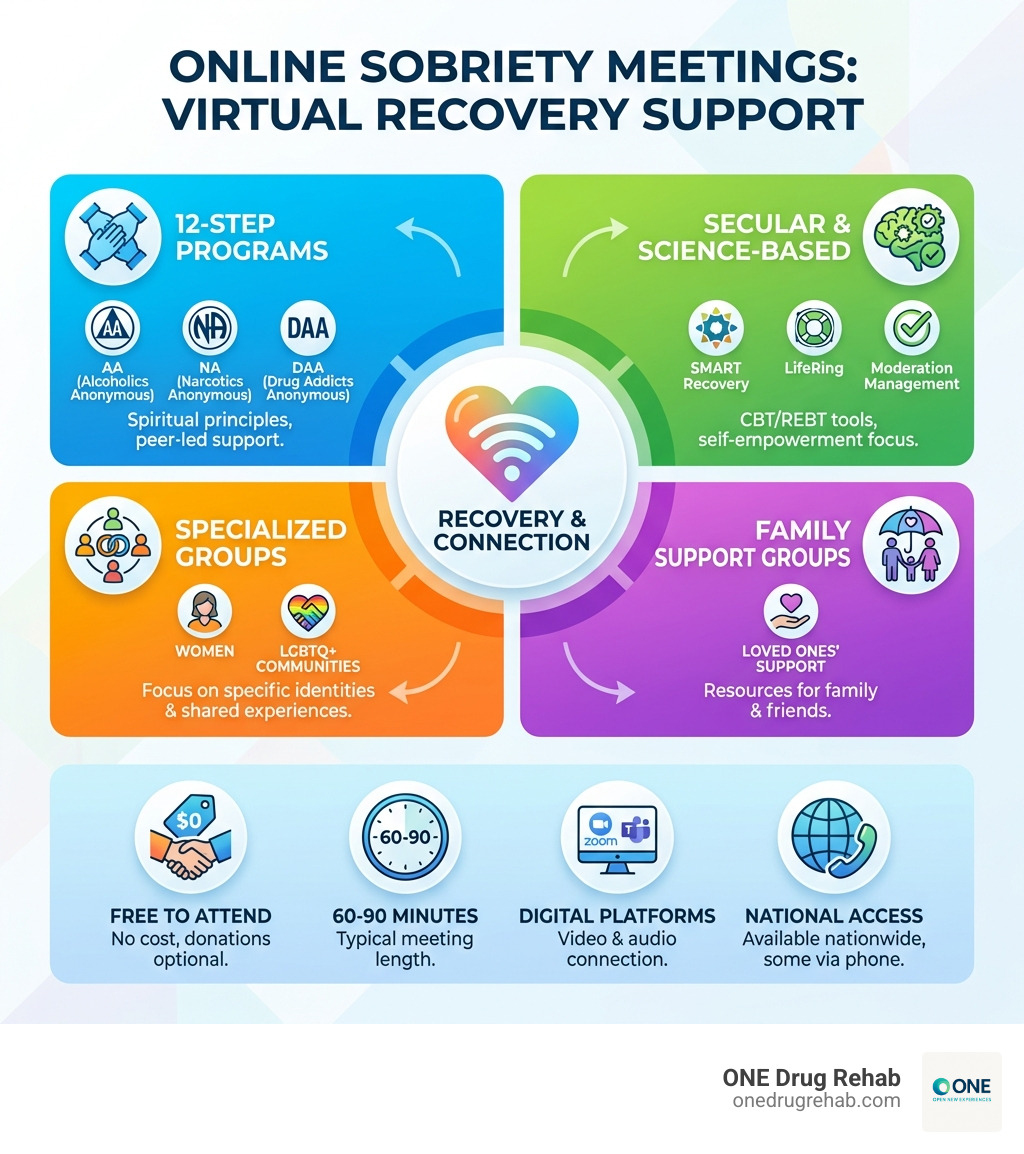
- Choose your program type: 12-Step (AA, NA, DAA) or secular alternatives (SMART Recovery, LifeRing)
- Find a meeting: Visit AA Online Intergroup or SMART Recovery Meetings
- Join the meeting: Click the Zoom link or dial in by phone using the meeting ID
- Participate: Most meetings are free, cameras are optional, and you only share your first name
What makes online meetings different from in-person? They’re accessible 24/7, eliminate travel, and reduce the anxiety many feel attending their first meeting. You can join a meeting across the country without leaving your living room.
This shift isn’t just about convenience. Research shows that people who attend 12-Step programs after treatment have twice the abstinence rates of those who don’t. Online meetings make this critical support accessible to anyone with a phone or computer.
Online sobriety meetings offer a safe, confidential space to connect with others who understand addiction. Most meetings are free, run 60-90 minutes, and are guided by trained facilitators or peers.
Find more about online sobriety meetings:
What Are Online Sobriety Meetings and Why Choose Them?
Online sobriety meetings are virtual support groups where individuals connect with peers and facilitators to overcome addiction. They use technology to create a safe, confidential space for sharing experiences and building a sober community.
These virtual spaces make support more accessible than ever, bringing help directly to you, whether you’re in a remote area or simply prefer the comfort of home. This is a game-changer for those who feel daunted by in-person meetings.

The Core Benefits of Going Virtual
Online meetings address many common barriers to traditional support.
- Convenience and Accessibility: Fit meetings into any schedule without a commute. This is a lifeline for those with mobility issues, chronic illness, or childcare duties. Geographical limits disappear, as many meetings are national and open to all.
- Reduced Anxiety for Newcomers: Joining from a familiar environment, often with your camera off, eases the anxiety of a first meeting. This gentle introduction helps newcomers engage with group support at their own pace.
- Improved Anonymity: The virtual setting improves privacy. You can use a first name, keep your camera off, and use virtual backgrounds to protect your identity, fostering a safe space for open sharing.
- A Wider Variety of Meetings: The internet provides a vast choice of meetings. You can find groups that match your specific needs, program philosophy, or schedule, regardless of your location.
- Consistent Support: Online meetings offer 24/7 access to help, which is crucial when traveling, sick, or facing sudden cravings. This consistent availability is a powerful tool for relapse prevention.
For those interested in understanding how group dynamics contribute to healing, we’ve explored it further here: More info about group therapy.
How Do Online Meetings Work?
The mechanics are straightforward and user-friendly.
- Platforms: Most meetings use familiar platforms like Zoom and Microsoft Teams for face-to-face interaction.
- Access: For security, meetings use a unique ID and sometimes a password, found in the meeting directory.
- Phone Dial-In: For those without reliable internet, many meetings offer a phone dial-in option for audio-only participation. Simply call the provided number and enter the Meeting ID. You can often mute/unmute with
*6. For detailed instructions, refer to instructions for joining a meeting by phone. - Text-Based Chat: Some groups offer text-only meetings, ideal for complete anonymity or low bandwidth. Participants interact by typing, using commands like
!to request to share. - Facilitators: Meetings are guided by a facilitator (or “convenor”), often a peer in recovery, who keeps the meeting on track. SMART Recovery facilitators are trained to use specific program tools.
- Participation: You can share, ask questions, or just listen. The facilitator explains the protocols, allowing you to participate in a way that feels safe for you.
Exploring the Different Types of Online Sobriety Meetings
Finding the right online sobriety meeting is crucial, as programs have diverse philosophies. We’ll explore traditional 12-Step models, secular science-based alternatives, and specialized groups to help you find the best fit.
Traditional 12-Step Programs: AA, NA, & DAA
These programs are built on spiritual principles, including acknowledging powerlessness over addiction, believing in a “Higher Power,” and helping others.
- Alcoholics Anonymous (AA): As the original 12-Step program, AA is a fellowship where members share experiences to solve their common problem with alcohol. The only requirement is a desire to stop drinking. Find meetings in the directory of Online AA Meetings.
- Narcotics Anonymous (NA): Following the 12-Step model, NA is for recovery from all drug addiction, including alcohol. It fosters a strong peer support network where members help each other recover.
- Drug Addicts Anonymous (DAA): DAA is another 12-Step program for drug addiction recovery. It provides a structured environment for sharing and working the steps, with many virtual options available.
For a broader understanding of these foundational groups, explore 12 Step Groups Near Me.
Secular & Science-Based Alternatives
For those who prefer a non-spiritual approach, these programs focus on self-empowerment and evidence-informed methods.
- SMART Recovery: SMART (Self-Management And Recovery Training) is a science-based approach for any addictive behavior. It teaches practical tools based on therapies like CBT. Free, facilitator-led meetings focus on a “4-Point Program”: building motivation, coping with urges, managing thoughts and behaviors, and living a balanced life. Learn about SMART Recovery.
- LifeRing: This is an abstinence-based, secular group with conversational meetings. Led by a “convenor,” discussions focus on current recovery experiences and future plans. The only requirement is a desire to be sober. Explore LifeRing.
- Moderation Management: This support group helps people concerned about their drinking make positive lifestyle changes. It offers a path for those who aim to reduce their drinking to moderate levels, rather than complete abstinence.
Specialized and Affinity Groups
Many meetings cater to specific demographics, creating highly relatable environments.
- Women for Sobriety: This non-profit offers abstinence-based support for women, focusing on positive affirmations and the unique challenges women face in recovery. Find support for women.
- 2SLGBTQIA+ Meetings: Many organizations offer dedicated meetings for the 2SLGBTQIA+ community, recognizing their specific needs and providing a vital sense of belonging.
- Family & Friends Support: Support is also available for loved ones. SMART Recovery Family & Friends meetings use tools from SMART and CRAFT (Community Reinforcement Approach & Family Training). Studies show CRAFT significantly increases the rate of loved ones entering treatment.
- Language-Specific Meetings: To improve accessibility, some organizations offer meetings in other languages, such as Spanish.
These specialized groups demonstrate the commitment of the recovery community to provide inclusive and custom support for everyone. For more general support groups, see Recovery Support Groups.
How to Find and Join Your First Online Sobriety Meeting
Finding and joining your first online sobriety meeting is simpler than you might think. This guide will walk you through the process of connecting with a supportive community.
Finding the Right Online Sobriety Meetings for You
Use online directories and their filters to find a meeting that resonates with you:
- SMART Recovery Finder: The Find a SMART Meeting near you tool lists meetings by location, but many are national and open to anyone online.
- AA Online Intergroup: The OIAA provides a comprehensive directory of Online AA Meetings worldwide, which you can filter by day, time, and type.
- LifeRing Meeting List: LifeRing’s official website hosts a list of their conversational online meetings.
- DAA and Other 12-Step Groups: Visit the official websites for Drug Addicts Anonymous, Narcotics Anonymous, and other fellowships to find their virtual meeting lists.
Try a few different meetings to find the one where you feel comfortable, understood, and motivated.
What to Expect: Your First Online Meeting
Joining your first meeting can be nerve-wracking, but you’ll find a welcoming community. Here’s a general idea of what to expect:
- Joining: Click the meeting link (e.g., Zoom) from the directory. You may need to enter a Meeting ID and password.
- Format: The facilitator opens with a welcome and explains the meeting’s format and rules. Meetings often start with a brief check-in where participants introduce themselves by first name. You are never required to speak; listening is fine.
- Sharing: The core of the meeting is group discussion. The format varies by program (e.g., sharing “experience, strength, and hope” in AA or discussing tools in SMART Recovery).
- Protocols: To share, you might use the “raise hand” feature in video meetings or type
!in text chats. Most meetings have a “no crosstalk” rule (no interrupting or direct replies) to ensure a safe sharing environment. - Camera Policy: Your camera can usually be off. Some meetings may require cameras for check-in, so check the meeting notes.
- Duration & Closing: Meetings typically last 60 to 90 minutes and end with a closing statement or reading.
Understanding Anonymity, Confidentiality, and Cost
These three aspects are fundamental to the safety of online meetings.
- Anonymity: This is a core principle. Protect your identity by using only your first name, not sharing personal details, and using virtual backgrounds.
- Confidentiality: “What’s shared in the meeting stays in the meeting.” This rule is vital for creating a safe space and relies on the integrity of all attendees.
- Cost: Most meetings are completely free to attend. These non-profit groups operate on voluntary contributions (the “7th Tradition” in 12-Step programs) to cover costs. Donations are appreciated but never required for participation. You can often find a donation link in the meeting details, like this one for Support a meeting.
The Role of Online Meetings in Long-Term Recovery
Online sobriety meetings aren’t just for getting started; they play a critical role in sustaining long-term recovery. They offer a constant, accessible source of strength and community needed to build a sustainable sober life.
Building a Sustainable Sober Life with online sobriety meetings
- Consistency and Routine: Regular attendance helps establish a healthy routine, reinforcing your commitment to sobriety.
- Relapse Prevention: Meetings are a great place to learn relapse prevention. You’ll hear how others cope with triggers, and programs like SMART Recovery teach specific cognitive tools to manage challenges.
- Immediate Support: When an urge strikes, immediate access to a meeting can be a powerful deterrent. A supportive community can provide the encouragement needed to ride out a craving.
- Peer Accountability: Hearing others’ stories fosters camaraderie and accountability. Celebrating milestones together reinforces positive behaviors and reminds you that you’re not alone.
- Integration with Treatment: Support groups are a vital complement to professional treatment. Studies show attending 12-Step programs after treatment can double abstinence rates. Online meetings serve as crucial aftercare, reinforcing skills learned in treatment. For more information on structured care, explore Information on Outpatient Rehab Programs.
Resources for Family, Friends, and How to Get Involved
Addiction impacts the entire family, and support is available for them, too.
- Support for Loved Ones: Groups like Al-Anon, Nar-Anon, and SMART Recovery Family & Friends offer invaluable resources. The SMART program uses CRAFT (Community Reinforcement Approach & Family Training), which studies show significantly increases the rate of loved ones entering treatment. Families learn effective strategies to encourage recovery. Find practical tools and guidance through Worksheets for Family & Friends.
- Getting Involved: If you’ve benefited from meetings, consider giving back. You can volunteer, train to become a facilitator, donate to keep meetings free, or share your story to inspire newcomers. This is a powerful act of service that strengthens the entire recovery community.
Frequently Asked Questions about Online Sobriety Meetings
We understand you might have lingering questions about online sobriety meetings. Here, we address some of the most common concerns.
Are online meetings really anonymous?
Yes, anonymity is a core principle. You are encouraged to use only your first name and are never required to share personal details. Using your camera is optional, and virtual backgrounds can obscure your location. The group’s shared commitment to confidentiality is key to maintaining a private and safe space.
Do I have to speak or turn on my camera?
No. You are always welcome to just listen, especially in your first few meetings. Keeping your camera off is also standard practice, providing comfort and anonymity. While most meetings are camera-optional, a few may have specific rules (e.g., for check-in), so it’s wise to check the meeting notes. You can participate at your own pace.
Can I get proof of attendance for court or treatment?
Yes, many meetings can provide proof of attendance. Some organizations have a dedicated verification system on their website; for example, you can visit the SMART Recovery Meeting Verification page. For other meetings, contact the facilitator directly. They can guide you on the steps to get the required documentation.
Conclusion
We’ve explored the expansive and invaluable world of online sobriety meetings, from foundational 12-Step programs to science-based alternatives and specialized affinity groups. There is a virtual space for everyone seeking recovery.
The benefits are clear: unparalleled accessibility, reduced anxiety for newcomers, and a global community offering consistent support. These virtual gatherings are powerful tools for building a sustainable sober life, preventing relapse, and connecting with others who truly understand. They also offer vital resources for family and friends.
When connection is more important than ever, online sobriety meetings empower individuals to choose their path to recovery, offering a lifeline that is just a click or a call away. The journey to sobriety is deeply personal, but it doesn’t have to be a solitary one.
If you or a loved one are exploring options for addiction treatment and recovery support, ONEDrugRehab.com is here as a third-party, non-affiliated resource. We provide general information to help you research various treatment options without endorsing specific providers, ensuring you have the knowledge to make informed choices.
Taking the next step is a sign of incredible strength. We encourage you to explore the diverse landscape of online sobriety meetings and find the community that will support you on your path to lasting recovery.
Explore different types of addiction treatment