

Why Understanding How Group Therapy Help Addicts Matters in Recovery
Many people ask how group therapy help addicts when exploring treatment options. In short, it provides peer support, reduces isolation, teaches coping skills, and creates accountability. As a cost-effective and widely available option, it’s offered by 93% of substance use disorder treatment facilities, and research shows it’s as effective as individual therapy for maintaining abstinence.
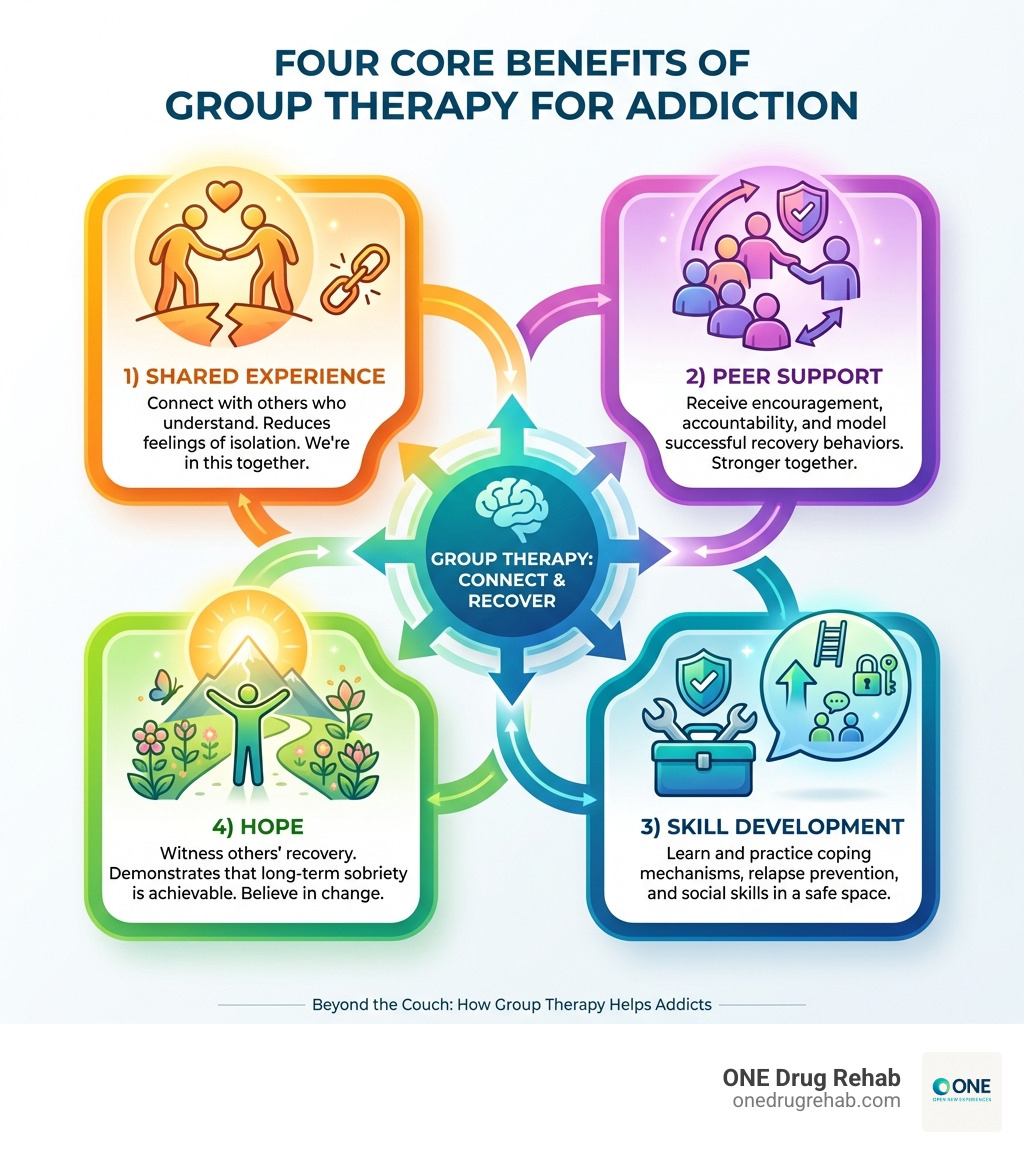
Quick Benefits of Group Therapy for Addiction:
- Shared Experience: You realize you’re not alone in your struggle
- Peer Support: Others who understand addiction provide encouragement and accountability
- Skill Development: Learn and practice relapse prevention strategies in a safe environment
- Hope: Witnessing others’ recovery shows that sobriety is possible
- Cost-Effective: Typically less expensive than one-on-one counseling
- Structure: Regular sessions add discipline and routine to recovery
Group therapy is more than just talking; it’s a proven tool that uses affiliation, peer support, and mutual accountability to help individuals bond with a culture of recovery. It addresses common issues like depression, isolation, and shame that often accompany addiction.
Led by trained professionals, group therapy leverages the human need for connection to foster healthy attachments and teach new social skills. Unlike peer-led self-help groups like Alcoholics Anonymous, formal group therapy involves licensed therapists guiding structured sessions designed to promote recovery.
Group therapy is a core component of most inpatient, outpatient, and continuing care plans. Understanding how it works can build confidence as you begin your recovery journey.
What is Group Therapy and How Does It Work in Addiction Treatment?
Group therapy is a treatment where a small number of people with similar issues, like substance use disorders (SUDs), meet with a trained professional. It’s a structured environment for support and accountability, creating a safe space to share experiences and diminish the isolation and shame of addiction. Research shows group therapy is as effective as individual therapy for SUDs, with participants often showing a stronger commitment to abstinence. This demonstrates how group therapy help addicts with tangible results.
For more information on various therapeutic approaches, explore our page on Addiction Therapy Methods.
Group vs. Individual Therapy: A Comparative Look
While individual therapy offers personalized attention, group therapy harnesses the power of collective experience. The table below highlights key differences. Both modalities are effective, and comprehensive treatment plans often integrate both for optimal results.
| Feature | Group Therapy | Individual Therapy |
|---|---|---|
| Cost | Typically less expensive | Generally more expensive |
| Structure | Multiple clients, 1-2 facilitators, structured sessions | One client, one therapist, flexible sessions |
| Focus | Peer interaction, shared experiences, social skills | Deep personal introspection, specific individual issues |
| Primary Benefits | Community, accountability, diverse perspectives, reduced isolation | Personalized attention, privacy, intensive focus on specific trauma |
| Confidentiality | Agreement among members, legal protections | Strict legal and ethical protections for one client |
| Therapeutic Alliance | Alliance with therapist and group members | Alliance solely with therapist |
To learn more about what goes on in a group setting, visit What Does Group Therapy in Addiction Entail?.
The Crucial Role of the Trained Group Facilitator
The effectiveness of group therapy depends on its leader. A trained facilitator, typically a licensed therapist or certified addiction counselor, is crucial for a safe and productive environment. Their expertise allows them to:
- Manage Group Dynamics: Ensure all members can participate and keep the session on track.
- Set Boundaries: Establish and enforce clear rules for safety and predictability.
- Ensure Safety: Protect members from emotional harm and manage conflict constructively.
- Model Behavior: Demonstrate healthy communication, empathy, and active listening.
- Adapt Interventions: Use techniques appropriate for clients with SUDs.
A skilled leader is central to how group therapy help addicts. You can find more comprehensive details on the role of facilitators in documents like Substance Abuse Treatment: Group Therapy.
Inside a Session: Structure, Rules, and Expectations
Understanding the structure of a group session can ease anxiety. Sessions are designed to help clients practice recovery strategies and build support networks. Key elements include:
- Group Size: Typically 6 to 12 members to allow for meaningful interaction.
- Session Length: Usually 60 to 90 minutes.
- Open vs. Closed Groups: “Open” groups allow new members anytime, while “closed” groups have a fixed membership for the program’s duration.
- Group Agreement: A contract outlining rules for confidentiality, participation, and behavior.
- Confidentiality Rules: Members agree to keep discussions within the group to create a safe space.
- Active Participation: The group thrives on members sharing experiences, offering support, and providing feedback.

This structured environment is fundamental to how group therapy help addicts by providing a consistent and predictable space for healing.
The Core Benefits: How Group Therapy Help Addicts Build a Foundation for Recovery
The therapeutic benefits of group therapy are rooted in human connection, helping individuals experience, learn, and grow within a supportive community. These advantages are a critical part of understanding how group therapy help addicts on their path to sobriety.

For a broader view of recovery advantages, check out our Benefits of Rehab page.
From Isolation to Community: Finding Your Tribe in Recovery
Addiction thrives in isolation. Group therapy shatters this by building a strong sense of community and letting you know “You are not alone.”
- Reduces Isolation: Hearing others share similar struggles is validating and combats the shame and loneliness of addiction.
- Fosters Connection: Shared experiences create genuine bonds and a feeling of acceptance.
- Builds a Support Network: These connections become a vital support system outside of therapy.
- Instills Hope: Witnessing peers succeed in recovery provides tangible proof that sobriety is achievable.
This sense of community is a cornerstone of how group therapy help addicts.
How Peer Support and Accountability Help Addicts in Group Therapy
Group therapy provides powerful peer support and accountability, which are crucial for sustained recovery.
- Positive Peer Pressure: Members encourage healthy choices and challenge self-defeating behaviors.
- Modeling Success: Observing peers steer recovery provides concrete examples and strategies.
- Mutual Encouragement: The group offers consistent support, uplifting members who are struggling.
- Feedback and Progress: Sessions are a platform to share progress and receive constructive feedback.
- Motivation: Reporting back to the group adds a layer of commitment to maintaining abstinence.
This blend of empathy and accountability is central to how group therapy help addicts. For a deeper understanding of the entire recovery journey, explore our Addiction Recovery Complete Guide.
A Safe Space to Practice: Building Coping Skills for a Sober Life
Group therapy provides a safe environment to learn and practice essential coping skills for a sober life.
- Relapse Prevention: Members learn to identify triggers and develop plans to manage them.
- Healthy Routines: The group encourages and reinforces structured, healthy daily habits.
- Stress Management: Participants practice techniques like mindfulness and relaxation.
- Social and Communication Skills: The group acts as a microcosm of the real world to practice healthy interaction.
- Setting Boundaries: Members learn and role-play how to say “no” and protect their recovery.
- Real-World Application: Skills are not just theoretical; members discuss their application in daily life.
By actively engaging in these practices, individuals gain confidence and competence. This is a fundamental aspect of how group therapy help addicts translate insights into practical living.
A Deeper Dive: Types of Group Therapy and Key Topics Covered
Group therapy includes various evidence-based models, allowing providers to tailor treatment to an individual’s needs. Understanding these different types is key to appreciating the versatility of how group therapy help addicts.
For a comprehensive overview of group therapy in addiction, see our Group Therapy Addiction Complete Guide.
Finding the Right Fit: Common Models of Group Therapy
The Substance Abuse and Mental Health Services Administration (SAMHSA) outlines several models of group therapy commonly used in addiction treatment:
- Psychoeducational Groups: Educate members on the consequences of substance abuse and the nature of addiction to motivate recovery.
- Skills Development Groups: Teach practical skills for abstinence, such as coping mechanisms, anger management, and stress reduction.
- Cognitive-Behavioral Therapy (CBT) Groups: Help members change problematic thoughts and behaviors linked to substance use, with a focus on relapse prevention.
- Support Groups: Provide a forum for mutual encouragement and emotional support, emphasizing shared experiences to reduce loneliness.
- Interpersonal Process Groups: Focus on the “here and now” of group dynamics to help clients understand how their relationship patterns contribute to substance use.
These models are often combined for a comprehensive approach. For a deeper dive into the research supporting these treatments, refer to A review of research-supported group treatments for drug use disorders.
Tackling the Tough Stuff: Common Topics in Addiction Groups
Group sessions address the many facets of addiction and recovery. These discussions are pivotal in how group therapy help addicts process their past, manage their present, and plan for their future.
Common topics include:
- Managing triggers and cravings
- Overcoming guilt and shame
- Family dynamics and rebuilding trust
- Spirituality in recovery
- Life skills (financial management, job searching)
- Building healthy interpersonal relationships
- Stress management techniques
These discussions, guided by a professional and enriched by peer perspectives, create a holistic environment for healing.
The Evidence Behind the Efficacy: Does Group Therapy Really Work?
Clinical research consistently affirms that group therapy is effective for treating addiction. Studies show its positive influence on abstinence, treatment retention, and psychological symptoms. Our understanding of Addiction Recovery Success Rates clearly shows the positive influence of structured therapeutic interventions.
What the Research Says About How Group Therapy Help Addicts
Numerous studies provide robust evidence for group therapy’s efficacy in addiction treatment.
- Significant Effect on Abstinence: A major meta-analysis found that group therapy has a significant positive effect on abstinence rates compared to no treatment.
- Comparable to Individual Therapy: The same analysis concluded its effectiveness is comparable to individual therapy, reinforcing how group therapy help addicts as a primary treatment option.
- Improved Treatment Engagement: Adding group therapy to individual treatment has been shown to improve engagement, abstinence rates, and peer support.
- Efficacy Across Substances: Research shows positive outcomes for various SUDs, including those involving cocaine, opioids, and methamphetamine, often using models like CBT and the Matrix Model.
The consistent findings across different substances highlight the broad applicability of group therapy. For more details, explore the SAMHSA document on Group Therapy In Substance Use Treatment.
A Holistic Approach: Treating Co-occurring Disorders in a Group Setting
Many individuals with SUDs also have co-occurring mental health conditions like depression or anxiety (a “dual diagnosis”). Group therapy is well-suited to address these complex needs holistically.
- Integrated Treatment: Groups often integrate interventions for both addiction and mental health, addressing how they influence each other.
- Specific Models for Co-occurrence: Models like Seeking Safety (for trauma/PTSD) and Dialectical Behavior Therapy (DBT) are designed for dual diagnosis clients.
- Peer Validation: In a group, individuals find understanding from peers with similar co-occurring struggles, reducing stigma.
- Skill Development: Participants practice skills relevant to both mental health symptoms and substance cravings, such as emotional regulation and distress tolerance.
This integrated approach significantly improves how group therapy help addicts manage their mental health alongside their recovery. For more specialized information, see our page on Co-occurring Disorder Treatment.
The Importance of Cultural Competence in Group Therapy
Effective group therapy must be culturally competent, recognizing that factors like gender, race, and sexual orientation influence recovery.
- Gender-Specific Groups: Women-only groups, for example, can provide a safe space to address unique issues like trauma and parenting.
- LGBTQ+ Affirming Spaces: Affirming groups address specific stressors and identity issues relevant to the community that can contribute to substance use.
- Culturally Responsive Practices: Therapists must understand the unique perspectives of clients from various backgrounds, including the impact of discrimination.
- Safe Environment: A competent facilitator is attuned to group dynamics and ensures a safe and inclusive space for all members.
By embracing diversity, group therapy maximizes how group therapy help addicts from all walks of life find healing. For those seeking specialized support, resources like Spanish Speaking Rehab Centers highlight the importance of cultural understanding.
Is Group Therapy Always the Right Choice?
While group therapy is a powerful tool, it’s not suitable for everyone at every stage of recovery. Client suitability is key to matching individuals with the most appropriate treatment modalities based on their unique needs.
Understanding the nuances of How Rehab Works Ultimate Guide helps clarify that treatment is highly individualized.
Understanding the Potential Disadvantages and Limitations
Despite its benefits, group therapy has potential drawbacks for some individuals:
- Confidentiality Concerns: There is always a risk of members sharing information outside the group.
- Social Anxiety: The setting can be overwhelming for those with severe social anxiety.
- Personality Clashes: Conflicts can disrupt the group dynamic, though a skilled facilitator can manage them.
- Less Individual Attention: The therapist’s focus is divided among all members.
- Slower Pace: The group’s pace must accommodate multiple individuals.
- Not a “One-Size-Fits-All” Solution: Some may need more intensive, individual intervention first.
These limitations highlight the importance of careful client assessment and matching.
When Individual Therapy Might Be a Better Starting Point
For some, individual therapy is a more appropriate starting point before joining a group. This is often true for individuals who are:
- Experiencing active psychosis.
- Unable to follow basic group rules.
- In an acute life crisis (e.g., severe suicidal ideation).
- Struggling with severe personality disorders that impair interaction.
- Completely unwilling to participate in a group setting.
- In need of private, intensive work on complex trauma.
In these cases, individual therapy provides foundational support and stability, preparing a person to eventually join a group and fully benefit from how group therapy help addicts in the long run.
Frequently Asked Questions about Group Therapy for Addiction
We understand you might have more questions as you consider group therapy for addiction. Here are some common inquiries we hear:
How much does group therapy cost compared to individual therapy?
Group therapy is typically less expensive than individual therapy, making it a more cost-effective option for many. This is because the therapist’s time is shared among multiple clients. The exact cost varies by provider, location, and whether it’s part of a larger treatment program, as well as your insurance coverage. Many insurance plans do cover group therapy as a component of addiction treatment. For a broader look at treatment costs, check out our More info about Rehab Cost Comparison page.
What’s the difference between group therapy and a 12-step meeting?
This is a common and important distinction!
- Group therapy is led by a licensed, trained professional therapist (e.g., a psychologist, social worker, or certified addiction counselor). It has specific therapeutic goals, often employs evidence-based modalities like CBT or DBT, and focuses on understanding and changing underlying behaviors and thought patterns.
- 12-step meetings (like Alcoholics Anonymous (AA) or Narcotics Anonymous (NA)) are peer-led support groups. They are not therapy in the clinical sense, but rather a fellowship of individuals who share their experience, strength, and hope to solve their common problem. They follow a spiritual program of recovery (the 12 Steps) and are typically free to attend.
Both can be incredibly valuable and are often used together as complementary components of a comprehensive recovery plan. Many treatment programs will recommend or require attendance at 12-step meetings in conjunction with formal group therapy. To learn more about 12-step programs, visit our More info about 12 Step Groups Online Guide.
How do I find a group therapy program for addiction?
Finding a group therapy program for addiction can be done through several avenues:
- Inpatient or Outpatient Rehab Programs: Most comprehensive addiction treatment centers, whether inpatient or outpatient rehab programs, include group therapy as a core component of their curriculum.
- Community Mental Health Centers: These centers often offer various group therapy options, sometimes on a sliding scale fee.
- Private Practice Therapists: Many licensed therapists who specialize in addiction offer group therapy sessions in addition to individual counseling.
- Referrals: Your primary care physician, a mental health professional, or an addiction specialist can provide referrals to reputable group therapy programs in your area.
- Online Search Tools: Resources like ONEDrugRehab.com can help you locate facilities that offer group therapy as part of their services.
When searching, inquire about the facilitator’s qualifications, the group’s specific focus, and whether new members are accepted (open vs. closed groups).
Conclusion
Understanding how group therapy help addicts reveals it as a true game-changer in the landscape of addiction recovery. It’s a powerful, evidence-based tool that leverages the inherent human need for connection to foster healing and growth. From breaking the chains of isolation and shame to building vital coping skills and offering a mirror for accountability, group therapy provides a unique and indispensable pathway to sobriety.
We’ve seen that it’s as effective as individual therapy, often more cost-effective, and plays a crucial role in treating co-occurring mental health conditions. With trained facilitators guiding diverse groups through shared experiences, individuals find not just treatment, but a community, a sense of belonging, and renewed hope.
If you or a loved one is considering addiction treatment, finding the right approach is a crucial step in the recovery journey. Group therapy is a foundational element in many successful treatment plans, offering a supportive environment where real change can happen.
ONEDrugRehab.com provides resources to help you explore your options and make informed decisions about your path to recovery. We encourage you to Explore different types of addiction treatment to find what’s right for you and find the power of healing in community.