

Understanding Alcohol Rehab Success Rates: What the Data Really Shows
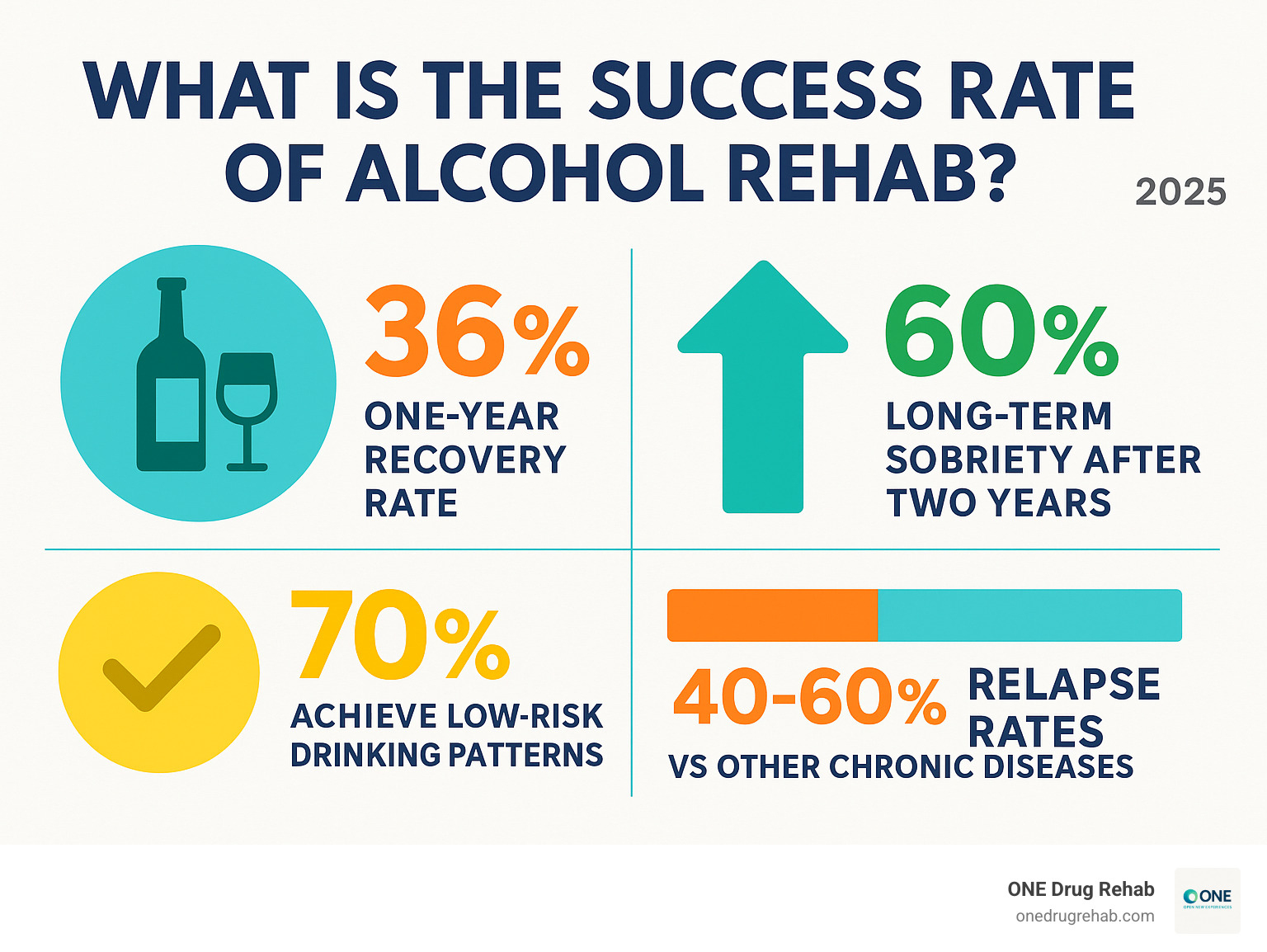
What is the success rate of alcohol rehab? The answer isn’t as straightforward as you might expect. Research shows that approximately 36% of people with alcohol use disorder recover after one year of treatment, while 60% of individuals who remain sober for two years achieve long-term sobriety. However, these numbers only tell part of the story.
Quick Answer: Alcohol Rehab Success Rates
- 1-year recovery rate: 36% of people with AUD
- 1-year abstinence rate: 16% maintain complete abstinence
- 1-year low-risk drinking: 70% achieve safer drinking patterns
- 2-year milestone: 60% achieve long-term sobriety
- 5-year milestone: Significantly higher chance of sustained recovery
- Treatment completion: Less than 43% complete their programs
- Relapse rates: 40-60% experience at least one relapse
The reality is more complex than these statistics suggest. Success in alcohol rehabilitation depends on many factors – from the type of treatment program to individual circumstances and support systems.
Consider this: the 2020 National Survey on Drug Use and Health found that over 28 million Americans struggled with alcohol use disorder, yet only 2 million received treatment. This massive treatment gap means millions of people are missing out on potentially life-changing care.
What makes measuring success even trickier is that different programs define “success” differently. Some focus solely on complete abstinence, while others recognize harm reduction and improved quality of life as meaningful victories.
What is the success rate of alcohol rehab terminology:
Beyond Abstinence: Redefining “Success” in Alcohol Recovery
For decades, the conversation around what is the success rate of alcohol rehab has been pretty black and white: you’re either drinking or you’re not. But here’s the thing – recovery is rarely that simple, and focusing only on complete abstinence can paint a misleading picture of what real progress looks like.
Think about it this way: if someone goes from drinking a bottle of vodka every day to having an occasional beer on weekends, are they a failure because they’re not completely sober? Most of us would say that’s incredible progress worth celebrating. Yet traditional success metrics might label this person as unsuccessful.
The good news is that treatment centers and researchers are finally catching up to what many people in recovery have known all along – success comes in many forms. Harm reduction approaches recognize that any positive change is meaningful. Maybe someone reduces their drinking by 80%, rebuilds their relationships, gets their job back, and feels genuinely happy for the first time in years. That sounds pretty successful to us.
This shift toward recognizing quality of life improvements means we’re looking at the whole person, not just their drinking habits. We’re celebrating when someone’s health improves, when they reconnect with their kids, or when they wake up without a hangover for the first time in months. These victories matter just as much as complete abstinence.
The research backs this up too. Studies show that many people who don’t achieve perfect abstinence still experience significant reductions in alcohol consumption and decreased alcohol-related problems. They might not be completely sober, but they’re living healthier, happier lives. And isn’t that what recovery is really about?
For a deeper look at how success rates vary across different types of addiction treatment, check out our guide on addiction recovery success rates.
The Problem with a Single Metric
Here’s where things get really interesting – and a bit frustrating if you’re trying to get a straight answer about success rates. When we only look at complete abstinence, we’re missing a huge part of the story.
The National Institutes of Health conducted a study that perfectly illustrates this point. They found that while about 25% of people stayed completely alcohol-free for a year after treatment, another 10% were drinking moderately without any problems. But here’s the kicker – the remaining participants, as a group, were abstinent 3 out of 4 days, had reduced their drinking by an average of 87%, and saw their alcohol-related problems drop by 60%.
If we only counted the people who were completely abstinent, we’d be ignoring these massive improvements. That person who used to get arrested for drunk driving and is now having wine with dinner on special occasions? Under the old way of thinking, they’d be considered a treatment failure. That doesn’t make much sense, does it?
This nuanced view of recovery recognizes that partial recovery can be life-changing. Someone might still have the occasional slip-up, but if they’re generally healthy, maintaining relationships, and avoiding the serious consequences they used to face, that’s real progress. A nuanced view of treatment outcomes from NIH shows us just how important it is to look beyond simple yes-or-no metrics.
The reality is that recovery looks different for everyone. Some people need and want complete abstinence – and that’s fantastic when they achieve it. Others find that moderation works better for their situation and mental health. Both paths can lead to dramatically improved client well-being.
Measuring Holistic Improvement
So if we’re not just counting sober days, what does success actually look like? It’s about rebuilding a life that feels worth living – one where alcohol isn’t calling the shots anymore.

When we talk about holistic improvement, we’re looking at every area of someone’s life. Are their relationships getting stronger? Maybe they’re finally showing up for their kids’ soccer games, or they can have honest conversations with their partner without everything turning into a fight.
Work and career satisfaction is another huge piece of the puzzle. Recovery often means people can focus better, show up consistently, and maybe even pursue goals they’d given up on. We’ve seen people go back to school, start businesses, or simply feel proud of their work again.
Then there’s psychological well-being – and this one’s massive. Depression and anxiety often go hand-in-hand with alcohol problems, so when someone starts feeling genuinely happy and confident again, that’s a huge win. Their self-esteem comes back, they start taking care of themselves, and they remember what it feels like to actually enjoy life.
These happiness indices might sound touchy-feely, but they’re incredibly important. After all, what’s the point of being sober if you’re miserable? Real recovery means building a life that’s so good, you don’t want to escape from it anymore.
When we measure success this way, what is the success rate of alcohol rehab becomes a much more encouraging question. Not everyone achieves perfect abstinence, but the vast majority of people who complete treatment see meaningful improvements in multiple areas of their lives. And that’s something worth celebrating.
What is the Success Rate of Alcohol Rehab, Really?
So, if success isn’t just about total abstinence, what do the numbers say about the success rate of alcohol rehab when we consider a broader definition? The statistics can vary widely depending on the source, the methodology of the study, and what metrics are being measured. It’s important to approach these numbers with a discerning eye, understanding that there’s no single, universally accepted “success rate” that applies to every person and every program.
Different treatment programs have varying approaches, durations, and intensities, all of which can influence outcomes. What works for one person might not work for another, which is why patient-centric plans are so crucial. Our goal at ONEDrugRehab.com is to provide you with the most comprehensive picture possible, drawing from various reputable sources. For a broader look at treatment effectiveness, you might also be interested in our guide on the Success Rate of Rehab for Drugs.
Understanding the Statistics: What is the success rate of alcohol rehab?
Let’s explore some of the reported statistics that paint a picture of recovery from Alcohol Use Disorder (AUD):
- 1-year recovery rates: According to the National Institute on Alcohol Abuse and Alcoholism (NIAAA), approximately 36% of people suffering from AUD recover after one year. This means they have significantly reduced their drinking or achieved abstinence.
- 1-year low-risk drinking: A promising 70% of people with an AUD report low-risk drinking after a year. This is a huge step towards a healthier life, even if it’s not complete abstinence.
- 1-year abstinence rates: For those aiming for complete sobriety, about 16% of individuals in recovery with AUD report abstinence after a year.
- Long-term sobriety after 2 years: The odds get even better with time. A significant 60% of individuals who are sober for two years after AUD treatment achieve long-term sobriety. This highlights the importance of sustained effort and ongoing support.
These figures, sourced from NIAAA alcohol facts and statistics, available through NIAAA alcohol facts and statistics, demonstrate that recovery is a tangible and achievable outcome for many.

The Impact of Sustained Sobriety
The longer a person maintains sobriety, the stronger their recovery becomes. Individuals who maintain abstinence for five years have a significantly higher chance of achieving sustained sobriety. This isn’t just about avoiding alcohol; it’s about building “recovery capital”—the sum of personal, social, and community resources that can be brought to bear to initiate and maintain long-term recovery.
Think of it like building a house. The first year or two might be about laying the foundation and putting up the walls. But the longer you live there, the more you solidify its structure, decorate it, and make it a home. Similarly, in recovery, time allows individuals to develop new coping mechanisms, strengthen supportive relationships, and integrate recovery principles into their daily lives. This sustained effort reduces the likelihood of relapse over time, reinforcing the idea that recovery is a marathon, not a sprint. The principles of long-term recovery are similar across various substance use disorders; you can explore this further in our discussion on What Percentage of Heroin Addicts Recover.
Key Factors That Influence Recovery Outcomes
When we ask what is the success rate of alcohol rehab, we’re really asking about the complex puzzle of recovery. The truth is, success isn’t determined by chance or willpower alone. It’s shaped by a carefully orchestrated combination of factors that work together like gears in a well-oiled machine.

Think of recovery like building a custom home. You wouldn’t use the same blueprint for a beach house and a mountain cabin, would you? The same principle applies to alcohol treatment. Individualized care is the foundation of successful recovery programs. This means looking at each person’s unique story, their health challenges, family situation, work life, and personal goals.
A good treatment plan considers everything from how severe someone’s drinking problem is to whether they’re dealing with other mental health issues. It takes into account their support system at home and even their learning style. Some people thrive in group settings, while others need more one-on-one attention. This personalized approach is what separates truly effective programs from cookie-cutter solutions.
How Treatment Duration Impacts What is the success rate of alcohol rehab
Here’s something that might surprise you: when it comes to treatment length, more really is better. While those famous 28-day programs you see on TV can be a great starting point, research consistently shows that longer treatment stays lead to better outcomes.
The magic number that experts keep coming back to is 90 days. Why? Because it takes time to truly rewire the patterns that led to alcohol dependence. During those first few weeks, your body is still adjusting. Your brain is learning new ways to cope with stress, boredom, and life’s curveballs.
Inpatient programs typically show the highest success rates because they provide that intensive, round-the-clock support during those crucial early days. But that doesn’t mean outpatient care isn’t valuable. Many people benefit from starting with inpatient treatment and then transitioning to outpatient programs as they build confidence and stability. You can explore these flexible options in our guide to Outpatient Alcohol Rehab Programs.
The key is giving yourself enough time to not just stop drinking, but to build the skills and habits that will keep you sober when life gets challenging.
The Critical Role of Dual Diagnosis and Aftercare
Here’s a statistic that might shock you: about half of all people with alcohol use disorder also struggle with mental health conditions like depression, anxiety, or trauma-related disorders. It’s like trying to solve two puzzles at the same time with pieces that overlap.
This is where integrated treatment becomes absolutely crucial. When programs address both the alcohol problem and mental health issues together, success rates jump significantly. It makes perfect sense when you think about it. If someone’s been using alcohol to cope with untreated depression, just taking away the alcohol without addressing the underlying depression is setting them up for failure.
But here’s where many people get tripped up: they think recovery ends when they leave rehab. In reality, that’s often when the real work begins. Aftercare planning isn’t just a nice-to-have – it’s essential for long-term success.
Effective aftercare weaves together several support threads. Relapse prevention strategies help people recognize their personal triggers and develop healthy responses. Peer support groups like AA or SMART Recovery provide that invaluable sense of community and accountability. Continued therapy offers ongoing support as new challenges arise in sobriety.
For some people, sober living environments provide that crucial bridge between the structured world of rehab and independent living. These homes offer a drug-free environment with built-in support during those vulnerable early months.
Research shows that people who stick with aftercare programs for at least three months have significantly higher success rates. Without this ongoing support, even the most successful rehab experience can become just a temporary pause in the addiction cycle. The goal is to build a sustainable, fulfilling life in recovery – and that takes time, support, and the right combination of resources.
Comparing Treatment Approaches and Their Effectiveness
When exploring what is the success rate of alcohol rehab, it’s important to understand that there isn’t just one type of treatment. Think of it like choosing a path up a mountain – there are many routes to the summit, and the best one depends on your starting point, your abilities, and what feels right for you.
The world of addiction treatment offers a rich variety of approaches, each with its own philosophy and methods. Some have been around for decades, while others represent cutting-edge research. The key is finding what works for your unique situation. For a comprehensive look at all your options, check out our guide on Types of Addiction Treatment.
| Treatment Approach | Philosophy | Approach | Reported Effectiveness |
|---|---|---|---|
| 12-Step Programs (AA) | Spiritual foundation, powerlessness over addiction, higher power guidance | Group meetings, sponsorship, working through 12 steps | High satisfaction among participants who complete program |
| CBT/DBT Therapy | Thoughts and behaviors can be changed through skill-building | Individual/group therapy focusing on coping strategies | Strong evidence base, particularly effective for dual diagnosis |
| Medication-Assisted Treatment (MAT) | Medical condition requiring medical treatment | FDA-approved medications combined with counseling | Naltrexone users nearly twice as likely to maintain sobriety |
| SMART Recovery | Self-management and motivation, personal choice and responsibility | Tools and techniques for building motivation and managing urges | Growing evidence base, appeals to those preferring non-spiritual approach |
Traditional vs. Modern Methods
For many people, 12-Step programs like Alcoholics Anonymous have been a lifeline. AA has helped millions of people get sober since it started in the 1930s. The program offers something powerful that many people crave: a community of people who truly understand what you’re going through. There’s comfort in sitting in a room where everyone knows exactly how it feels to wake up with regret, to make promises you couldn’t keep, or to feel like alcohol was controlling your life.
The spiritual foundation of AA – acknowledging powerlessness over alcohol and turning to a higher power – resonates deeply with many people. The structure of working through the 12 steps provides a clear roadmap, and the sponsorship system offers personal mentorship. You can learn more about their approach at Alcoholics Anonymous.
But addiction treatment has come a long way since the 1930s. We now have Medication-Assisted Treatment (MAT), which treats alcohol addiction like the medical condition it is. MAT combines FDA-approved medications with counseling and therapy, giving people multiple tools to fight their addiction.
The medications used in MAT for alcohol addiction each work differently. Naltrexone blocks the feel-good effects of alcohol, making drinking less rewarding. Studies show that people taking naltrexone are almost twice as likely to stay sober compared to those who don’t use medication. Acamprosate helps with the anxiety and restlessness that can linger after you stop drinking, while Disulfiram creates an unpleasant reaction if you drink alcohol, acting like a safety net.
These medications work best when they’re part of a complete treatment program that includes therapy and support. It’s not about replacing human connection and personal growth – it’s about giving your brain the chemical support it needs while you do the hard work of recovery.
Alternatives to 12-Step Programs
While AA has helped countless people, it’s not the right fit for everyone. Some people feel uncomfortable with the spiritual aspects, others prefer a more scientific approach, and some simply connect better with different philosophies of recovery.
SMART Recovery offers a refreshing alternative that focuses on self-management and personal responsibility. Instead of viewing yourself as powerless, SMART Recovery teaches that you have the ability to change and make better choices. The program uses practical tools and techniques to help you build motivation, cope with urges, manage thoughts and behaviors, and live a balanced life. You can explore their approach at SMART Recovery.
Cognitive Behavioral Therapy (CBT) and Dialectical Behavior Therapy (DBT) represent evidence-based therapeutic approaches that have shown strong results. CBT helps you identify the thoughts and situations that trigger your drinking, then teaches you new ways to respond. It’s like rewiring your brain’s automatic responses. DBT adds skills for managing intense emotions and improving relationships – crucial abilities for anyone in recovery.
These therapy-based approaches are particularly effective for people who also struggle with mental health conditions like depression or anxiety. When you’re dealing with both addiction and mental health issues, addressing both together gives you the best chance of success.
The beauty of today’s treatment landscape is that you don’t have to choose just one approach. Many successful people in recovery combine elements from different methods – maybe they take medication to reduce cravings, attend CBT sessions to learn coping skills, and go to AA meetings for community support. What is the success rate of alcohol rehab depends greatly on finding the combination that works for you.